
New state data on student discipline sheds light on racial disparities
It’s a well-researched problem that Tacoma and other school districts have seen firsthand for years: Students who belong to racial and ethnic minority groups face discipline more often than other students.
Now, Washington educators, families and taxpayers can see how various student groups compare in their own districts and across the state.
A new online tool from the state Office of Superintendent of Public Instruction allows educators to more closely analyze suspension and expulsion rates by district, racial group, special education and low-income status and other factors.
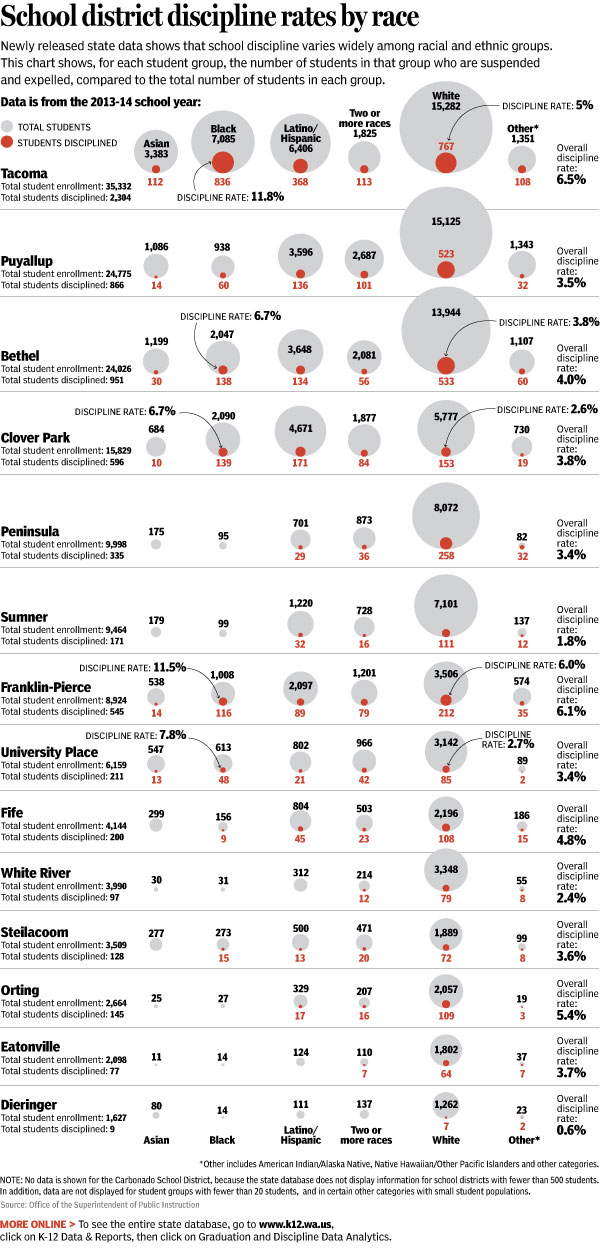
The new state data points to a 2013-14 discipline rate in Tacoma of 11.8 percent for black students, compared with only 5 percent for white students and 6.5 percent overall.
In Puyallup, data from the same year show that 6.4 percent of black students were disciplined, compared with 3.5 percent of white students and a 3.5 percent overall.
Similar disparities exist in other Pierce County school districts.
Some districts were already tracking data internally. Tacoma began looking hard at its numbers four years ago, following a consultant’s report that pointed to problems. Tacoma Superintendent Carla Santorno said the state data release held no surprises for her.
“We are definitely at the top end of disparity, compared to some of our peers,” she said. “We know disparity rates are decreasing, but they are still way too high.”
Erin Jones, a Tacoma administrator who has spearheaded a new teacher training effort aimed at the problem, notes that “particularly for black and brown boys, it is pandemic across the nation.”
“We own that we are not in a good place,” she added. “That’s one reason I’m committed to doing the training.”
TACOMA DIGS DEEP
In Tacoma, Santorno said, school leaders now have information to show not only broad group numbers like those in the state database, but also more details about individual discipline incidents.
“We can get where the discipline is coming from — from the lunchroom, or at the individual teacher level,” Santorno said.
She is held accountable by the school board, which considers discipline disparity rates among many factors in its evaluation of the superintendent. And she acknowledges that change in Tacoma is still a work in progress.
Santorno notes that for serious offenses, such as bringing a weapon or drugs to school, the district has no discretion.
“We don’t see what color you are,” Santorno said. “You’re out.”
But she said the highest disparity in discipline falls under the category of class disruption, which is more subjective.
If a student uses profanity, for example, she believes there are alternatives to suspension. In some cases, Santorno said, students might try to use that kind of language to goad a teacher into suspending them because they want to be out of school.
Another factor: While more than half of Tacoma students are students of color, 86 percent of its more than 2,000 faculty members are white, as are the vast majority of teachers statewide.
Tacoma has sent recruiting teams to some of the nation’s historically black colleges to try to shift that balance. It also is reaching out to Tacoma high school students of color. On June 13, the district will join with local colleges to host Teach Tacoma, an event aimed at potential educators.
Santorno said Tacoma has great teachers, but they “have so many more dimensions to balance than ever before.”
“We have a diverse population that speaks 60 languages,” said Santorno, who is African American. “It’s a complex job.”
THE WHOLE CHILD
Last year, Tacoma began a new program called the Tacoma Whole Child Initiative which uses positive discipline techniques. Instead of telling kids what they can’t do, it spells out what they can and should do. The goal is to make sure schools meet the needs of students not just academically but also socially and emotionally. That often requires understanding a student’s cultural background.
The program began in 13 Tacoma schools in the 2013-14 school year. This year, 14 more were added. That’s roughly half of the district’s 53 schools.
“We know each student comes to us with different experiences, different strengths and different ways in which they learn best,” said Kecia Keller, principal at Franklin Elementary. “We work hard to know each student well and provide structures and supports for all based on what they need.”
The key is establishing clear expectations and reinforcing them consistently with all students. That way, Keller said, students “can meet those expectations more readily than if they have to guess or experience negative consequences to figure out what the expectations are.”
She offers an example: If a student is disrespectful to an adult, Franklin staff use the episode as a “teachable moment.” Instead of sending the child immediately to the office, teachers instead review their expectation of how to behave respectfully.
TEACHING TEACHERS
Tacoma also is working to educate its staff about culturally responsive teaching.
“I believe that when people understand the role of culture, they don’t have as many discipline problems,” Jones said.
For example, conflicts and misunderstanding can stem from how kids and adults from different cultures think about noise, she said.
“About 70 percent of discipline starts with noise — kids making noise or talking back to a teacher,” Jones said. “In some cultures, that’s not seen as disrespectful. It’s known as advocating for yourself.
“As a classroom teacher, you need to understand that there are many different ways of being. If you understand that each way has value, that changes how you interact with a student.”
Instead of punishment, Jones said, student and teacher can come to an agreement about what behavior should look like.
She brings a unique perspective to the issue. She is African-American but was raised by a white couple, both educators, who taught in the Netherlands, where she grew up.
While her life experience means she can switch between cultures easily, she notes that most students don’t have those coping skills. In public schools, she said, the established norms are those of the white middle class. And that can set up students of color for classroom conflicts.
In her workshops for teachers, Jones uses media clips and storytelling to break down barriers and foster deep discussion.
“It’s a really tough thing talking about culture,” she said.
DATA LIMITATIONS
The state database shows how many students are disciplined, which group they belong to and the rate of discipline by group. It doesn’t yet spell out how many times each student is suspended or expelled, for how long, for which behaviors and from which schools. State officials said that information will be shared as it becomes available. Data aren’t reported publicly for districts with fewer than 500 students, for student groups that number fewer than 20 in a district and in certain other cases where small numbers could skew the results.
OSPI wants to help schools and communities use the available data to recognize discipline disparities and identify practices that will keep more kids in school. The office wants to assist local school districts in recognizing discipline disparities and identifying practices that can help eliminate them.
“Interventions should focus on the root causes of the disparities,” said Calandra Sechrist, director of the Equity and Civil Rights Office for OSPI.
This story was originally published June 7, 2015 at 5:00 PM with the headline "New state data on student discipline sheds light on racial disparities."