‘Gangsta Gardener of L.A.’ bringing his message to Tacoma: Tending plants is freedom
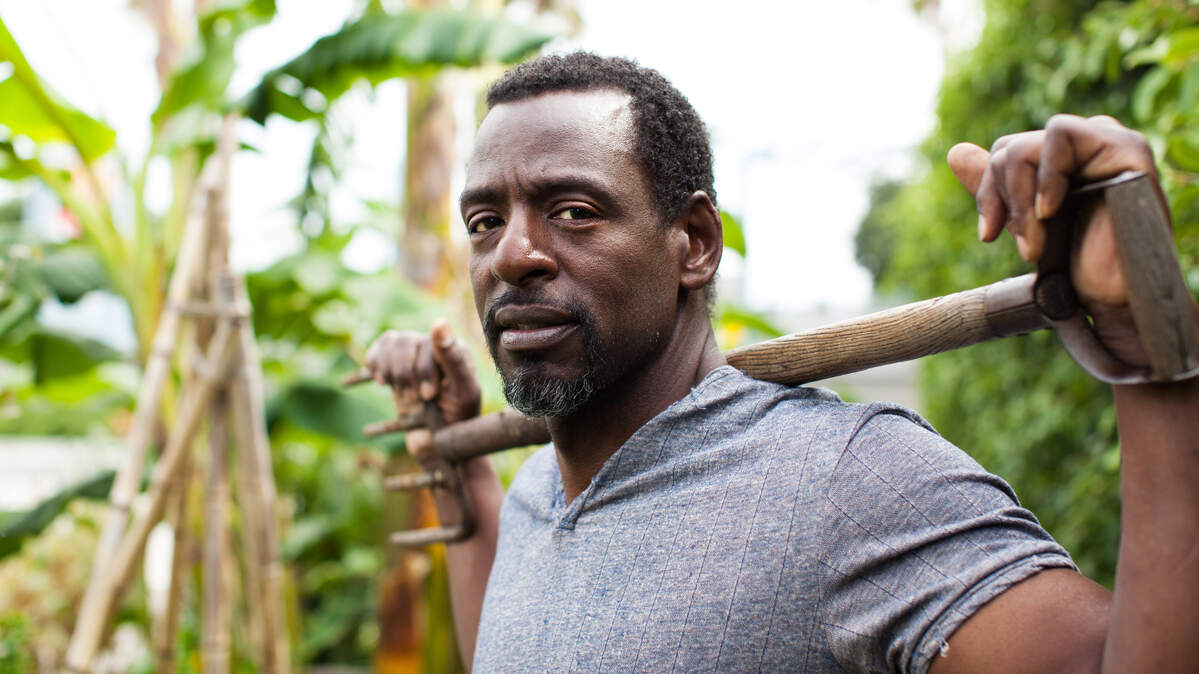
Ron Finley is talking about a lot more than gardening.
That fact hits you pretty quickly, even though — ostensibly — gardening is the reason you called.
Over the last decade, Finley has grown into the persona that now largely defines him.
He’s the “Gangsta Gardener of L.A.” — an outspoken and colorfully blunt proponent of urban gardening and its potential to reshape and rethink the inadequate food systems that often plague neighborhoods like his own, South Los Angeles.
It might seem natural for any conversation with Finley to start there, in the dirt.
In my experience, it does, but it also doesn’t.
For Finley, gardening is the entry point. Gardening is the revolution.
Gardening is simply a vehicle for the kind of community change he’s demanding without apology.
“It’s not even about food,” Finley says without hesitation, describing his work and advocacy, which will include a Wednesday, Feb. 19 visit to Lincoln High School.
“It’s about freedom,” he says.
Finley doesn’t beat around the bush.
He looks around and sees neighborhoods and communities stuck inside a food system designed to keep people down.
He sees families poisoned by unhealthy diets, often with little to no access to an alternative. Drive-thrus are their dining rooms.
He sees people with no connection to the food they put in their body, and, through social conditioning, they don’t think much about it. Processed consumption has become an expected way of life.
He sees neighborhoods stripped bare, sometimes with blighted, vacant parcels providing the only patches of green. Violence sprouts like weeds out of cracked concrete.
In short, Finley says, these built surroundings communicate the unspoken but crystal clear injustice: They lack value.
All of this is what Finley is fighting to change, though he acknowledges he never knew it would come to this.
Roughly a decade ago, Finley found his profile rising after tilling a subversive garden in the parking strip in front of his L.A. home. He parlayed that into a TED Talk that put him over the top — and into mainstream consciousness.
So he let it ride, and years after it all began, his story and message have traveled far and wide.
In 2013, The New York Times compared Finley to a “pavement-pounding Johnny Appleseed” for helping to create and inspire urban gardens across the country. Little has changed since.
Which brings us back to gardening and Finley’s quest to make urban gardens the new normal through what’s now called The Ron Finley Project.
“You want to talk about magic? You want to talk about alchemy? You want to talk about amazing?” Finley says. “You take a teeny-tiny seed that you can barely see and you put it in soil, and you give it some water, and you maintain it, and all of a sudden you’ve got a fruit tree that will give you fruit forever.”
“Or take a carrot,” Finley continues. “When a kid looks at a carrot there and says, ‘I made this,’ you know that moment can change their whole outlook on life.
“I’ve seen it happen.”
Finley’s observations can be brutally honest, based on the deficiencies and intentional oppression he sees all around, and the people he sees subjugated to them.
Food desserts. Food prisons. Food apartheid. All of these terms cascade jaggedly out of him, intentionally roughing up any recipient, hopefully to the point of action.
Then Finley pivots to urban gardens and their potential as launching pads
When someone works the land, putting in the time and effort to cultivate a crop, it helps instill value. The learning and perspective that can provide has an ability to reshape communities.
Or, as he more directly puts it, “Gardening is a gateway drug.”
“These kids should be taught that there’s nothing more precious than they are. They have a right to everything, and to earn it. It’s not just given to you,” Finley says.
“How do you not get there through gardening?”
Kale Iverson is a horticulture and plant biology teacher at Lincoln whose after school club, Abes Acres, helped bring Finley to town. His Wednesday appearance was a joint effort between the club and the school’s library department.
For years, Iverson has shown Finley’s videos to students in the school’s career technical education and biology classes, as inspiration.
Funded in part through Lincoln’s well-known annual plant sales, Iverson says, the appearance will hopefully inspire change far beyond the classroom.
Finley’s is a message Iverson thinks the whole city and school district needs to heed, particularly for students like his, who grow up in the South End and Eastside.
“He kind of sets the tone: gardening is cool. It’s defiant and therapeutic. He flips the script on what it means to be a gardener,” Iverson says. “That’s huge for my students, to see themselves in someone else gardening in a new way. That’s really important.”
Iverson, who sees his role as that of a facilitator, says his students hope Finley’s appearance will “make a strong plea to our community” to address prevalent food disparity issues and “hopefully … push the discussion forward.”
He wonders: What if vacant land was turned into community gardens? Or, since his students already produce thousands of pounds of produce each year that gets donated to local food banks, what if the school district better embraced agricultural programs like Lincoln’s, and students began growing the food served in cafeterias?
What if?
“I hope, and the kids, that this will start a conversation,” Iverson says.
Finley firmly believes it can start more than a conversation, and it’s precisely what he hopes students — and anyone else in attendance Wednesday — will take away.
“When I’m talking to kids, one of the first things I talk about is the value that they have just by being who they are,” Finley says. “Nothing is more valuable than them. All this goes together — water, air, soil all of it.
“It’s about way more than gardening. It’s about humanity, period, first and foremost.”
Ron Finley at Lincoln High School
▪ Wednesday, Feb. 19 at 2:30 p.m.
▪ Free event includes screening of the documentary “Can You Dig This?”
▪ Register at https://lhsfinley.brownpapertickets.com
This story was originally published February 15, 2020 at 7:00 AM.