What a 1924 KKK gathering in Tacoma tells us about white nationalism in the U.S. today
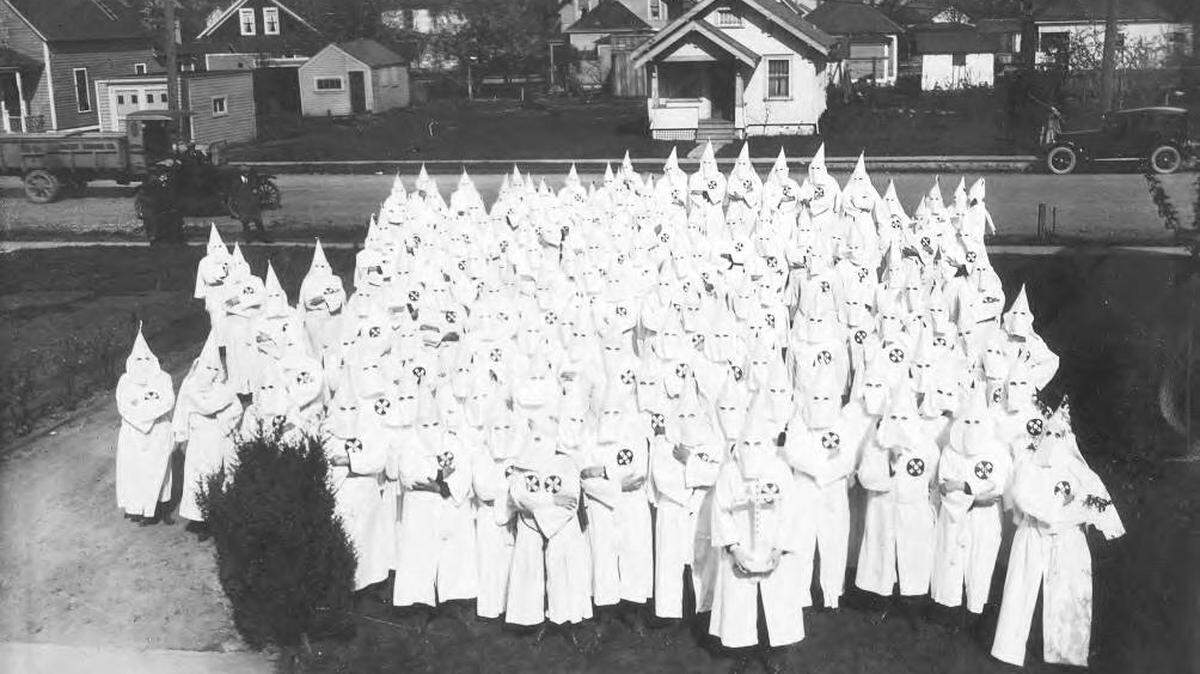
Michael Lafreniere was researching a building — not the history of white supremacy in Tacoma.
So what he stumbled across while digging through the digital archives at the Tacoma Public Library shocked him, the communications director for Historic Tacoma acknowledged this week.
There, before Lafreniere’s eyes, stood more than 100 members of the Ku Klux Klan, gathered for a funeral in a vacant lot along what’s now known as South Tacoma Way. The Klansman had arrived in Tacoma in full regalia from throughout the region and state.
In the photograph — which was published in The News Tribune in 1924 — the mass of anonymous white hoods strike an intentionally ominous pose, while a “small fiery cross,” which library archives indicate was used during the ceremony, adds a terrifying touch.
Lafreniere, who is also currently the managing director of the Tacoma Historical Society, explained this week that he came across the photo while researching a far less troubling subject: the history of the Piper Funeral Home, where the photograph was taken.
He never expected to unearth a glimpse into the Klan’s history in Washington state, and more particularly Tacoma, Lafreniere said.
“I think many of us — either through TV or movies or so on — we think of the Klan as something that’s part of the history of the South, and limited to the South,” Lafreniere said. “So it’s shocking to find that it’s right here, actually outside your front door.”
For Lafreniere, the stark discovery occurred almost exactly two years ago. In August 2018, as communications director for Historic Tacoma, he posted the photo and some additional context to the nonprofit’s Facebook page.
Today, the post — which has attracted hundreds of comments and shares — continues to resonate.
As recently as last week it again made the rounds on social media, propelled — as usual — by many who draw parallels between the undertones of nationalism and white supremacy inherent to the Klan and those that still pulse through our politics.
While cautioning against the simple assumption that history always repeats itself, Portland State University history professor David Horowitz said there are appropriate comparisons to draw from the rise of what he describes as “the Second Klan” in the 1920s and the most hard-line nationalist, populist strains of our current political spectrum.
Differentiating it from the KKK that emerged after the Civil War and again after World War II, the Klan of the 1920s, “arguably represents the combination of white cultural nationalism, traditional morality, and populist self-identity that continues to play a significant role in segments of American political culture,” Horowitz wrote in 2016, shortly after Donald Trump’s election.
For Lafreniere — who said finding the photo helped lead him to a better understanding of the Klan’s activities in this part of the country — the fact that the photo continues to be discussed and shared comes as little surprise.
While it might be “easy to envision” a photo like this having been taken in the South, in Tacoma, Lafreniere said, it “really jumps out at people.”
“What you saw there was certainly very disturbing,” Lafreniere said of the photo.
The KKK in Tacoma and Pierce County
According to local historian Michael Sullivan, understanding the full scope of Ku Klux Klan activity in Tacoma and Pierce County can be challenging.
While the iteration of KKK that emerged in the 1910s and 1920s sought to establish a more mainstream and public identity than the white-hooded terrorist group that targeted post-Civil War African Americans in the South, in local recorded history there’s still not much to go on.
However, there’s little question that the Klan had a presence in Pierce County in the 1920s, Sullivan said.
That presence included maintaining an office in the Perkins Building in downtown Tacoma, and welcoming the Klan’s Imperial Wizard, Hiram Wesley Evans, to an appearance at the Masonic Temple in November 1924, according to Tacoma Ledger archives.
In Tacoma proper, Sullivan said the presence and influence of ethnic labor organizations likely limited the Klan’s popularity and influence.
That wasn’t the case elsewhere, he said. Sullivan described Puyallup and Sumner as local Klan hot spots, and noted that — after spreading up from Oregon — the group had significant presences in other parts of the state, including Centralia, Bellingham and Seattle.
The fact that the second coming of the Klan had a Pacific Northwest presence shouldn’t be shocking, according to Horowitz.
Revamped in Atlanta by a Methodist preacher in 1915, by 1922 the Klan had a large nationwide membership of “native-born white Protestant Men,” Horowitz has written. The rapid growth was buoyed by a pyramid scheme to increase membership and the success of the film Birth of a Nation, but it was short-lived. By the middle of the decade, the second coming of the Klan was waning.
Compared to the post Civil War KKK and the post World War II Klan — which both largely relied on anonymous violence and murder against Black Americans — the 1920s iteration of the Klan focused more on the perceived dangers of immigration, intellectualism, moral degradation and — perhaps most of all — Catholicism.
Racism was still a key component, but this wasn’t the same secretive vigilante terrorist organization, Horowitz noted. Seeking political legitimacy, the Klan of the 1920s sought to differentiate itself, and the re-branding appealed to many white, blue-collar men who suddenly felt under attack in a country ripe with cultural shifts, Horowitz said.
While the Klan’s activity included championing the racist eugenics movement, targeting Catholics and Jews and helping to push through nativist federal immigration quotas, it also included morality quests like defending prohibition or raising money for local widows.
“In a certain way, I think the Klan of the 1920s is the birth of populist white nationalism as we know it,” Horowitz said. “I think it comes from people who are … having a difficult time adjusting to cultural change.”
“That’s an almost universal human attribute,” Horowitz continued.
“People deal with it in different ways, and most of the time it’s not very positive.”
What history teaches us
Asked about why a nearly 100-year-old photo of the KKK gathering in Tacoma still has relevance today, Lafreniere cited a well-known quote often attributed to Mark Twain.
History doesn’t repeat itself, but it often rhymes, Lafreniere said.
“At its core, there are some common features,” Lafreniere said when comparing the 1920s Ku Klux Klan to some of the white supremacist movements of today. “There are some differences … but, still, what it has in common is ignorance, fear and hatred.”
As an academic, Horowitz acknowledged the difficulty that comes with trying to explain the differences between the 1920s KKK and the more well-known post Civil War and post World War II versions. Many people have trouble wrapping their minds around a Klan that in any way defies the image of lynchings, night rides and murders, he said.
They’re differences that matter, Horowitz argued, but mostly in the historical complexity and human nuance they help to illuminate.
The Klan of the 1920s — and the Klan pictured gathering in Tacoma in that vacant lot along South Tacoma Way — still represented some of the ugliest and most troubling aspects of humanity, Horowitz said, including racism.
But these were people, not caricatures, and many donned white hoods out of fears, anxieties and biases that should be familiar to all of us today.
Understanding this dynamic — without condoning it — is the key to making sense of what history teaches us, Horowitz said.
“It’s not the best of human nature, and it should be called out for that. We should always comment upon people’s prejudices and their narrow mindedness,” Horowitz said of the 1920s KKK.
“People who were anxious about what they perceived as a loss of power projected their anxiety on people who had even less power than they did,” he continued.
“That’s the tragedy of history. It happens a lot.”
This story was originally published August 26, 2020 at 11:43 AM.