Tacoma writer’s family history shapes graphic novel on resistance to WWII internment
Frank Abe had one request.
“Please don’t call it a dark chapter of American history,” the longtime journalist, thespian and filmmaker told me Wednesday.
“It was real,” he continued, even while acknowledging he didn’t necessarily have a better term to describe the internment of thousands of Japanese Americans during World War II. “And this book attempts to shed some light on it, so that we can look at it and confront it.”
Over the last 40 years, few people have spent as much time and effort confronting the complexities of Japanese eviction, internment and deportation during World War II than Abe, a third generation Japanese American.
In 1978, he helped to organize the first Day of Remembrance in Seattle, which included a street-theater style procession of Japanese Americans making their way from Pioneer Square to the Puyallup Fairgrounds, much like they were forced to do in 1942 after President Franklin D. Roosevelt authorized their removal and incarceration on the West Coast. More recently, he’s won awards for his literary and documentary work, zeroing in on stories of Japanese American identity in the time and aftermath of interment, and, often, those who resisted it.
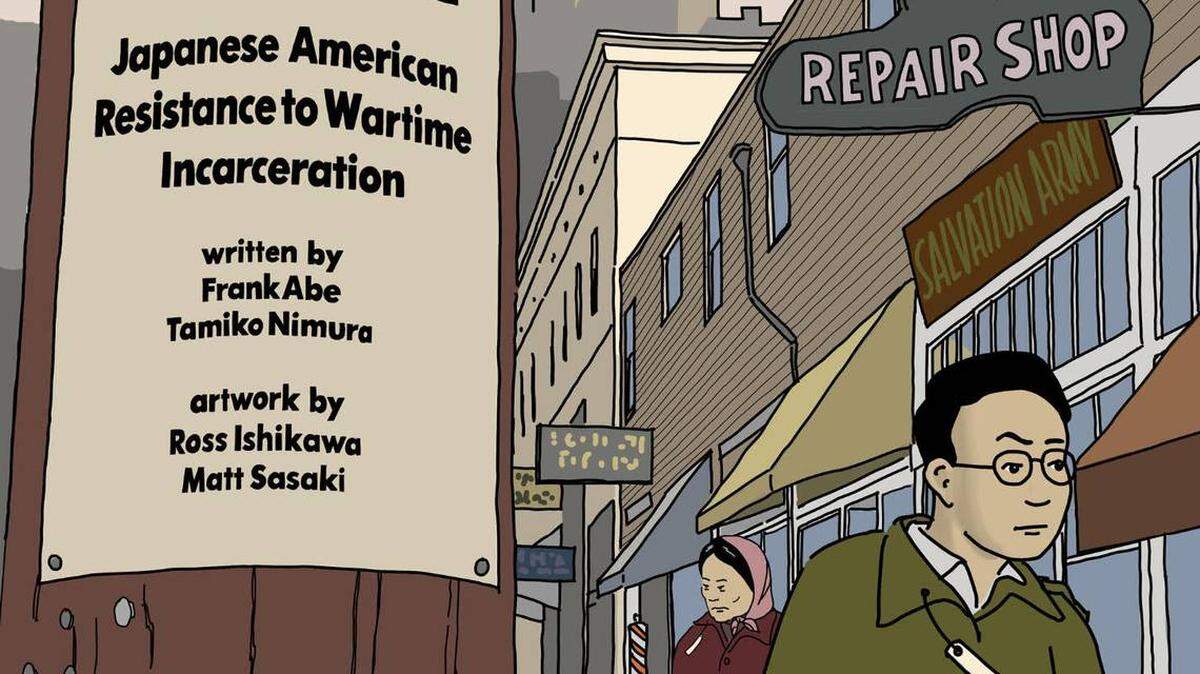
Now Abe — who went on to work for KIRO Newsradio and as communications director for King County Executives Gary Locke and Dow Constantine — is preparing for the publication of his latest contribution to the ongoing historical exploration he’s helped to champion. Written along with Tacoma’s Tamiko Nimura, “We Hereby Refuse: Japanese American Resistance to Wartime Incarceration” is a graphic novel commissioned by the Wing Luke Asian Museum in Seattle, telling the story of Japanese Americans who, in different ways, all fought back against WWII internment and the shameful racial oppression of American government and society at the time.
The book focuses on three individuals. Abe and Nimura hope their words — along with the artwork of Ross Ishikawa and Matt Sasaki — will help to humanize them beyond historical caricatures.
One is Jim Akutsu, who refused to be drafted into the military after being incarcerated in Puyallup and Idaho, arguing that the U.S. government had classified him as an enemy alien. Akutsu is perhaps the most well known, having served as the inspiration for John Okada’s 1957 novel “No-No Boy”.
Abe and Nimura also bring to life Mitsuye Endo, whose lawsuit led to the 1944 Supreme Court declaration that Japanese Americans could not be incarcerated without proof of their alleged disloyalty, and Hiroshi Kashiwagi, a poet and playwright who resisted singing a loyalty oath while interned at Tule Lake in Northern California and renounced his U.S. citizenship, later fighting to have it restored.
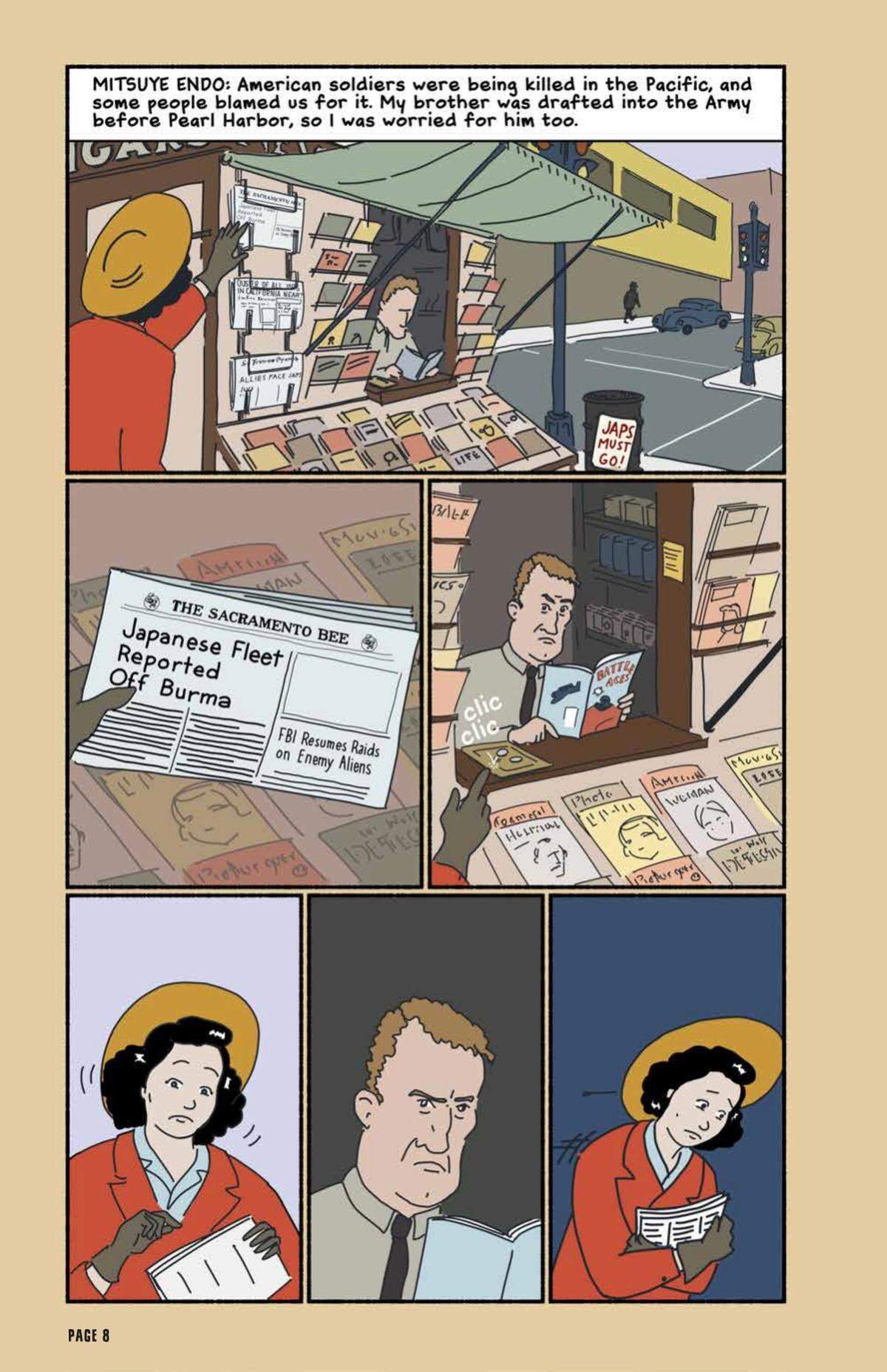
While, in the current context, it’s tempting to view the real-life characters in the novel as simple heroes, they were just people trying to navigate an ignoble moment of American history, Abe says. And they weren’t alone. In the moment — and for many years after it — those who resisted internment were often stigmatized as traitors or scratched from the historical narrative altogether, even within the Japanese American community, Abe says. Today, at best, they often show up as one-dimensional names in the dusty annals of time.
As our understanding of Japanese internment evolves — thanks in no small part to efforts of writers like Abe and Nimura, who has researched and written about the history of Japanese Americans in the Puget Sound region — a fuller and more instructive picture is revealed, Abe says.
That’s particularly important within the Japanese American community, he says, where acceptance of internment resistors has been painfully slow for a number of political and cultural reasons. With the new graphic novel, Abe said he hopes to “extend the range of understanding around the camp experience to include all those experiences which ... Japanese America has chosen to look away from.”
“My work has always been about shifting the paradigm,” Abe said.
Earlier in his career that meant working to acknowledge that Japanese internment camps “were wrong and needed to be redressed,” while more recently it has centered on accepting “draft resistance World War II as an act of civil disobedience in American 20th century, and not simply delinquency,” he said.
“That has always been the goal — to legitimize the resistance, and the existence of principled protest, in the camps by Japanese Americans ... first inside our own community, and then to share that with the public as well,” Abe said.
After growing up in Roseville, California and later building a career in Tacoma, it’s a facet of the Japanese internment story that has felt missing from the collective understanding, according to Nimura, even if it wasn’t missing at home.
“Resistance is in my family,” Nimura said, noting that Kashiwagi is her uncle, so she’s long known there were Japanese Americans who resisted the egregious violations of internment.
Still, stories like these have often been forgotten or intentionally ignored, she says, while others have never truly been told.
“I feel like my family history emerges in a bunch of different ways in the book. And part of it, of course, is in my uncle story,” Nimura said. “But I also wanted to highlight the strength of Nisei (second generation Japanese American) women, because I experienced that so much in my own life.”
Like Abe, Nimura hopes the duo’s forthcoming graphic novel — which is scheduled to be published by Chin Music Press and the Wing Luke Museum on May 18 — will help to rectify this erasure.
She also hopes it will reverberate in the current moment. Not only do Asian Americans once again find themselves in unfortunately familiar territory as the targets of racism and bigotry in America, she says, but other marginalized communities face similar threats.
“I hope that the book will point out a wide variety of paths to resistance,” Nimura said. “Our policies have a direct impact on not just the people we might be incarcerating or surveilling or imprisoning or brutalizing, but on their children and their children’s children. What happened to Japanese Americans has been a legacy of inter-generational trauma. … Now, in places like the border or in sites of mass incarceration, this is inter-generational trauma in the making.
“So I want folks to think about just how long do we want these impacts to last?”