A Hilltop uprising changed Tacoma forever. Now, new leaders find lessons in the past
Jim Walton is tired of talking about Tacoma’s Mother’s Day Disturbance.
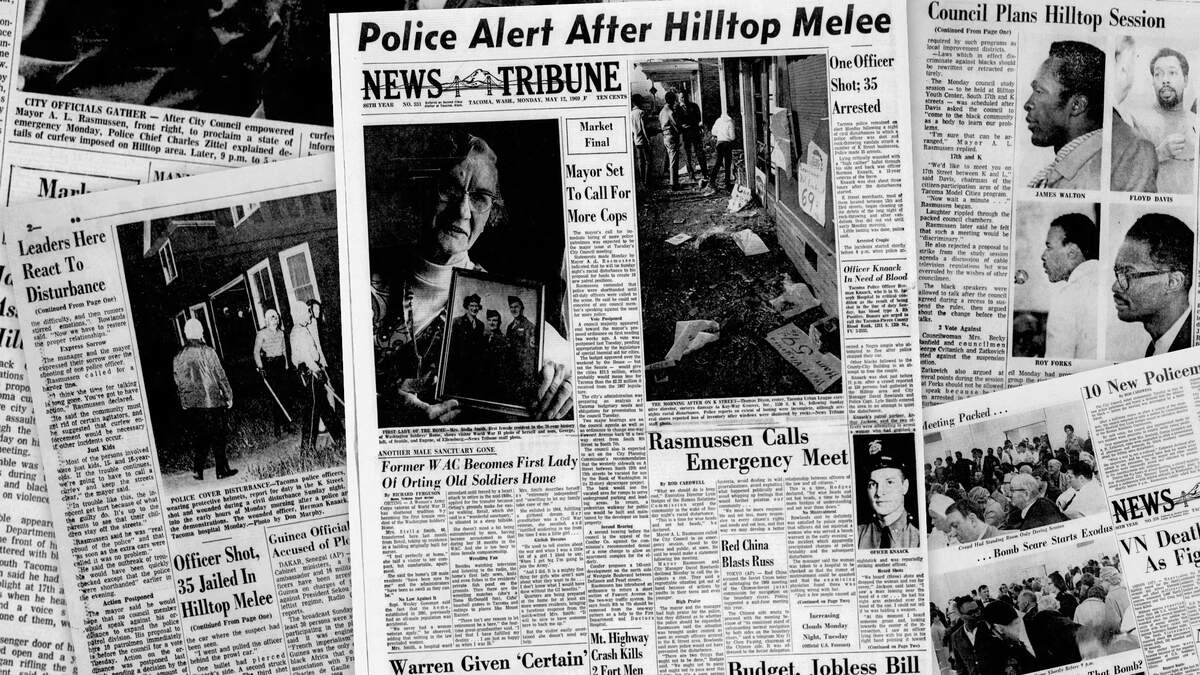
Or, to be more accurate, Walton is tired of talking about the May 11, 1969 uprising — which the next day’s News Tribune described as a “melee” on Hilltop ignited by the arrest of a 19-year-old Black woman — in the way it’s typically been described in the media and mainstream discourse, as an explosion of destruction and violence perpetrated by a seething Black community at a time of simmering racial tension across the country.
Yes, the disturbance — 53 years ago this week, and marked by broken windows, dozens of arrests and the shooting of a Tacoma police officer — was all of those things.
For Walton, who at the time was an emerging civil rights activist in his early 30s, the more important story, which is rarely told in full, has two chapters: What came next, and what didn’t.
If the night of unrest was the turning point in Tacoma’s history — as it’s often described — it’s because of the social justice work and collaboration that it helped to spawn, said Walton, who found himself thrust into the role of peacemaker and champion of change in the days following the disturbance.
That moment in history helped establish the prominence and power of organizations like the Tacoma Urban League, Walton explained, while helping launch the careers of several of the area’s most prominent Black leaders, including his own as the director of the city’s Human Relations Department and later as Tacoma’s first Black city manager.
Then there’s the other side of the coin, which clearly troubles Walton, now 83.
“Every time that someone asks me about that and we talk about it, it kind of bothers me because not a heck of a lot since that period of time — of significance — has changed,” Walton told me on Wednesday, 53 years to the day after the Mother’s Day Disturbance.
“The event was triggered by a police stop on Hilltop,a police encounter with African Americans, which continues to happen to this day,” Walton said. “So each time we play this through, that’s what comes to mind for me, is that we’re essentially talking about the same kinds of triggers and relationships.
“I always question really how much meaningful progress have we made?”
Call to action
Walton, now retired and, among other civic endeavors, a community representative serving on The News Tribune’s Editorial Board, wasn’t discussing the Mother’s Day Disturbance for sport.
Working with the local nonprofit Institute for Black Justice, Walton and other figures from the time — like Black Collective director Lyle Quasim, former state Senator Rosa Franklin, former University of Puget Sound student turned mayor Bill Baarsma and Amir Abdul-Matin, a Stadium High School and Tacoma Community College alum who was a young Black activist in 1969 — recently participated in a series of podcasts looking back on the tumultuous chapter of Tacoma’s history.
Next week, all five will participate in a two-day symposium at Pacific Lutheran University focused on the Mother’s Day Disturbance, and the lessons it provides today.
According to Institute for Black Justice founder Carol Mitchell, the goal is to provide “a very unique call to action” for a future generation of civil rights leaders.
Mitchell said the symposium, which will be open to the public, is specifically designed to include participants in the Institute for Black Justice’s leadership program. The program’s current cohort of roughly 10 people between the ages of 18 and 35 have spent recent months learning about the Mother’s Day Disturbance and listening to the wisdom of those involved in it, Mitchell explained. Next week they’ll be asked to provide their takeaways, while offering up what she called “a blueprint” for how the lessons of yesterday can be applied today.
The Institute for Black Justice will then incorporate those ideas into the programming it develops over the next year, Mitchell said.
Andre Jimenez is a 27-year-old student at University of Washington Tacoma who currently serves as chair of Tacoma’s Human Rights Commission and is one of the emerging leaders participating in next week’s symposium.
A member of last year’s Institute of Black Justice leadership program cohort, Jimenez said he has been acting as a “coach” for this year’s class, helping them to find meaning and direction from what they’ve learned.
Jimenez wasn’t aware of Tacoma’s Mother’s Day Disturbance until learning about it recently. Like Walton, he said he has struggled with the snail’s pace of social justice progress and how little has seemingly changed since Hilltop became ground zero for a confrontation years in the making more than 50 years ago, particularly when it comes to police reform.
Jimenez also said that looking back — and being honest about the work yet to be done — provides plenty of motivation for the future.
“One lesson is that if we don’t get this right, history is going to repeat itself,” Jimenez said.
“We have run out of time to not get this right, and the burden to change some of these systems permanently is upon us.”
This story was originally published May 13, 2022 at 5:00 AM.