Tacoma and Pierce County’s ‘white hot’ housing market has cooled. It’s about time
Derek Eyring helps people buy and sell homes for a living. An owner and broker with John L. Scott, with offices in North Tacoma and Bonney Lake, he’s been in the business for more than 30 years, all of them working in Pierce County.
Given his chosen profession, it can be a bit jarring to hear what Eyring — who sports a salt-and-pepper beard and a laid-back, unassuming demeanor that’s at home in the Pacific Northwest — is hoping happens next in the South Sound housing market.
Like a lot of frustrated would-be buyers, Eyring wants things to slow down and begin to normalize.
Those skyrocketing sale prices?
In the end, they’re not good for anyone, Eyring says — even him.
“It’s absolutely not sustainable,” Eyring said of what he described as the “white hot” local housing market of recent months. ”The optics on the outside looking in is that real estate brokers are just killing it, right? But the reality is that most brokers are buyer’s agents … and it’s been incredibly hard to get our buyers under contract.”
“Balanced markets are better for everybody,” he continues. “Historically, if you look back, in a balanced market sellers still have a 4 to 5% appreciation every year, which is reasonable, and buyers are able to purchase properties and not go through all of this. So I think it’s better for buyers, better for sellers, and better for our community.”
For Eyring — and other local real estate professionals — that’s what makes recent shifts in the local housing market encouraging.
While homeowners have likely grown accustomed — and, in some cases, emotionally attached — to receiving monthly emails from outfits like Redfin tempting them with the latest high sale prices their properties could likely fetch on the open market, news that things are finally cooling off, at least a little, comes as a relief.
As The News Tribune’s Debbie Cockrell recently reported, active home listings in Pierce County are up while sales are slightly down. Along with those trends — and influenced by other factors, like increased interest rates, the impact of inflation and exhausted would-be buyers — prices have begun to level out.
While they’re still rising, and homes in Pierce County are still significantly less expensive than in King or Snohomish counties, we’re now inching closer to some semblance of normalcy. In many cases, it means the days of bidding wars, multiple offers and houses being snapped up in a matter of days are over, at least for the time being.
In his three decades in real estate, Eyring says nothing compares to what he’s seen over the last few years.
It’s been a wild ride, but it’s time for it to end, he says. Enough is enough.
In a weary county — where the median single-family residential home sale price for May was $582,000, compared to $510,000 a year ago — it’s not difficult to agree.
The question now: What does a slowdown actually mean for those looking to buy and sell, and for the rest of us watching the madness from the sidelines as the price of housing reshapes our communities and neighborhoods?
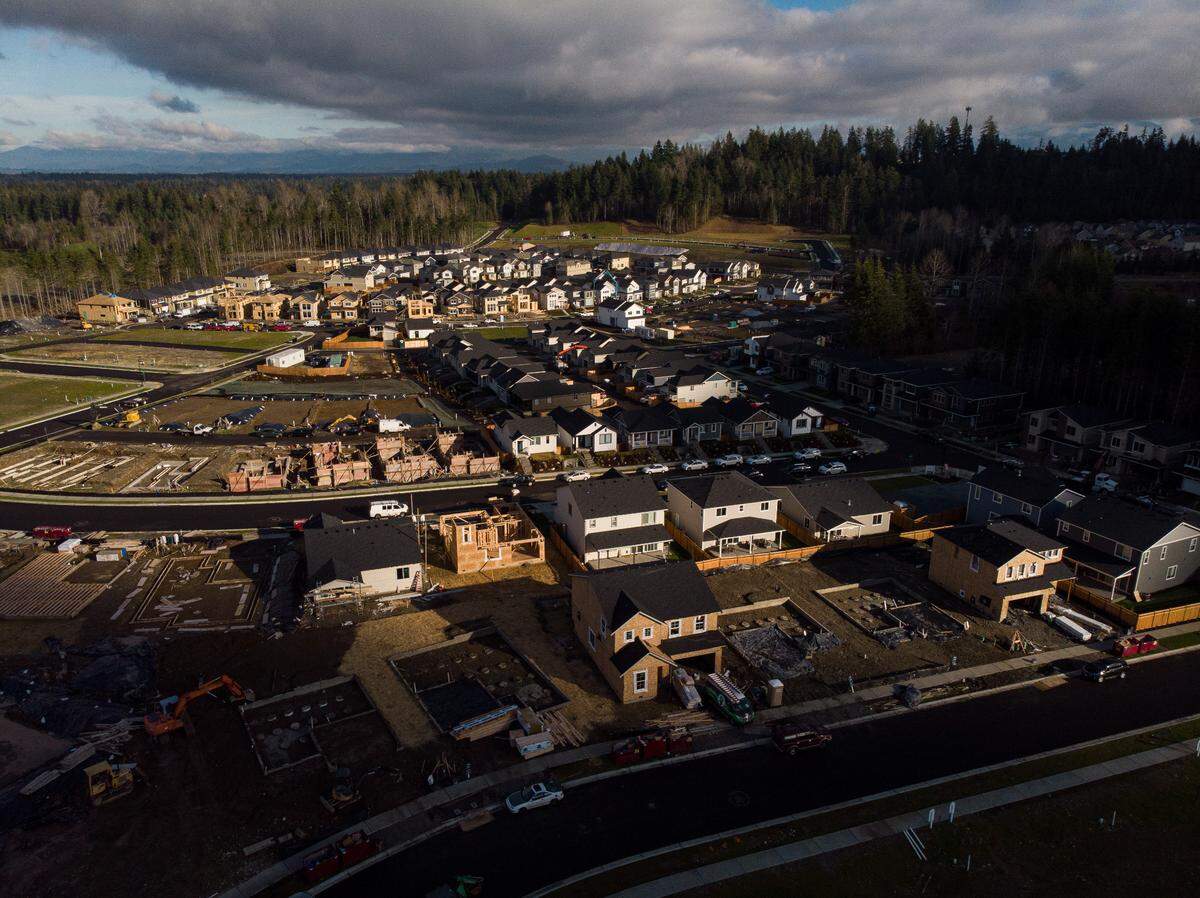
Housing inventory
According to Michael Robinson, a managing broker at Windermere Professional Partners in Tacoma, the story is in the stats, and what they reveal. Back in January, there were roughly 430 homes on the market in Pierce County. Today, there are roughly 1,400.
That increase in available inventory means sellers can no longer afford to get greedy with their asking price, and buyers suddenly have a sliver of leverage for the first time in months, he says.
To gauge the housing market, Robinson often looks at two figures: the number of pending sales and the number of active listings. Roughly, it paints a picture of how many buyers are out there and how many homes are available, he says. During the market’s peak, Robinson says there were points when there were four times as many buyers as homes. Today, it’s closer to 1.4 buyers per home.
That’s not a balanced market, but it’s a lot closer than where we’ve been, Robinson said.
“It’s still a good time to sell, but sellers need to curb their irrational exuberance when pricing,” Robinson said. “You just kind of need to hit pause a little and realize that the market is extremely good — it’s up 30% in the last two years, and you’ve done fantastic on your real estate investment. You can still command a really high price, and you can still essentially be in the driver’s seat when it comes to marketing and negotiations. But there’s a limit, because you’re not the only game in town. Now you have some competition, whereas three years ago you didn’t.”
For buyers, the inverse is true, Robinson said. Don’t expect screaming deals, but some of the pressure has clearly been released.
“Buyers can now maybe look at a house more than once and make a decision in less than two hours. They can actually think about it for a minute,” Robinson said. ”The sellers are still in the driver’s seat, but buyers might be able to get a home inspection, or they might be able to ask for a work order. They can’t get greedy, but they have a little bit of clout as a buyer as the market starts to balance.”
Of course, with the memory of the Great Recession and the housing market collapse still fresh in many people’s minds, there’s also an understandable fear — or, in some cases an outright hope — that the signs of slowdown we’re now experiencing are a precursor to a more precipitous tumble.
Even with the economic uncertainty swirling in the country, Robinson and Eyring wouldn’t bet on it.
If anything, the local housing market — and the overall shortage of inventory — is a lasting repercussion of the 2008 financial meltdown, even all these years later, Eyring says, and one that will continue to feed demand..
He also believes the factors that contributed to the housing market crash — loose loans and unscrupulous business practices — don’t exist this time around.
“I honestly believe that the supply issue started with the recession. When the recession happened, the money basically froze up, and nobody was doing anything. And that went on for years. Builders stopped building, permits stopped, everything stopped. … So we had all this time where we just had no growth, and I think we’re still in a hangover from that on the supply side.” Eyring says.
“We still have a long way to go,” he added, grateful for the slowdown Pierce County’s housing market is experiencing. .
“I guess if you’re a seller, you might not think it’s a good thing, because you’re not going to get 20 offers over ask. But for the greater good, it’s better to have a balanced housing market.”
This story was originally published June 13, 2022 at 5:00 AM.