
4-year-old walking pet snail discovers rare stingless bees in California, researchers say
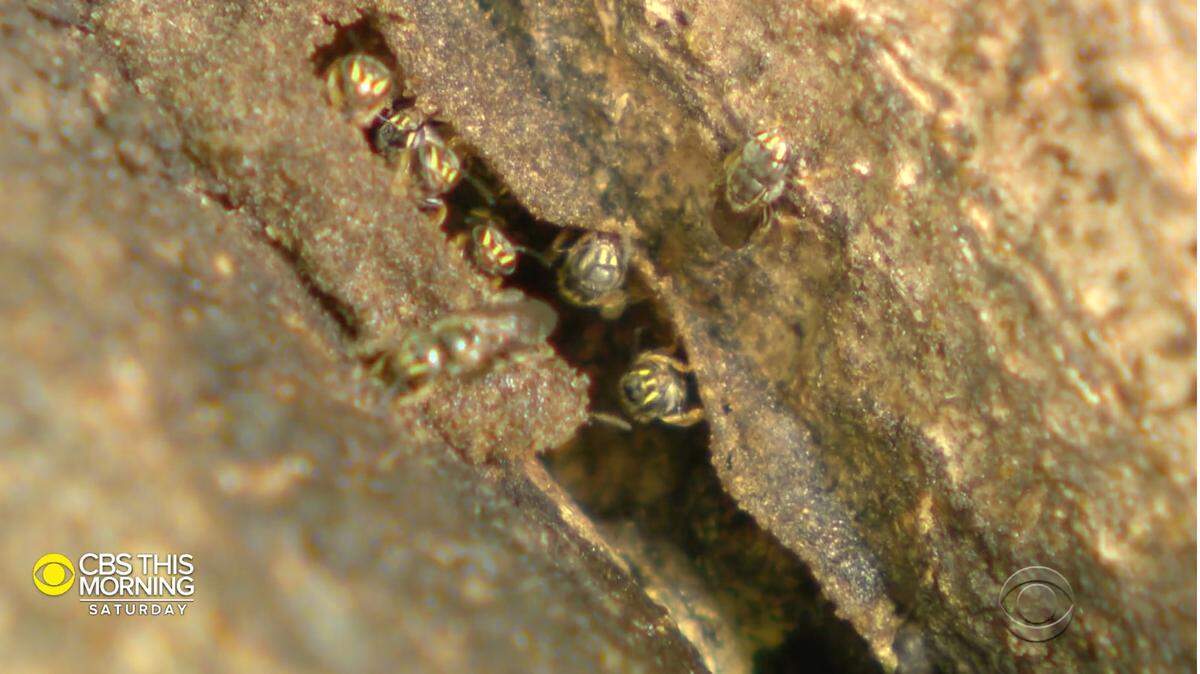
An unlikely duo made an impressive discovery — and it’s one that has researchers buzzing.
Four-year-old Annika Arnout and her pet garden snail found two colonies of rare stingless bees while on a neighborhood walk with her caregiver, according to Bay Nature.
The Plebia emerinara species of bees are the third and fourth colonies found in Palo Alto — having largely gone unnoticed by scientists in the last 70 years, the magazine reported.
That is until Arnout’s detective instincts came in.
“I climbed the tree and I saw the black bugs,” Arnout told Bay Nature. “I scratched myself on my hand right here. But it was no big deal. I couldn’t tell if they were bees or wasps.”
Arnout’s bees became a hit on iNaturalist, a social network where citizen scientists and biologists share their findings with the world.
It’s also where Dr. Martin Hauser, senior insect biosystematist for California’s Department of Food and Agriculture Plant Pest Diagnostics, noticed the girl’s discovery, CBS News reported.
The stingless bees, which are smaller than an average honey bee, aren’t supposed to be in California, according to Brazilian entomologist Dr. Paulo Nogueira-Neto’s research paper published in 2002.
They are native to Brazil.
In the late 1940s and early ‘50s, the U.S. Department of Agriculture (USDA) wanted to increase the yield of fruit and vegetable crops. Nogueira-Neto shipped 30 colonies of foreign bees to the USDA to see if the bees could make good agricultural pollinators, according to his research.
“He (Nogueira-Neto) sent them in the ‘50s to Gainesville, Florida, Logan, Utah, and Davis and Palo Alto. And he said all the bees died in one year,” Hauser told CBS News.
“They didn’t like the cold weather in Utah. They couldn’t compete in Florida,” he added.
The only colony that survived was the one in Professor George Schafer’s backyard in Palo Alto for eight years, according to the research paper. Then, in 1962, stingless bee sightings came to an end when Schafer died.
Although Nogueira-Neto said that the likelihood of stingless bees surviving in the U.S. was slim, “there may also be a kind of ecological compensation in places where very favorable local ecological factors would compensate for other ecological factors that are not so well suited for these bees,” he wrote in his paper, Bay Nature reported.
The Brazilian entomologist turned out to be right.
In 2013, a homeowner close to Professor Schafer’s house found what he thought were wasps. Instead, they turned out to be the stingless bees Nogueira-Neto hoped had survived, CBS News reported.
The second sighting came in 2018, in the same Palo Alto neighborhood as the first sighting, Bay Nature reported.
The third and fourth finds were Arnout’s.
“I was very impressed that she found two colonies,” Hauser told CBS News. “That’s very amazing that she found two and all the scientists found none.”
Hauser told Bay Nature that Arnout’s findings are of one of 512 species of stingless bees in the world.
This story was originally published August 30, 2021 at 4:51 PM with the headline "4-year-old walking pet snail discovers rare stingless bees in California, researchers say."
.png)