The Constitution, God and crime: Why Keith Swank is running to be Pierce County sheriff
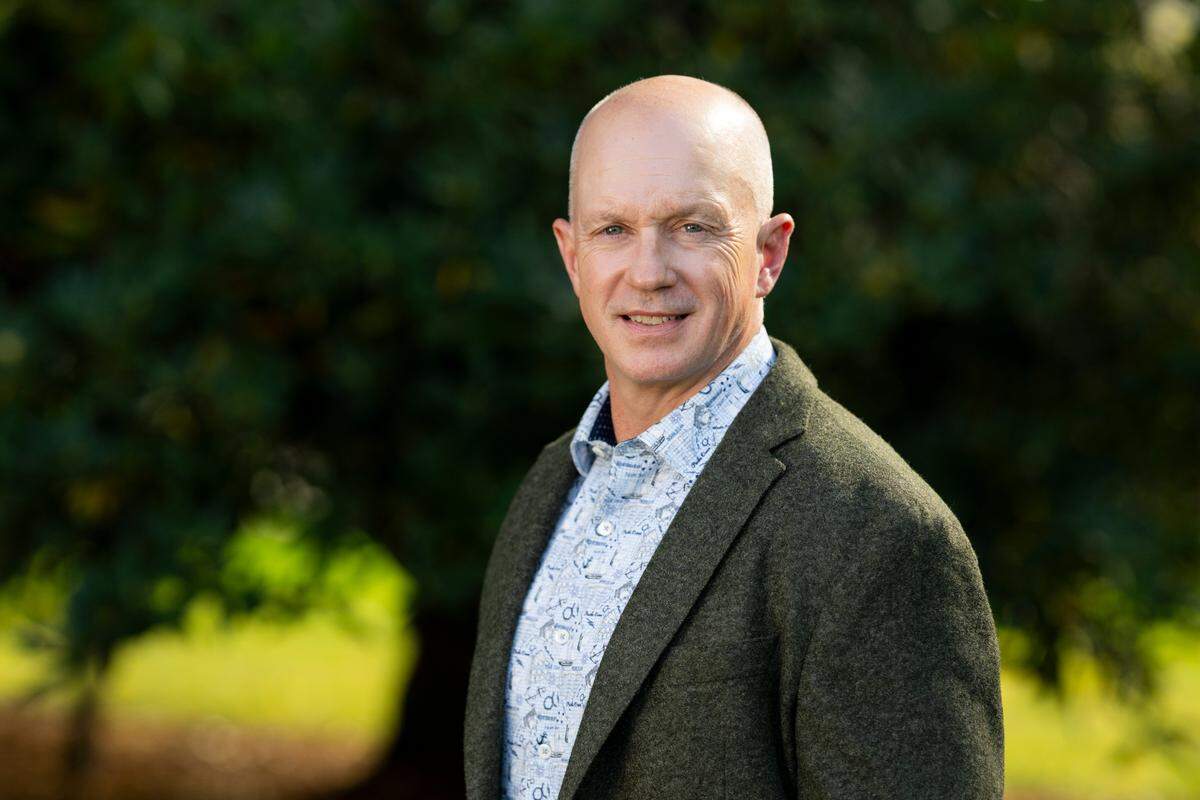
Keith Swank wants to bring an outsider’s eye to the job of Pierce County sheriff in a department he believes to be hampered by favoritism and ineffective leadership, creating controversies and low morale.
As he campaigns in the final weeks before the Nov. 5 election, Swank is trying to convince voters that his years on the street as a Seattle cop and experience teaching de-escalation techniques make the best resume to support the rank-and-file while also building trust between the public and a large law enforcement agency.
Swank, 56, is a retired Seattle Police Department captain and a longtime Puyallup-area resident who first came to Pierce County when he was stationed at Fort Lewis — now Joint Base Lewis-McChord — in the U.S. Army in 1987.
He’s made four prior bids for office in U.S. Congress as a Republican and hasn’t won an election. He ran to unseat Democratic Sen. Maria Cantwell in the Senate in 2018 and has run three times for positions in the House of Representatives. Now he’s up against Patti Jackson, who is chief of patrol for the Sheriff’s Department and has long worked in its Corrections Bureau, including as chief for eight years.
At a community event on a Saturday at Bethel High School in October, Swank and his wife, Nina, set up a table inside the school advertising his campaign. They handed out little sheriff badges to a young man wearing an Iron Maiden T-shirt and shook hands with parents.
Swank was near the gymnasium, right next to a table for a church. One man who approached him complained that deputies couldn’t do anything anymore and said Swank had his vote.
As the event was winding down, Swank told The News Tribune that lately he’s been going to any event he could attend, hoping to hear from different parts of the county and the issues important to them. He said violent crime is an issue everywhere, but in South Hill, for example, he’d heard that gripes about parking have sometimes led to fist fights, and at the event he spoke with a man who felt Spanaway had become worse in recent years, after he’d moved there to avoid crime in Tacoma.
One idea he said he’s considered is expanding a reserve deputy program made up of trained and armed volunteers. Swank said he’d like to have 100 reserve deputies trained to be commissioned law enforcement officers. They would be armed with firearms and work two or three shifts a month riding with a full-time deputy.
“There are lots of good people in our communities that want to give back, and they’d love to be a part-time deputy,” Swank said in an interview with The News Tribune.
The elected sheriff will provide law enforcement services to the hundreds of thousands of people who live in unincorporated areas of the county, along with Edgewood and University Place, cities that contract for police services. He or she will run the jail and wield a budget of more than $377 million. The sheriff is a nonpartisan position and is elected for a four-year term, limited to three consecutive terms.
Swank’s pitch for the job is one of tough enforcement on what he’s described as “out of control” crime in Pierce County, while also centering Constitutional rights and Christianity as guideposts to his principles.
In an interview with the Family Policy Institute of Washington in July, Swank said he was considering moving to Florida before he decided to run for sheriff in August 2023, but while he was sitting in his hot tub, stargazing and thanking God for getting him through his career, God told him to run for sheriff.
“He said to me, ‘Son, you have not been listening. You are to run for sheriff,’” Swank told two interviewers on Zoom. “So I ran upstairs. I told my wife, ‘Honey, God just told me I have to run for sheriff.’ And she said you better, or you’ll end up in the belly of a whale.”
Swank filed to run for sheriff seven days later. He told the Family Policy Institute that was the real reason motivating him to run for office, but he also felt motivated by crime in the county and his neighborhood.
When Swank sat down with The News Tribune at the Pioneer Park Pavilion in Puyallup to talk about his background and campaign, he said God’s role in his decision-making as sheriff would be praying for wisdom to make the right decisions and hold himself accountable.
Swank is a vocal supporter of conservative issues, and he often uses social media to comment on topics, such as Initiative 2117, which would repeal a Washington program that limits the amount of carbon emissions businesses can produce. Swank and others have blamed the program for high gas prices.
He’s also used social platforms to blame former U.S. House Speaker Nancy Pelosi for “coordinating” the storming of the U.S. Capitol on Jan. 6, 2021, associated Democrats with hating “the American people” and denigrated transgender people and their parents.
The Seattle Office of Police Accountability reviewed Swank’s accounts on X and Facebook in May 2023 after a PubliCola journalist reported his posts for possible violations of SPD’s social-media policy. The case remained pending Oct. 21, according to the OPA.
Swank is aware of the complaint. He said he was running for U.S. Congress when some of the posts were made, and he was trying to increase his name recognition.
“I was being provocative about some things there, like other people are,” Swank said. “I’m a staunch supporter of the Constitution. I’m all for free speech, and free speech, as you know, the reason why we have it is for people to be able to say things other people don’t like.”

If elected sheriff, Swank said the public wouldn’t be seeing political tweets from him in an official capacity. He said he’d prefer to leave communications about department activities to professionals such as public information officers, but he said he understood there could be times when he should address news media.
Swank scrubbed his X profile of several posts after the August primary. In one now-deleted tweet posted in September 2023, he suggested that members of Gen Z should perhaps not be allowed to vote if they live with their parents or grandparents while sharing an article describing moving back in with your parents as good financial advice.
In another tweet that remains up, he suggested that if former President Donald Trump was safeguarded by the Seattle SWAT officers he commanded, the July assassination attempt at a Pennsylvania rally wouldn’t have happened.
Asked about the deleted posts, Swank said they had nothing to do with law enforcement, and as sheriff, that’s what he would be focused on. He said he might delete his X account entirely if he is elected.
“I want to be a non-partisan sheriff and treat everybody equally under the law,” Swank said.
Swank wants to tackle violent crime, enforce immigration
In a Sheriff’s Department run by Swank, the main priority would be responding to violent crimes. That’s something he agrees on with his opponent, but Swank believes his street-level patrol experience makes him the better pick.
In campaign videos, Swank emphasizes his own work on high-stakes arrests and hairy situations, such as being a SWAT commander who oversaw clearing the CHOP zone in Seattle during protests in summer 2020.
It’s a background that he says has given him wisdom to make decisions about what tactics to employ in scenarios that can attract a lot of public attention, such as when deputies uses force or become involved in vehicle pursuits.
Chasing suspects as a young officer in the 1990s is something he remembers with some fondness, but Swank said becoming a supervisor and having to be accountable to the public taught him to weigh the risks and know when a chase isn’t worth it. Although recent changes in state law have given police discretion to pursue suspects, so long as the risk of letting them go is greater than the risks of giving chase, Swank said pursuits have to be for violent crimes.
“Unless you’ve been there, you don’t know what it is like to go to a family member and say, ‘I’m sorry we chased somebody into your loved one and killed them, but they had a taillight out,’” Swank said.
Swank also wants to target issues such as human trafficking and the movement of drugs along Interstate 5 by working with local and federal law enforcement partners.
Violent crime such as murder, rape, aggravated assaults and arson declined in the county last year, according to the Washington Association of Sheriffs and Police Chiefs’ annual crime report. Drug violations and human trafficking have spiked. Motor-vehicle theft remains above pre-pandemic levels.
He has also said he would work to fully enforce immigration laws. It’s unclear how he would do so. The state Legislature in 2019 determined that a person’s immigration status is not a matter for police action when it passed the Keep Washington Working Act, which also limits law enforcement agencies from sharing information with federal immigration officials.
Researchers from the University of Washington Center for Human Rights found in 2021 that several police agencies continued to share information about individuals’ court dates, places of birth and home addresses after the law was passed. More recent research from UW has found greater compliance.
Asked whether he would share information about inmates at Pierce County Jail with Immigration and Customs Enforcement, Swank said he would coordinate with the Prosecuting Attorney’s Office for legal guidance.
“But I do want to be able to help out, and if we have violent criminals that are in the country illegally and they’re committing violent crimes, I want to make sure we’re holding them accountable also,” Swank said.
In his campaign, Swank has drawn a hard line between his tactical know-how and his opponent’s career, which has primarily been in corrections.
Jackson was appointed chief of the Sheriff’s Department’s Corrections Bureau in mid-2015 and stayed there until January when she became chief of patrol while Chief Micah Lundborg was at the FBI academy, but she remained in the position after he returned in April, and in the wake of a no-confidence vote from the Pierce County Corrections Guild.
Swank frequently criticizes Jackson’s career as not up to snuff for the responsibilities required of the sheriff, and he brings up the 150-14 no-confidence vote as a sign of low morale among those she leads.
“I met with them,” Swank said of the corrections guild. “They said her leadership is terrible. She’s vindictive and mean to people and goes after them.”
Swank would not have the same familiarity with the Sheriff’s Department that Jackson does if he is elected, but he has said he would appoint Lt. Cynthia Fajardo as his undersheriff to help him lead and familiarize him with the deputies. Fajardo has worked for the Sheriff’s Department for more than 35 years and currently commands the Foothills Detachment, which patrols about 435 square miles from the Orting Valley to Crystal Mountain.
Fajardo lost the 2020 sheriff election to Sheriff Ed Troyer. She ran again this year, but she was ousted in the August primary. She told The News Tribune that in her conversations with Swank, she found that they both shared a philosophy of prioritizing the support of their deputies, while also making sure they know where the line is and remain true to each other and the civilians they serve.
She also described how she believes Swank’s years doing the work of fighting crime make him a better choice to lead the department than Jackson. She compared Jackson surrounding herself with patrol veterans to help her make leadership decisions to watching a YouTube video before performing surgery.
“All of the successful sheriffs that I’ve worked for and that I have seen have never lost their connection to the street,” Fajardo said.
‘I never intended to be a cop.’
Swank was born in Maryland in February 1968.
After high school, a friend convinced Swank to enlist in the Army.
The year after he enlisted, Swank was stationed at Fort Lewis in 1987. He remained an active-duty service member for three years and was in the reserves for five years. He got out in 1989 thinking he would finish college and return to the military to become an officer.
After he was discharged, Swank said he got a job tending bar at the West Seattle Golf Course. He was studying psychology as a freshman at the University of Washington at the time, and he hoped the job would help him pay for it. But he said he was laid off during a rainy February when people weren’t golfing. Swank started filling out job applications to get unemployment benefits.
“I would scour the ‘Help Wanted’ section of the Seattle Times,” Swank said. “And I saw this notice for Seattle Police Department hiring. I didn’t think anything about it other than I need to fill out an application so I just did it so I could get my unemployment benefits.
“I never intended to be a cop.”
Swank was hired in April 1990 for $12.35 an hour. He withdrew from classes to go to the police academy and went back to college after he completed his field training, working the night shift and going to school during the day.
Swank moved in 2002 to the Puyallup area in South Hill.
Poor experiences in Seattle prepared Swank to lead
Working for the Seattle Police Department, Swank loved patrolling city streets. As decades passed, he butted heads with leadership and was skipped over for promotions he said he fought hard to receive.
Swank said his time in the department taught him how not to treat people, and it was the negative experiences there that have prepared him to be a leader in Pierce County.
Nick Bauer, a retired Seattle police sergeant who worked with Swank, said he knew him as a great street cop and leader who knew how to motivate people. He said they both worked in the East Precinct for a time in the 1990s.
Bauer said he felt Swank was passed over for promotions without justification several times. He said Swank was a strong personality with strong opinions, which he looks for in a leader.
Swank spent 15 years on patrol before he was promoted to sergeant. He was assigned to oversee the 911 center. It was a job no one wanted, according to Swank, and he said a lot of sergeants failed there without the right skills to supervise civilians rather than officers.
“But it was the best thing ever happened to me because I learned people skills. I learned about contract negotiations. I learned about all kinds of things,” Swank said.
It was in the 911 center that Swank helped diffuse a mass shooting at the Seattle Jewish Federation in 2006. According to the Seattle Times, then-Police Chief Gil Kerlikowske lauded 911 dispatchers for their calmness while talking with the shooter, who surrendered and was later convicted in a jury trial and sentenced to life in prison.
On his campaign website, Swank says he played a pivotal role in de-escalating the situation. Asked how he did so, he told The News Tribune he sat beside the call taker, wrote her notes and suggested what to say to the shooter.
Swank said he believes his background in the 911 center was part of the reason police department leadership later chose him to help develop crisis intervention training when the U.S. Department of Justice and the Seattle Police Department agreed to a consent decree in 2012 that required reforms in the department.
In 2011, then-Police Chief John Diaz suspended Swank without pay for 10 days for a lack of supervision at the scene of a robbery investigation, where a gang detective threatened to beat the “Mexican piss” out of a Latino man. Swank was acting watch lieutenant at the time, and according to the Seattle Times, he was disciplined for failing to recognize the serious misconduct of the remark.
Swank told The News Tribune the gang detective wasn’t under his supervision, but he heard the remark, removed the detective from the situation and spoke with him about the language. He said he reported it to the detective’s sergeant and his own captain, but that in subsequent internal investigations his captain lied and said Swank didn’t speak to him about the incident.
According to Swank, he appealed his suspension, and an arbitrator ultimately found that Swank failed to report the incident to the Office of Police Accountability. Swank said his suspension was reduced to three days. Looking back, Swank said he should have reported the detective’s remarks to internal affairs himself.
Swank later became a permanent watch commander when he was promoted to lieutenant. In 2017 he was promoted to captain. He worked in the vice section and the narcotics section before working as the night-duty commander for 18 months.
As a captain he also commanded the Metro Special Response Section, which included the SWAT team, bomb squad and other units.
In June 2023, Swank retired from the force.
Swank says voters want change
In his campaign, Swank has cast himself as a change from the way Sheriff Ed Troyer has run the department, both by hitting on Troyer’s support of Jackson and earning the support of Fajardo.
“The voters in the county, I think they see those issues going on with the agency, and I talk to people all the time who say they want some change,” Swank said.
Jackson told The News Tribune she would bring different leadership and management styles to the department than Troyer has, and that she would support the men and women she leads without hiding from any mistakes. She also commended Troyer for his decades of service.
Swank expects that most of the current command staff will retire after the election. He said Fajardo would help him identify leaders in the organization. Jackson has said both Undersheriff Brent Bomkamp and Chief of Administrative Services Nick Hausner would retire no matter how the election goes.
“I don’t owe anybody anything, and I want to put the best people in the best place,” Swank said.
This story was originally published October 24, 2024 at 5:00 AM.