
WA restricts turbine sites for state’s largest proposed wind farm near Tri-Cities
AI-generated summary reviewed by our newsroom.
- Washington energy board imposes 2-mile exclusion zones around some ferruginous hawk nests.
- Those and other exclusions eliminate sites for some shorter turbines, solar panels.
- Construction may not start until other litigation resolved.
A state board significantly limited the spots where wind turbines and solar panels can be placed in the large Horse Heaven Hills wind farm project south of the Tri-Cities. The limits are to protect endangered ferruginous hawks.
A year ago, former Gov. Jay Inslee gave Scout Clean Energy approval for the Horse Heaven Clean Energy Center after Inslee rejected an initial recommendation with more protections for the hawks.
The project, at least as it was proposed for as many as 222 turbines along the Horse Heaven Hills, would be the largest wind farm in Washington.
The project also includes solar arrays and battery storage of power for short periods until it is needed.
Now, it is not clear how many wind turbines Scout can fit into areas where it’s being allowed to build.
Under the latest restrictions, the Washington state Energy Facility Site Evaluation Council voted last week that four of 44 possible historic ferruginous hawk nesting sites cannot have wind turbines, solar panels or battery storage built within two miles in all directions.
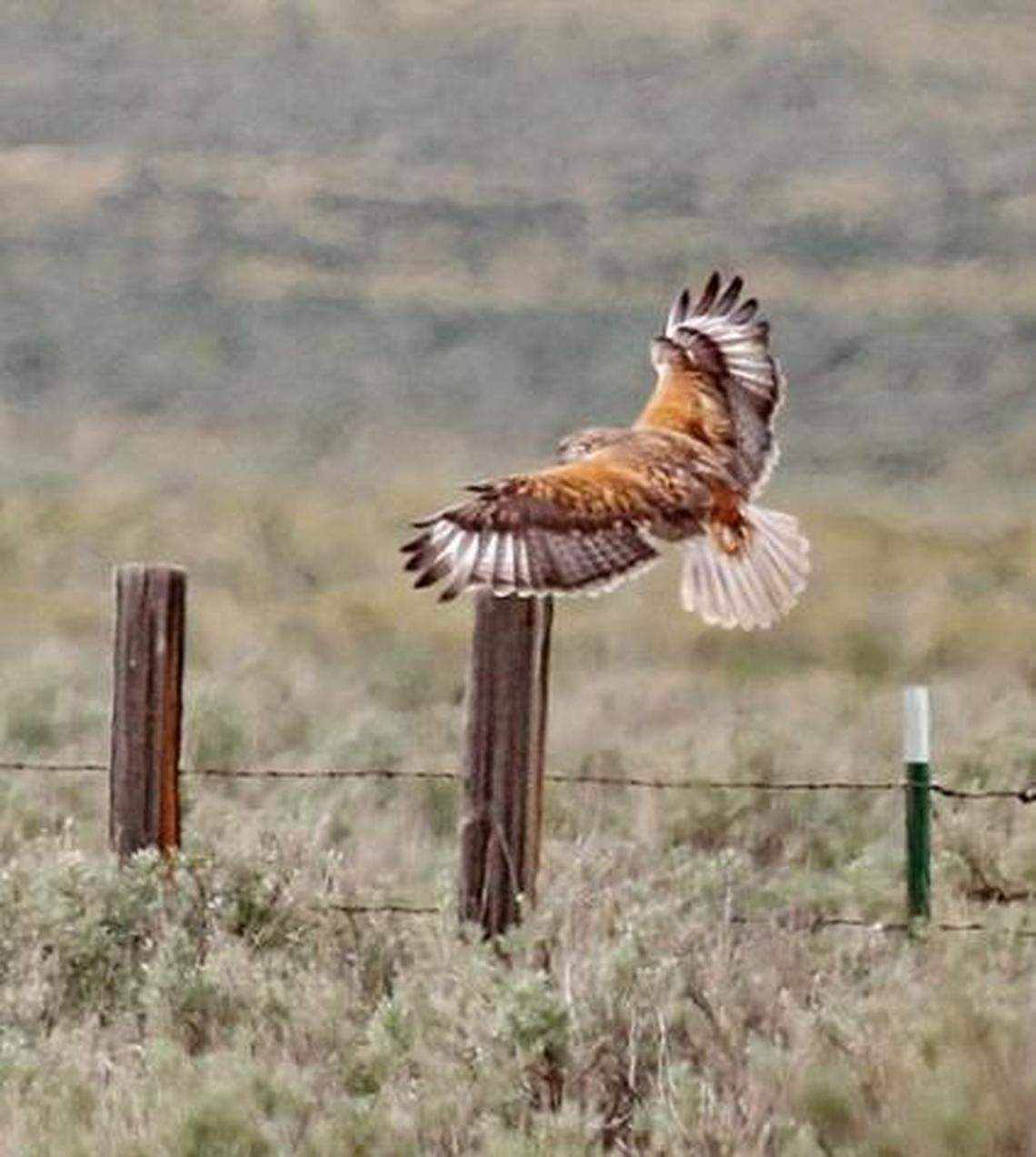
The same restriction was placed on a fifth nest discovered this year to be occupied for what may be the first time by a breeding pair of ferruginous hawks. The occupied nest was formerly used by Swainson’s hawks.
Information from a Scout Clean Energy document said those five exclusion zones would eliminate sites for a solar array considered for the east end of the project and 39 turbines, under the proposal for 222 turbines that are 500 feet tall.
Scout Clean Energy had alternately proposed 147 turbines that stand 670 feet tall.
It has not made public how the latest exclusion zones, plus others, would limit where the taller turbines can be placed.
Since Scout Clean Energy applied for a state site certification for the project in early 2021, turbines taller than 500 feet have become the standard for wind farms.
The location of historic and current ferruginous hawk nests has not been made public to protect nesting sites. But key nests that are required to have 2-mile exclusion zones around them appear to be near the top of the Horse Heaven Hills.
The view of the ridgeline from the Tri-Cities has been a point of contention for many of those who have objected to the wind turbines being built along the southern skyline.
Scout Clean Energy says the construction of the Horse Heaven project would support 930 jobs and that the project would contribute $260 million in local taxes over its 35-year lifespan. The wind farm would be built with union labor following a 2022 agreement with Tri-Cities unions.
Areas for 82 wind turbines excluded
EFSEC originally recommended to the governor the 2-mile exclusion zones for all historic ferruginous hawk nests on the project. But Inslee rejected the council’s first recommendation, saying that he strongly encouraged the council to provide a new recommendation “that appropriately prioritizes the state’s pressing clean energy needs,”
EFSEC revised its proposal to only a 0.6-mile exclusion zone for nesting sites that no longer had viable habitat for the birds and called for a technical advisory board to make a recommendation on that to the council.
The technical advisory group unanimously agreed that 39 of the sites no longer had viable habitat, primarily due to development that included cropland, housing and industrial uses.
However, that smaller exclusion area would still eliminate sites for 14 of the shorter turbines, according to a Scout Clean Energy document.
Other exclusion areas were previously set to allow some aerial firefighting in fire-prone areas near Benton City, to protect cultural resources important to the Yakama Nation in the Webber Canyon area and to provide a buffer near some homes.
Those would eliminate sites for 29 of the shorter wind turbines.
The total exclusion areas for all reasons would eliminate sites for 82 of the shorter wind turbines, according to a Scout Clean Energy document.
Scout has the option of trying to fit more turbines into nonrestricted parts of the project, but it does not appear that would significantly change the number of turbines.
Horse Heaven under litigation
The decision on exclusion areas for ferruginous hawks appears to be the last contentious issue EFSEC needed to decide for the project.
Ferruginous hawks have been designated as endangered in Washington state, where the hawks breed primarily near the Tri-Cities. They have been impacted by the loss and fragmentation of shrub steppe and grasslands from agriculture and residential development and the resulting decline in their primary prey, jackrabbits and ground squirrels.
They are not listed nationally as endangered.
It would have a nameplate energy generating capacity of up to 1,150 megawatts, according to Scout. In comparison, the Columbia Generating Station near Richland, the Northwest’s only commercial nuclear power plant, has a generating capacity of 1,207 megawatts, but can operate around-the-clock regardless of weather conditions. That’s enough power for 1 million homes.
Scout Clean Energy is not expected to move forward immediately with construction because the Horse Heaven project remains in litigation.
The Yakama Nation, Benton County and Tri-Cities CARES appealed Inslee’s previous approval of the project.
This story was originally published October 20, 2025 at 5:00 AM with the headline "WA restricts turbine sites for state’s largest proposed wind farm near Tri-Cities."