
$47M for new Richland lab. It will harness AI for faster scientific discovery
AI-generated summary reviewed by our newsroom.
- PNNL commissioned AMP2 prototype to automate microbial phenotyping and AI analysis.
- DOE awarded $47M to Ginkgo for a 32,000 sq ft M2PC facility to scale autonomy.
- Autonomous labs will speed experiments, expand datasets and boost biotech output.
Microbes too tiny for the eye to see are at the center of a big project in the Tri-Cities, leading the way on the use of artificial intelligence to advance scientific discovery.
U.S. Energy Secretary Chris Wright tapped a few keys on a laptop on the campus of Pacific Northwest National Laboratory in Richland on Thursday, commissioning a first-of-its-kind system using AI.
It is planned to greatly accelerate the speed at which biological science is done, making discoveries that change lives and help the nation.
But the system, the Anaerobic Microbial Phenotyping Platform, or AMP2, that Wright started up is just the beginning of the work that will be done on the campus of the Department of Energy national lab as part of the nation’s new Genesis Mission, a Trump administration initiative to apply AI to scientific research.
“What we are all about is accelerating the rate of scientific discovery, engineering innovation — and we’re going to do that with our labs, with our commercial partners and with an atmosphere that encourages, rewards and incentivizes innovation,” Wright said.
A $47 million contract has been awarded through the DOE Office of Science to Ginkgo Bioworks of Boston to build a facility with 10 times the laboratory space of the current prototype commissioned Thursday at DOE’s Environmental Molecular Sciences Laboratory (EMSL) on the PNNL campus.
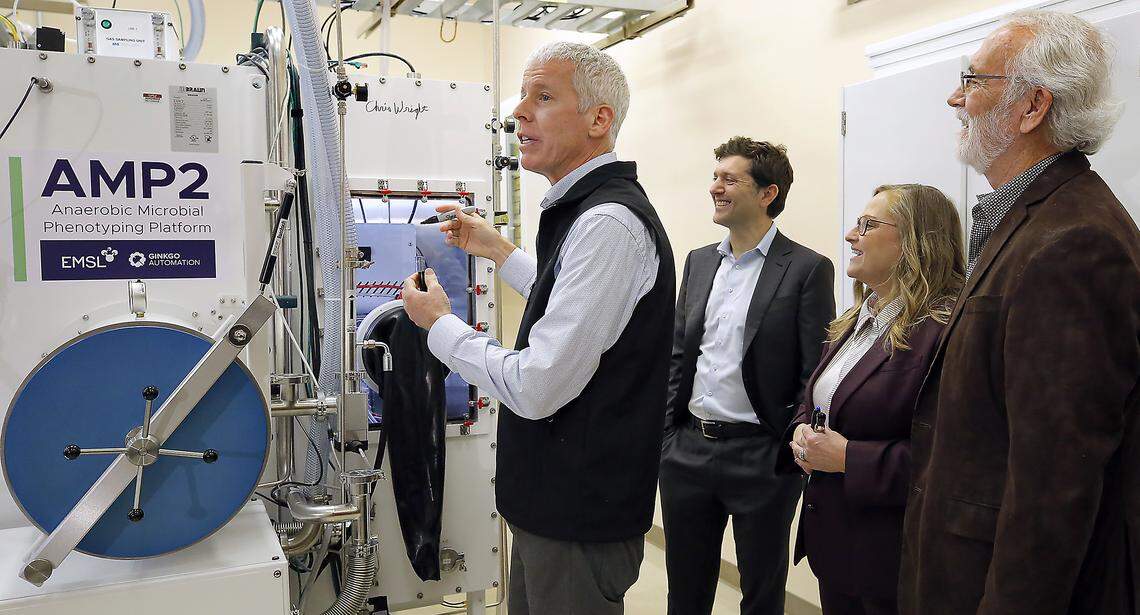
The 32,000-square-foot facility will be in an addition built at EMSL, a scientific user facility where scientists compete to use the lab’s sophisticated scientific equipment and the expertise of PNNL scientists in their research. It will have 100 high-tech analytical instruments for scientific experimentation.
Ground will be broken next year with the new Microbial Molecular Phenotyping Capability, or M2PC, in use in 2030. In the meantime, the prototype facility within EMSL will begin research projects next month.
Autonomy paired with AI
Like its prototype, also created by Ginko Bioworks, M2PC will be autonomous — somewhat like a self-driving care is autonomous.
Scientists will come up with a theory and order experimental work from the new systems to test it.
Robotic arms will do tasks such as filling and loading sample containers and moving containers from one laboratory location to another, operating around the clock.
But the systems involve much more than robots doing repetitive tasks.
True autonomy also involves designing whole series of investigations so that one experiment flows into another experiment automatically without constant human intervention. AI will be used to analyze scientific findings immediately and then use the conclusions to pick and then move on to the next best research step.
Scientists will still have the ability to guide experimental designs and run the system, but the automation makes it possible to do more experiments more quickly, providing a huge dataset to draw conclusions from more quickly.
“Autonomy and AI are rapidly changing and reshaping the way that science is done, amping up the throughput in laboratories and allowing investigators to accomplish in days what normally would take weeks, months and often times years,” said Douglas Mans, interim director of Earth and Biological Sciences at PNNL.
Most microbe qualities a mystery
Microbes, such as bacteria and fungi, represents the largest pool of biological function on Earth.
But scientists have explored only a small fraction of the microbial species on Earth. Scientists don’t know anything about 95% of them, Wright said.
Combining AI and an autonomous system will allow knowledge to advance from the equivalent of an old, grainy black-and-white photo of the microbial world to a full-color, 360-degree panoramic image, said PNNL scientist Scott Baker.
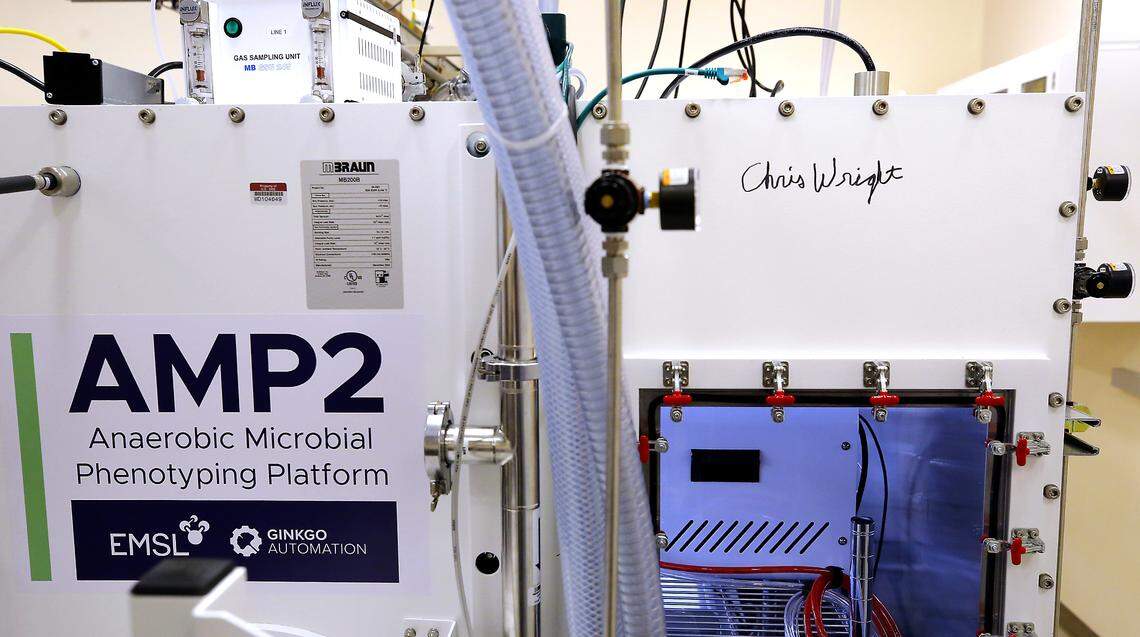
The prototype and full-scale system will look at characteristics of many microbes such as how fast they grow; what nutrients, temperature and pH they like; how long they produce a compound of interest and much more. The collection of traits is known as a microbe’s phenotype.
“The quest to understand the biology underlying microbial phenotypes is a big deal,” Baker said. “ ... To create a very broad, basic understanding of the breadth of the microbial world and to be able to predict and control what these bugs do, we need a huge team of researchers doing impactful science, coupled with one of the most sophisticated laboratories in the world focused on the microbial world.”
The research could speed development of new medicines for diseases such as Alzheimer’s and cancer. It could produce new materials for energy sources.
It could expand on the current use of bacteria and fungi in industry by replacing discoveries now made through trial and error with more knowledge of how microbes behave under different conditions. Products could be made more efficiently.
In one project planned as part of the nation’s new Genesis Mission, the possibility of using acid produced by a particular kind of bacteria to leach out valuable metals like lithium and cobalt from mine tailing waste will be investigated.
Currently, the worldwide bioeconomy is valued at more than $4 trillion, but it is expected to grow to more than $30 trillion within three decades.
AI research jobs impact
“Washington’s life sciences sector already supports more than 100,000 jobs, shaping the next generation of science and technology,” said Sen. Maria Cantwell, in a statement.
“Now PNNL will be leading the nation in developing an AI biotech platform that will accelerate breakthroughs in cleaner fuels, sustainable materials, and new medicines, positioning Washington at the center of some of the most critical industries of the future,” she said.
The acceleration of research will only increase the demand for scientists, Wright said. As the productivity and innovation of research increases, even more will be wanted, he predicted.
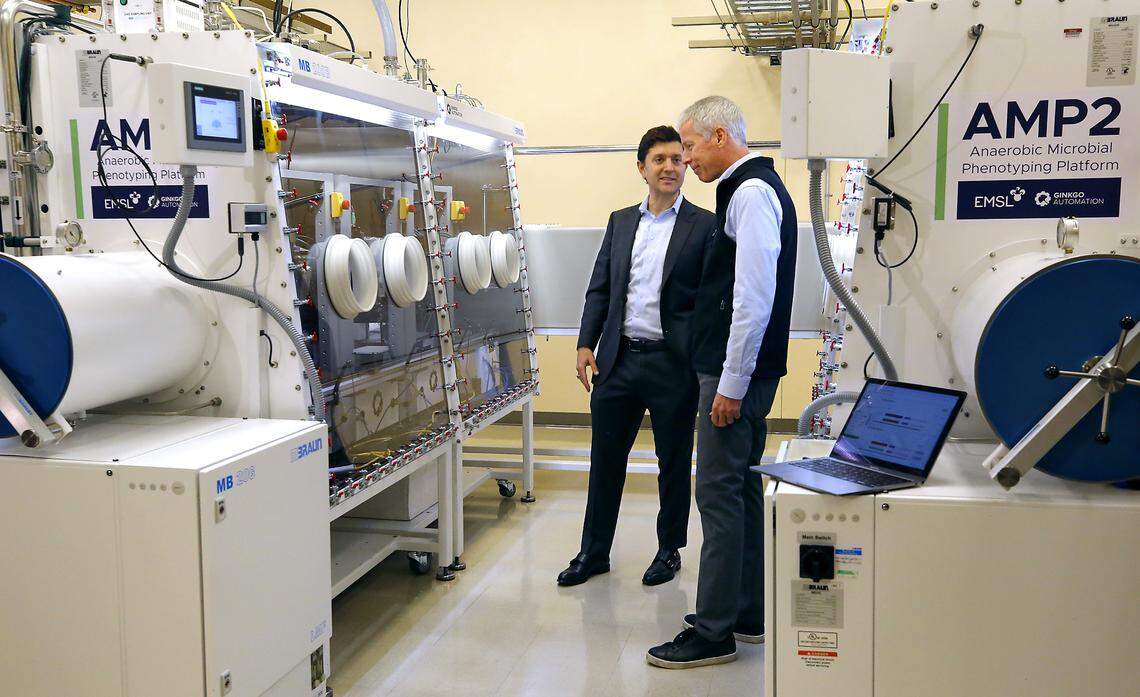
The tools in AMP2 and M2PC will enhance scientists’ work, not replace them, he said.
“This is about much more than simply making current processes more efficient,” said Mans, who brought the concept of a large-scale autonomous laboratory to EMSL when he became its director in 2019.
“Automation and AI are vehicles for true scientific innovation,” he said. “We can perform many more experiments and lead to new insights that we cannot even image.”
In addition to commissioning AMP2 Thursday, Wright also toured PNNL as part of his commitment to visit all 17 national labs in 2025. He was accompanied by Rep. Dan Newhouse, R-Wash., to what was the 16th national lab he toured before completing his visits with a tour of Idaho National Laboratory next week.
This story was originally published December 6, 2025 at 5:00 AM with the headline "$47M for new Richland lab. It will harness AI for faster scientific discovery."