
It’s mushroom season in WA. How to tell true morels from deadly fakes
It’s peak mushroom season in the Pacific Northwest.
Various mushrooms grow across Washington state, and the U.S. Forest Service allows individuals to gather up to five gallons per day for personal use for free.
While the popular morel mushroom grows abundantly in the Pacific Northwest, so does its deadly cousin, the false morel.
Here’s how to tell the difference:
What morel mushrooms grow in Washington state?
While there are multiple morel varieties, most can be categorized as black morels or yellow morels, according to mycologists.
Most of the species found in the Pacific Northwest are black morels, according to Danny Winkler in his book “Fruits of the Forest: A Field Guide to Pacific Northwest Edible Mushrooms.”
Experts note a few differences between the two categories:
- Black morel caps darken over time
- Black morels are typically found in recently burned areas and around tree species like ash, black cherry, aspens and cottonwood
- Yellow morels are often found around living ash, dead elms, sycamore and apple trees
- Yellow morels can grow larger than black morels, and are often more globular
Yellow morels, also known as blonde morels, are more often found on the East Coast, while black morels are fairly common on the West Coast.
How to identify black morel mushrooms
Both black and yellow morels can be consumed and are considered quite tasty.
The mushrooms must be cooked thoroughly and properly or else they can cause digestive problems, nausea and other symptoms, according to experts.
Black morels, or Morchella elata, are cone-shaped mushrooms with irregular brownish pits. The pits are arranged vertically with rough parallel grooves.
The mushroom’s cap can be up to 2.5 inches tall and 1.25 inches wide, Guillaume Eyssartier writes in “The Ultimate Guide to Mushrooms.”
Black morel stems are cream-colored and entirely hollow. An easy way to identify which fungus you’ve picked is cutting the mushroom in half, as only true morels have hollow stems.
The semi-fragile mushrooms have a faint odor and a sweet flavor.
They thrive on decaying plants and dead organic material such as branches, according to Washington State magazine.
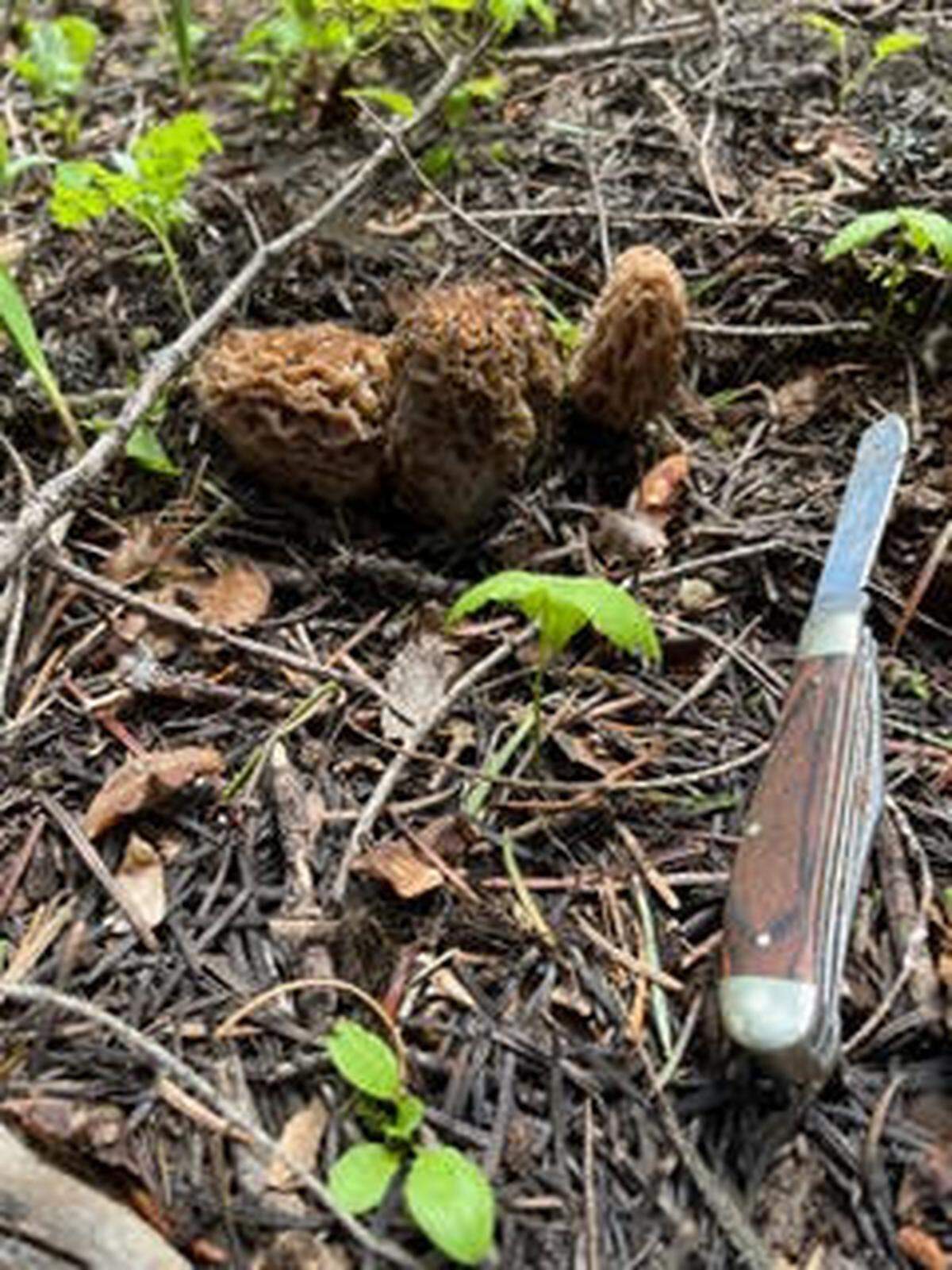
What do yellow morel mushrooms look like?
While less common, yellow morels — sometimes called blonde morels — can also be found in the Pacific Northwest.
The yellow varieties are often globe-shaped with deep, uneven pits.
The cap can grow up to 2.75 inches tall and wide, and may appear beige, yellowish-brown or tinted red.
According to mycologists, the yellow morel’s stem is entirely hollow, cream-colored and smooth.
Yellow morels have semi-fragile, thin skin as well as a faint odor and sweet flavor.
How to tell a false morel from a real morel
Make sure you’re absolutely positive about which mushroom you’ve harvested before taking it home.
Mushroom foraging is a learned skill, and making a mistake while foraging for fungi can be a matter of life and death.
Morel species are often confused with false morel species.
In Washington state, the most common false morel is the Gyromitra esculenta. These mushrooms have marbled stems with pits and flesh, rather than the morel’s signature hollow stem.
The cap of this false morel also looks slightly different, with more of a brain-like appearance than a true morel’s misshapen honeycomb look.
Certain false morel varieties can be poisonous.
“Morels resemble other closely related species frequently found in similar habitats,” the U.S. Forest Service said. “These run the gamut from choice to deadly poisonous, so learning to identify true morels from ‘false’ morels is critical.”
If you’re unsure about a mushroom’s cap and can’t tell if it’s a real or false morel, cut it in half from top to bottom.
“Both the stalk and cap should have enough of a void that you could almost stick one on every digit like finger puppets,” Frank Hyman wrote in the book “How to Forage for Mushrooms Without Dying.”
Hyman offers an easy mnemonic device for remembering the key identification between morels and false morels: “If it’s hollow, you can swallow.”
Why are fake morel mushrooms dangerous?
False morel mushrooms contain a toxic substance that can affect “your body’s mucus membranes and digestive system,” according to health information website WebMD.
“Heating removes the neurotoxin from these mushrooms and turns it into a gaseous form,” WebMD said. “This means that if you cook false morels in a small, poorly ventilated space, you can inhale enough neurotoxin to get sick.”
Although careful cooking might remove traces of the poisonous substance, “even slightly undercooking the mushrooms” could make you ill, WebMD said. “Be on the safe side — never cook or eat false morels.”
Tips for foraging mushrooms in Washington state
Mycologists recommend learning about mushroom identification and foraging techniques with experts.
Mushroom clubs and mycological societies can be found across Washington state. They meet often during peak mushroom season and hold forays to look for mushrooms as a group.
The South Sound Mushroom Club does not recommend using apps for identification, as they often incorrectly identify mushrooms.
Using guide books or reputable websites can help get you started, but don’t rely just on those resources.
No matter how experienced you are, it’s important to follow this maxim: “When in doubt, throw it out.”
What should I do if I ate a poisonous mushroom?
Symptoms can set in hours after ingesting a poisonous mushroom.
According to UC Davis Health, less toxic mushrooms can cause nausea and vomiting within six hours of ingestion.
More dangerous species can cause similar symptoms more than six hours after ingestion.
If you or someone you know thinks they’ve been poisoned by a mushroom, call poison control at 800-222-1222 or go to your local emergency department.
Save an uncooked sample of the consumed mushroom, or one from the same batch.
This story is an updated version of a previous article.