
Gray wolves are making a comeback in all but one area of WA. Will that change?
AI-generated summary reviewed by our newsroom.
- Washington’s year-end wolf count for 2025 rose 17.4% to a minimum of 270 wolves.
- State report recorded 23 breeding pairs and 49 packs in Washington in 2025.
- Reported wolf-livestock depredations fell to 17 in 2025 from 54 in 2024.
Washington’s gray wolf population is making a comeback, according to a new state report.
On Friday the Washington Department of Fish and Wildlife (WDFW) announced that the state’s year-end wolf count for 2025 climbed by 17.4%, according to the Washington Gray Wolf Conservation and Management Annual Report. It rose to a minimum of 270 wolves — the highest level yet — plus 23 breeding pairs and 49 packs.
This comes after a drop the prior year, which saw 230 wolves, 18 breeding pairs and 43 packs, per the report from WDFW, tribal partners and the U.S. Fish and Wildlife Service.
Wolves are counted each year by WDFW via track, aerial and camera surveys, according to WDFW. Because it’s hard to tally every animal, the results feature minimum wolf counts linked to packs plus 12.5% for lone wolves and dispersers, which are wolves that leave to find a mate or form new packs.
Kristin Botzet with the Defenders of Wildlife advocacy organization said that annual reports help monitor the animals’ progress in recovery.
“It’s always exciting to see when you have growth,” she said in a Monday call.
Washington isn’t the only state with optimistic new wolf-population numbers. Oregon’s fish and wildlife department late last week also published a report showing that that state saw a wolf-count bump of 13% in 2025 over the previous year.
Wolves are a native species to Washington, Botzet said, but by the mid-1930s, they’d been wiped out. Reasons included overhunting and certain programs to eliminate them.
In 1980, wolves were classified as endangered under state law.
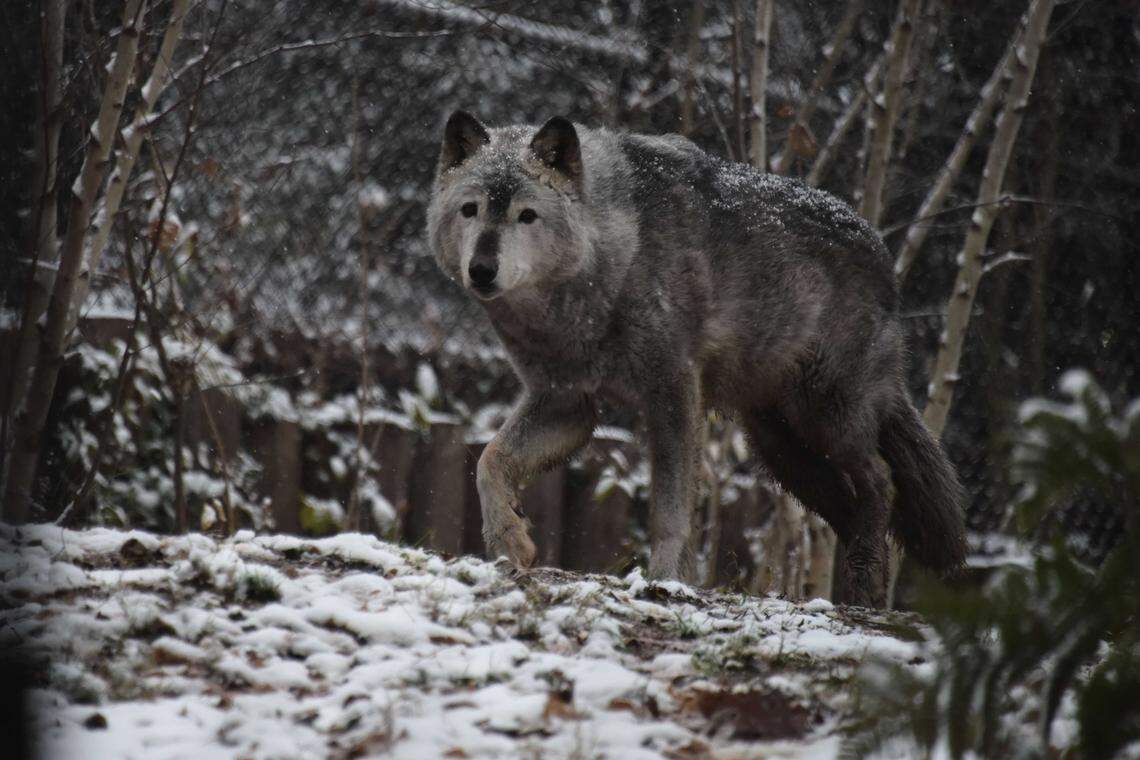
Then in the late 20th century, following better wildlife-management practices across the U.S., wolves began making a return, Botzet said. Starting in 2008, Washington saw its first established pack.
Gray wolves’ population is mainly concentrated today in the eastern part of Washington, per the Defenders of Wildlife. Despite the state’s progress, there’s still work to do in reaching the recovery aims in the state’s conservation and management plan from 2011, which, in part, set targeted population numbers.
While two of the plan’s recovery zones, the Northern Cascades and Eastern Washington regions, have achieved their recovery objectives, the third — called the Southern Cascades and Northwest Coast region — has not, Botzet said.
She explained that the last region, which includes the Tacoma and Olympia areas, logged at least one wolf-dispersal event last year. To her that was good news: Even though the wolf didn’t stick around, it showed that the animals can make it to that region, which is the remaining area in the state still needing to meet full recovery.
It’s been difficult for wolves to get established in the Southern Cascades and Northwest Coast region, she said, adding that poaching is a pretty major problem.
Botzet also takes the recent increase in the Northern Cascades region’s breeding pairs as a sign of hope for the southern zone. Young wolves in the north will likely hit the point that they’ll begin to scope for new territory to establish, she said.
“So that means that we’re probably going to see more dispersal events in the future to that southern region,” Botzet said.
Washington has also witnessed a decline in reports of wolf-livestock depredation: just 17 last year compared with 54 in 2024, the Defenders of Wildlife said in a news release. Depredation means when predators, including wolves, injure or kill domestic animals.
In 2025, WDFW logged 14 collared wolves that dispersed from their pack territories and 17 depredation events, which involved five of 49 packs.
“That leaves 90% of known packs that were not involved in any known depredations in 2025 (including probable depredations) despite most pack territories overlapping livestock operations on both public and private lands,” WDFW wolf biologist Trent Roussin said in an April 17 news release.
This story was originally published April 21, 2026 at 5:00 AM with the headline "Gray wolves are making a comeback in all but one area of WA. Will that change?."
.jpg)