
WA residents lost more than $18M to imposter scams in 2025. How to spot fraud
Falling for a scam can come with significant financial loss.
Clicking on the wrong link or trusting the wrong caller can expose your personal information — and drain your bank account.
How much money has been lost to scammers in Washington state? And which age groups are more likely to fall victim to fraud?
Here’s what you should know:
What is an imposter scam?
According to the Federal Trade Commission, an imposter scam consists of a scammer pretending to be someone they’re not in order to trick people into giving them money, access to their financial accounts or personal information.
“Scammers often pretend to be from a business you know or from a government agency — or both,” the Federal Trade Commission said. “They try to gain your trust and get you to believe they are who they claim to be.

How much money do Americans lose to fraud?
A recent study by financial investment platform BrokerChooser looked at fraud reports in 2024 and 2025 to see which states and age groups are more likely to fall victim to fraud.
In 2025, Americans lost $800 million to imposter scams, according to the BrokerChooser report.
These people most often fell for scammers posing as officials belonging to government agencies such as the Social Security Administration, the Internal Revenue Service and the U.S. Department of Health and Human Services, the investment platform said.
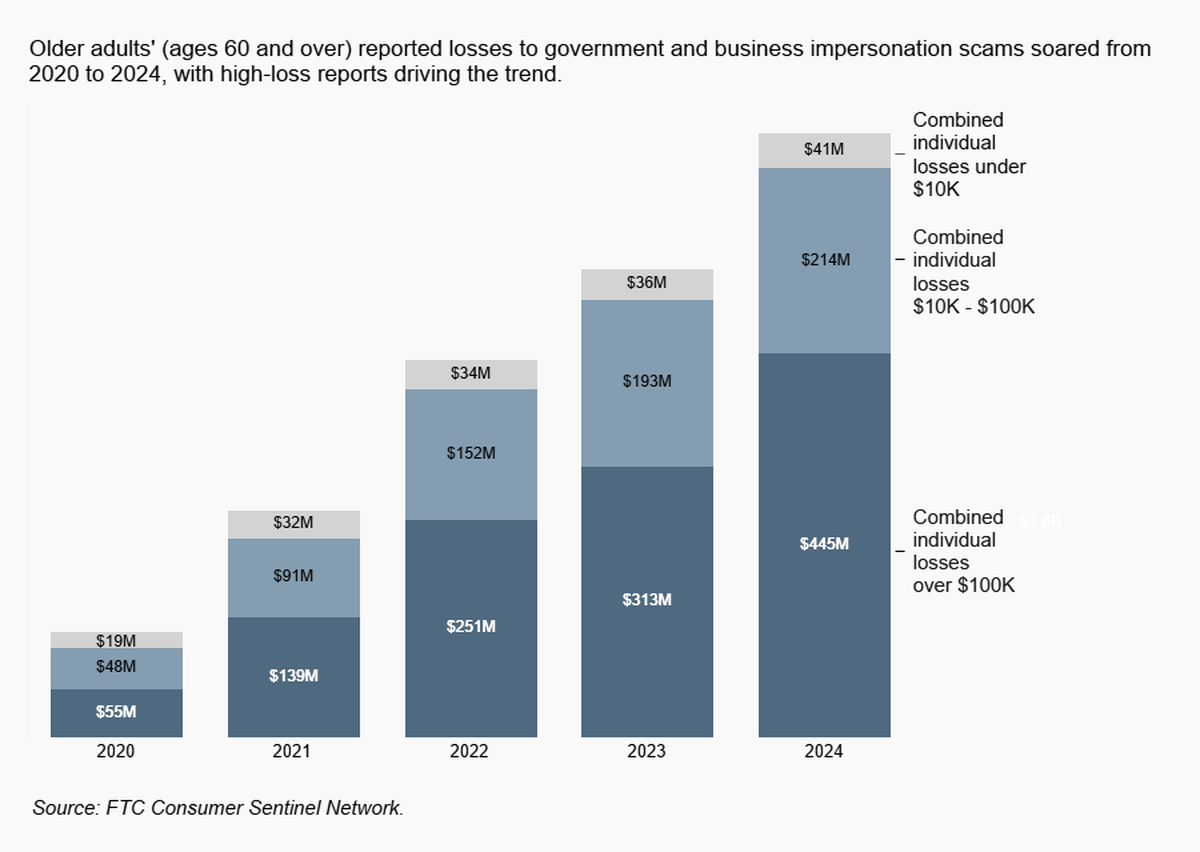
According to BrokerChooser, total fraud losses among Americans over the age of 60 have increased 400% since 2020. The majority of cases involved business imposter scams.
Scams targeting family and friends increased by more than three times from 2024 to 2025.
How often are Washington state residents targeted by scams?
Washington state ranks sixth in the nation in terms of the states most targeted by imposter scams, according to BrokerChooser.
Scam victims in Washington state lost $2,204 to scammers on average, according to BrokerChooser.
Although Delaware topped the list of states targeted by scammers, Arizona residents saw the highest losses to fraud — losing an average of $3,587.
Are imposter scams increasing in Washington state?
In Washington state, there were 1,091 imposter scam reports per every million residents in 2025, resulting in total losses of more than $18.6 million, according to BrokerChooser.
Imposter scams in the Evergreen State decreased by nearly 12% compared to 2024, when there were 1,222 scam reports per every million residents.
In 2024, Washington residents lost about $21.1 million to imposter scams, the BrokerChoser study found.
Which age group is most likely to fall for imposter scams?
Across the country, boomers were hit the hardest by imposter scams, according to BrokerChooser.
Americans ages 60 to 79 lost $361.8 million in total to scammers in 2025, accounting for more than 46% of all imposter scam losses, the financial investment platform found.
“Imposter scams are spiraling across the US and the signals are getting increasingly subtle, with AI enabling scammers to mimic voices, emails and websites easily,” said Adam Nasli, BrokerChooser’s head broker analyst. “Older Americans are especially at risk, with our research showing a clear trend of scammers largely targeting retirees’ life savings.”
In August 2025, the Federal Trade Commission reported that scammers are stealing older adults’ life savings, with losses increasing dramatically. “Reports to the FTC show a growing wave of scams aimed squarely at retirees’ life savings,” staff with the Division of Consumer Response and Operations wrote. “These scammers pretend to be from known and trusted government agencies and businesses.”
The commission said scammers “use fake security alerts and other false alarms to prey on older adults’ vigilance about protecting their money and identity to steal from them.”
What kinds of imposter scams are most common?
According to the Federal Trade Commission, common types of imposter scams include scammers impersonating:
- Government organizations including the IRS and Social Security Administration
- Local court systems, such as jury duty summons
- Law enforcement agencies including police departments and sheriff’s offices
- Businesses including fake job recruiters, package delivery scams and prize scams
- Family members and romantic partners, such as fake family emergencies and catfishing scams
Additionally, Nasli said, scammers are increasingly targeting trading accounts, impersonating financial advisors, brokers and platform support agents.
“If anything feels off, step back and contact your broker directly to stay protected,” Nasli said. “Always use regulated brokers registered with the (Commodity Futures Trading Commission).”
How to spot an imposter scam
The Federal Trade Commission shared some “sure ways to spot a scammer” and save yourself from financial strife.
“Scammers say and do things that can tell us they’re lying — and they’re not who they pretend to be,” the commission said.
Scammers typically start by claiming that someone is using your account, your information is being used to commit crimes or there are security problems or other issues needing immediate attention.
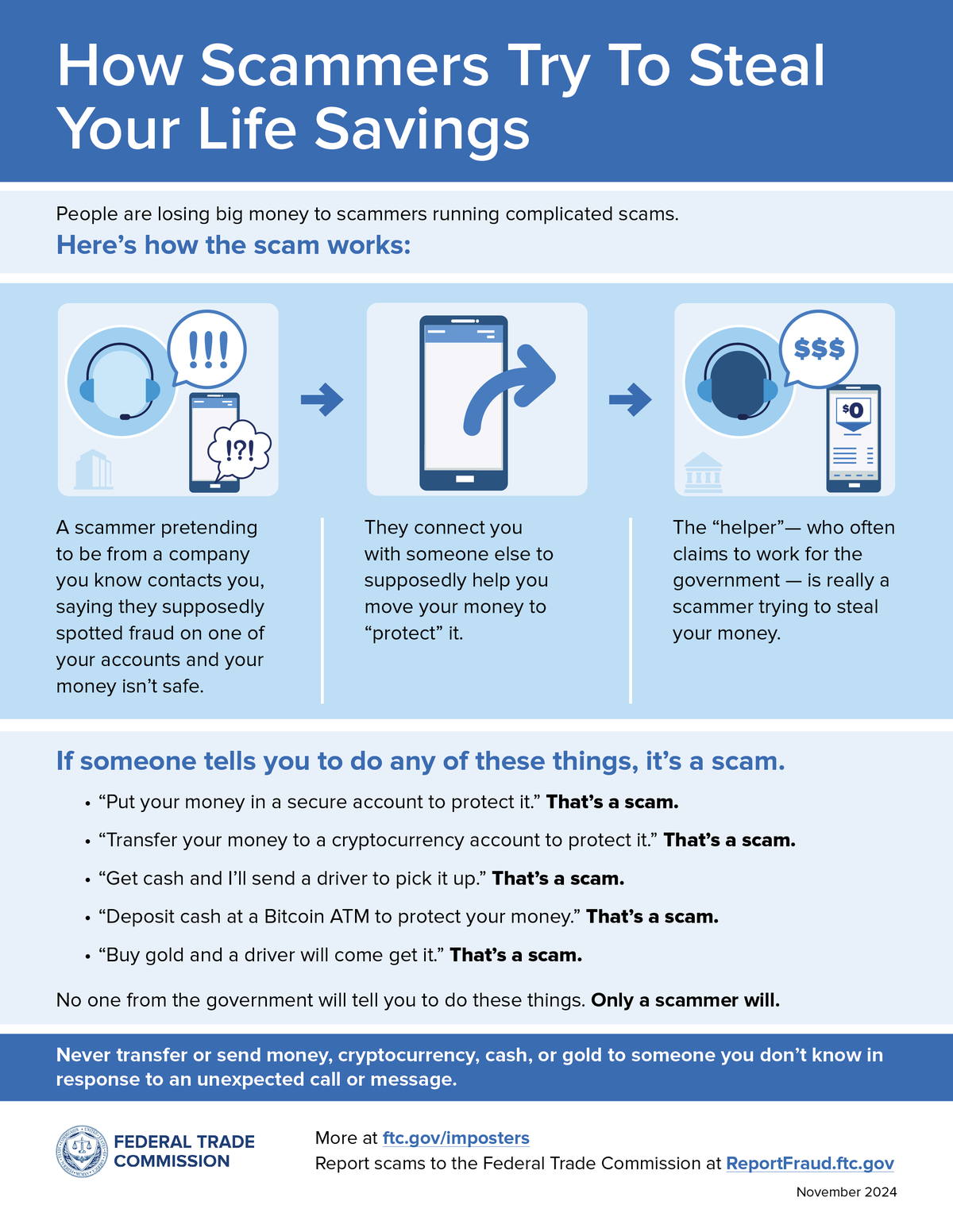
The scammers often claim the only way out of the situation is to follow their instructions, which end in sending them money or information.
One of the most consistent signs of a scam is high pressure, with people claiming you have to act immediately, can’t hang up the phone or can’t trust the people in your life.
Rarely will a trusted organization call out of the blue with an immediate need for sensitive information.
“Imposters often demand immediate action, threaten account freezes or insist you transfer funds to ‘secure’ your assets, hoping to cloud judgment with panic,” Nasli said. “Always pause and verify the request directly with official channels, and never hand over personal information to make transfers on the spot.”
What are signs that I’m being scammed?
The Federal Trade Commission lists several signs of imposter scams:
- Instructions to lie or say specific things
- Claims you’ll be arrested, fined or otherwise punished if you don’t do what they say
- Trying to keep you from hanging up
- Saying you need to move your money to protect it
- Instructions to withdraw cash and give it to a specific person or bank account
- Instructions to go to a Bitcoin ATM
- Instructions to buy gift cards
“If you see or hear any version of any of these phrases, you’ve just spotted a scammer,” the commission said. “Instead of doing what they say, stop. Hang up. Delete the email. Stop texting. Block their number — anything to get away from them.”
A familiar caller ID or specific employee information such as a real name or identification number are not substantial enough evidence to trust an unexpected caller. The scams are believable for a reason.
Make sure you do not click links or call numbers from unexpected messages. Always verify any claim of an urgent issue by contacting the organization directly, through numbers, websites or emails you know and trust already.
Links from scammers may look extremely close to the real thing, with minor changes meant to fool you, so look carefully.
Bank of America recommends inspecting URLs to ensure there is an S in the “https.”
Additionally, the Federal Trade Commission has call blocking options to keep scammers from reaching you.
If someone calls saying there’s a problem with your identity or any of your accounts, experts say, you should talk about it with someone you trust.
It’s important to remember you have rights and protections — even if you owe debt, missed jury duty, had your identity stolen or experienced another issue.
How can I report an imposter scam? Elder fraud?
Report scams to the FTC using ReportFraud.ftc.gov.
Additionally, the U.S. Department of Justice has a National Elder Fraud Hotline.
The hotline, which is available 10 a.m. to 6 p.m. Monday through Friday, provides services to adults 60 and older who may be victims of financial fraud.
Call the hotline at 833-FRAUD-11 or 833-372-8311.
The hotline is staffed by case managers that provide support by assessing a caller’s needs and identifying their next steps.
Staffers doesn’t investigate scams, but assist victims by identifying additional reporting agencies and assisting with forms and consumer complaints.