Washington is slipping toward deep, dark winter. Here’s how much daylight we lose each day
Remember waking at the start of October and being able to throw open your curtains to a ray of sunshine as early as 7 a.m.? Or how about when you get home from a busy day and enjoyed the outside sun until as late as 6:45 p.m.?
Hold on to those memories. By the end of October, that’s all they’re going to be.
As the days tick on from the autumnal equinox, when the sun sits directly above the equator, the days become shorter than the nights. The angle of the Earth in relation to the sun means the Northern Hemisphere sees less daylight as we slip toward the winter.
October is the month with the most drastic loss of daylight and dipping temperatures, according to Carly Kovacik with the National Weather Service in Seattle.
But just how fast are we losing sunlight? Probably more quickly than you imagine.
October: the most dramatic month of fall
October witnesses the fastest decrease in daylight of any other month as we move past the autumnal equinox, which was on Sept. 22.
As the sun crosses the equator southward, it takes slightly longer to rise and slightly quicker to set each day as the axial tilt points the Northern Hemisphere away from the sun’s rays.
The transition is fastest during October because directly after the equinox, the tilt causes the sunlight that hits a region to decrease more rapidly than in the dead of winter. The sun is positioned at one end of the spectrum during the summer and winter solstices, when the days are either longest or shortest, respectively, and therefore the change in daylight isn’t as drastic.
“As you start to get over and towards the equinoxes it can change a bit, because we’re not pointed directly away or towards the sun at that point,” Kovacik told McClatchy News. “So there’s a lot of change going on.”
So how much daylight do we lose per day?
On Oct. 1 in Washington, the sun rose at approximately 7:08 a.m. and set at 6:48 p.m., for a total of 11 hours and 40 minutes of daylight.
On Oct. 31, the sun will rise around 7:51 a.m. and set at 5:54 p.m., totaling just 10 hours and 2 minutes of daylight, nearly a 90-minute difference.
On average, Washington loses around 3 minutes of daylight per day in October. Compared to December, when the winter solstice occurs, the difference in daylight from the start of the month to the end is approximately 12 minutes.
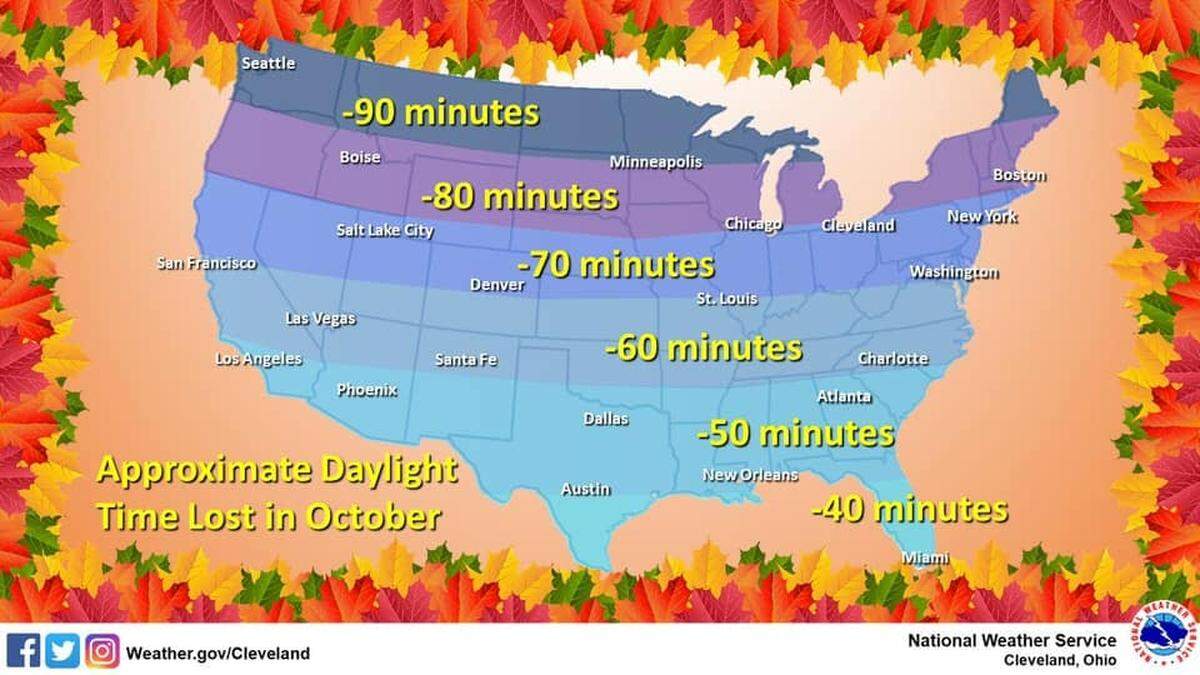
The dramatic decrease in daylight in October also coincides with a quick decrease in temperature, Kovacik said.
“As we start to get into the fall, the nights are growing longer. So don’t have as much sunlight. So you’re going to start to see larger temperature swings. From day and night, versus if you’re in the winter, you don’t get much direct sunlight at all. So there’s not much room for the temperature to increase. So you don’t really get as many wild swings.”
The same phenomenon regarding daylight and temperature can be flipped for April each year, shortly after the spring equinox: The days get longer more quickly, and the temperature increases most dramatically during April.