A supermoon? And three planets? It’s all going to be visible above Washington this weekend
The final supermoon of 2023 will shine bright above Washington on Friday evening, accompanied by a few special companions: Jupiter, Saturn and Mercury.
The celestial event, called the Harvest Supermoon, is the fourth and final supermoon of the year. It’ll rise at 7:12 p.m. on Friday in western Washington, such as Tacoma, Olympia and Bellingham, according to Time and Date, which will be the best time to spot the moon when it appears largest. It’ll rise slightly earlier in eastern Washington, such as the Tri-Cities area, were the moon will appear on the horizon at 7 p.m.
The Harvest Moon is unique in that it isn’t related to a specific month, unlike other moons. The Harvest Moon is whichever full moon occurs closest to the autumnal equinox on Sept. 23, according to the Old Farmers’ Almanac, which means the Harvest Moon could happen in October.
The Harvest Moon earned its name because, before electricity, farmers would rely on the moonlight to harvest later into the evening than usual. It earns the distinction of a supermoon because it’s near its closest approach to Earth, according to NASA, which is about 226,000 miles.
Tri-Cities residents may have to be patient to spot Friday night’s moon, with the National Weather Service forecasting a 30% chance of showers on Friday night, while western Washington can expect clear skies.
What is a supermoon?
The term “supermoon” was first used in 1979 by astrologer Richard Nolle, according to NASA. Nolle used the term to describe either a new or full moon that occurs when the moon is at its closest approach to Earth.
Because it will be closer to Earth than most full moons, the harvest moon will likely appear 10% to 11% larger in the sky, according to Space.com, though the difference may not be evident to casual observers without telescopes.
It’ll look even larger when closer to the horizon due to a phenomenon called the “moon illusion.”
“For reasons not fully understood by astronomers or psychologists, a low-hanging moon looks incredibly large when hovering near to trees, buildings and other foreground objects,” Space.com states. “The fact that the moon will be much closer than usual on Wednesday will only serve to amplify this strange effect.”
When will the planets be visible?
Saturn, Jupiter and Mercury will also feature in the night sky over the weekend, with all three planets visible on Saturday night.
Saturn will be the first planet to rise, around 5:45 p.m. on Saturday, meaning it’ll appear in the sky over an hour before the moon, according to Space.com. It’ll be visible from Washington by looking toward the southeast, or upward and to the moon’s right, in the Aquarius constellation. The stars in Aquarius are relatively faint, making Saturn easy to see.
Jupiter will be next, rising around 8:15 p.m., about an hour after the moon has appeared on the horizon. Jupiter will appear to the moon’s left in the Aries constellation, which is also a faint constellation, making Jupiter easier to spot.
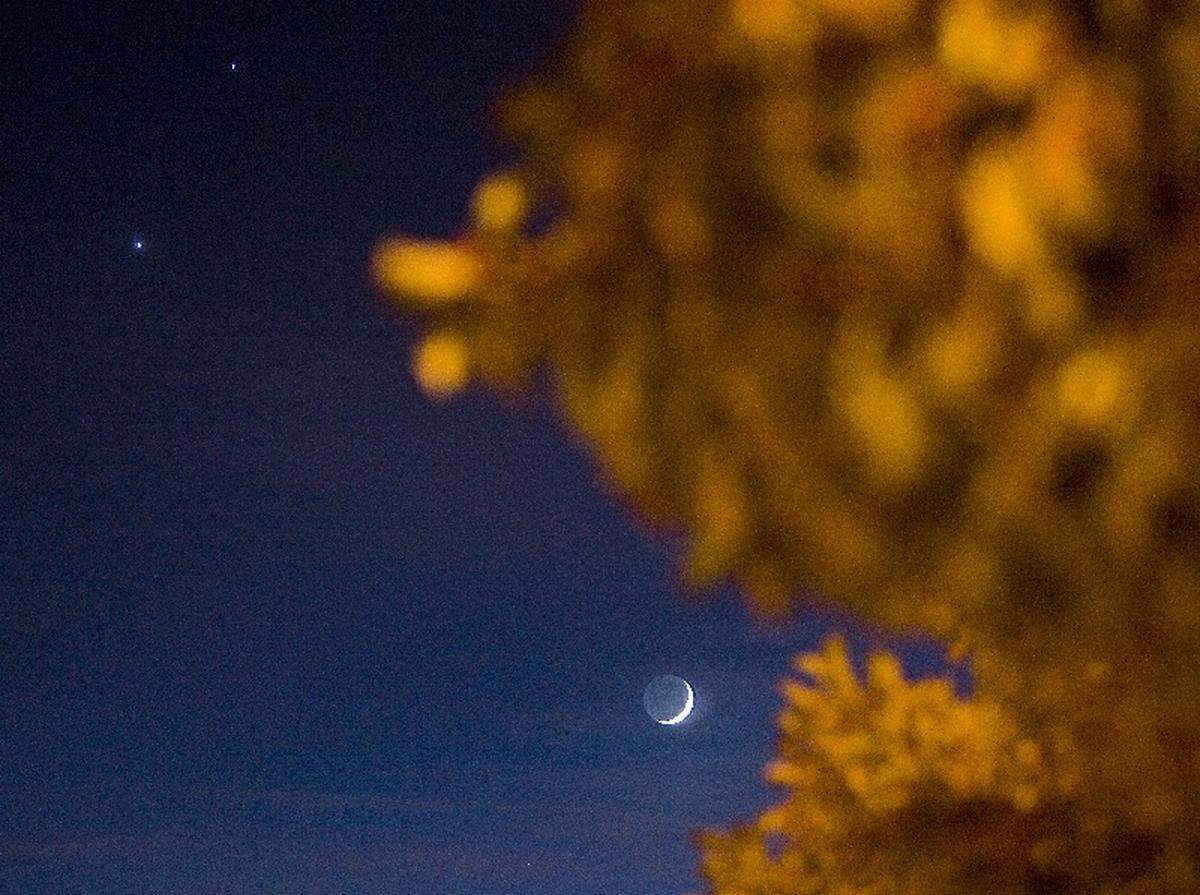
Lastly will be Mercury, which won’t be visible until 5:45 a.m. on Sunday. Mercury will be tougher to see due to its small size and proximity to the sun and will only be viewable alongside the Harvest Supermoon for about an hour.
More full moons in 2023
Here’s when to see more full moons in 2023, with information from Space.com:
Oct. 28: Hunter’s moon
Nov. 27: Beaver moon
Dec. 26: Cold moon
This story was originally published September 28, 2023 at 9:56 AM.