October solar eclipse to darken Washington skies. Here’s what to know about historic event
When the sky turns dark, and the sun becomes an ominous, burning “ring of fire” later this month, don’t worry; the apocalypse isn’t upon us.
It’s a rare annular (or ring-shaped) solar eclipse and will darken the skies across the United States on the morning of Oct. 14. It’s the first annular solar eclipse in the United States since May 2012 and the first solar eclipse of any sort in the U.S. since the total eclipse in 2017.
But what is an annular solar eclipse, and what will it look like from Washington?
What is an annular solar eclipse?
There are three main kinds of solar eclipses, but first, what exactly is a solar eclipse, and what causes it?
A solar eclipse happens when the Earth, moon and sun align so that the moon sits in the middle of the three, at least partially blocking the sun from the point of view of a person on Earth.
The moon creates a shadow on Earth, often hundreds of miles wide, which is called the path of totality, according to NASA’s description. Within this path is where the moon appears to block the sun completely, resulting in the most darkness. But you don’t have to be within the pass to see an eclipse; you just won’t be plunged into nighttime-like darkness.
The most well-known type of eclipse is a total solar eclipse, where the moon completely blocks the sun. This type of eclipse happened in 2017 when the path of totality passed through northern Oregon.
A partial eclipse is just what it sounds like — the Earth, moon and sun don’t align perfectly, meaning that when the moon crosses between the Earth and sun, it makes the sun momentarily look like a crescent.
The third kind, an annular solar eclipse, will happen this month. An annular eclipse, according to NASA, is when the moon lines up perfectly between the Earth and the sun, but it’s too far away from Earth, meaning, from our point of view, it doesn’t entirely eclipse the sun.
Instead, the moon will align perfectly with the sun for those in the path of totality, but a “ring of fire” will glow ferociously around the dark moon.
Can you see the annular eclipse from Washington?
All of North America will experience the solar eclipse to some degree, but Washington is especially close to the path of totality. Area residents will be able to enjoy some of the more spectacular views.
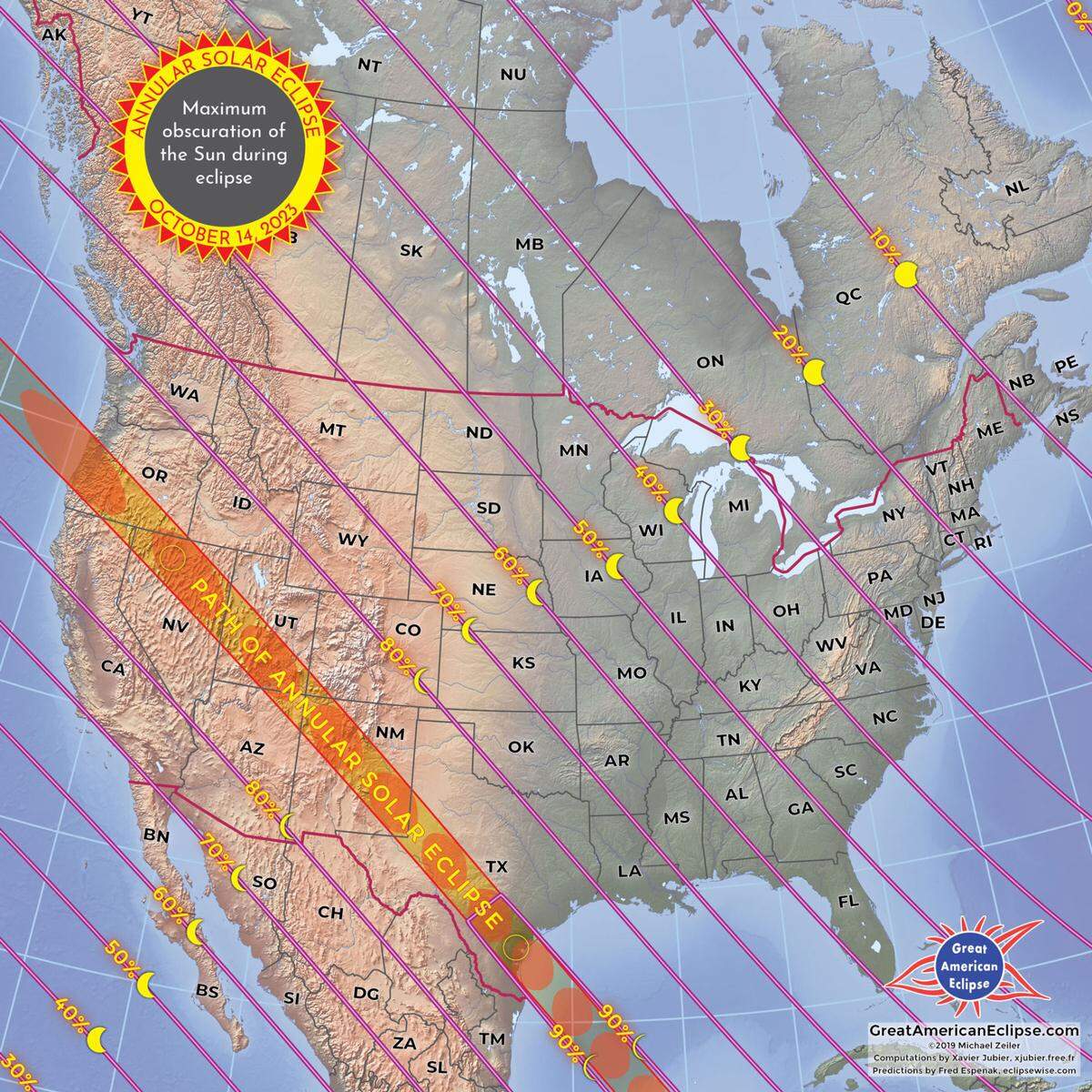
The path of totality starts on American soil in western Oregon before traveling on a southeast route through northern Nevada and into Utah. Those in the path of totality will see about 91% of the sun blocked at the peak of the eclipse, according to Space.com, with the 9% being the ring of fire around the outer edge.
The partial eclipse in Oregon will start at about 8:05 a.m. Pacific Time, with the annular eclipse beginning at 9:16 a.m. PT and lasting for about three-and-a-half minutes. Once the annular eclipse ends, a partial eclipse will continue until 10:39 a.m. PT, by which time the moon would’ve moved entirely past the sun.
For those wanting to remain in Washington for the eclipse, it won’t be as magnificent as it would look within the path of totality, but it’ll be pretty close.
Washington will see about 81.2% of the sun blocked out, with a partial eclipse starting at 8:09 a.m. The annular eclipse will reach its max for Washington at 9:20 a.m. and last for several minutes before fading into a partial eclipse, lasting until 10:39 a.m.
Forecasting weather almost two weeks out is often tricky for meteorologists, but early predictions for Washington on Saturday, Oct. 14, are cloudy with rain statewide.
When is the next eclipse after October?
If you miss the eclipse this month — or the weather doesn’t cooperate — the next eclipse in the United States will be a total solar eclipse in April 2024.
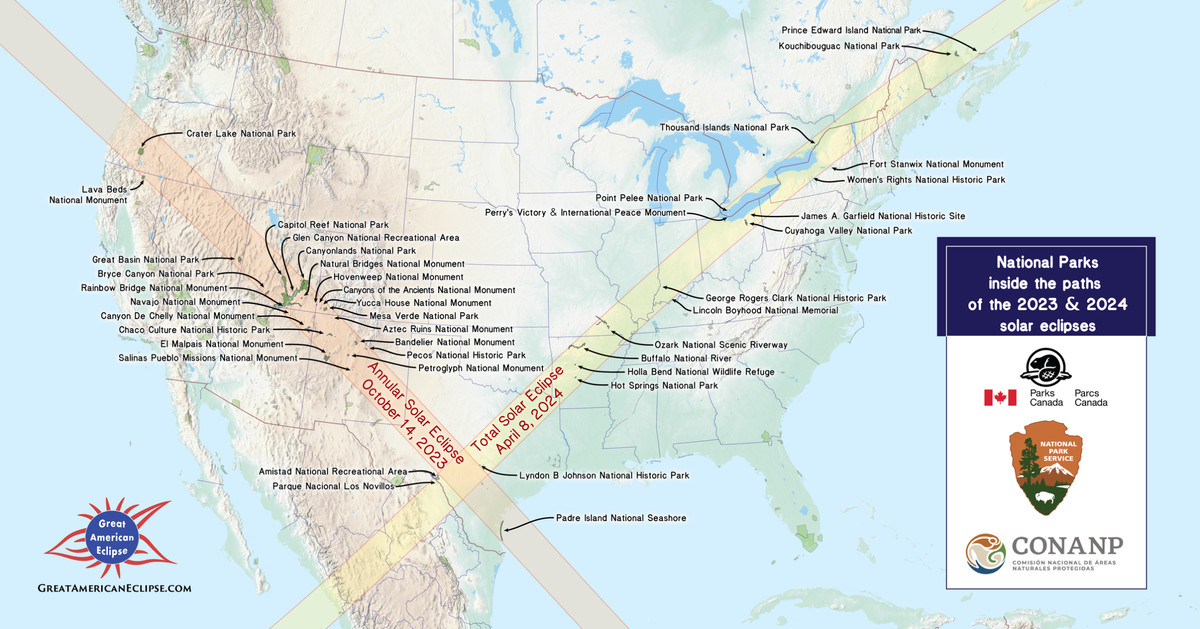
Unfortunately, the path of totality for that eclipse won’t come anywhere near Washington. It’ll enter the United States through the Mexico-Texas border and travel northeast, through Arkansas, Missouri and into the northeast U.S. Instead, it’ll be viewable as a partial eclipse for most of the northwest, including Washington, according to Time and Date.
Most of the United States will also see two lunar eclipses in 2024. A lunar eclipse occurs when the Earth passes between the sun and the moon, causing the moon to turn red. The first will be on March 24-25, and the second on Sept. 17-18.
This story was originally published October 3, 2023 at 5:00 AM.