The Pineapple Express is hitting the West Coast ... again. Here’s how hard it’ll hammer WA
Western Washington could be in for several torrential downpours starting Friday night and lasting into next week.
An atmospheric river, also known as a Pineapple Express, from the Pacific Ocean is aiming right at the United States’ west coast, bringing heavy rainfall to Washington, Oregon, and California.
A similar weather phenomenon occurred in Washington in early December 2023 when Puget Sound had approximately 6.5 inches of rainfall from Dec. 1 to Dec. 10.
“It’s probably going to be more like a series of three (rain events), heading into early next week,” Maddie Kristell, a meteorologist with the National Weather Service in Seattle, told McClatchy News. “We’re expecting round one to arrive later (Friday) afternoon into this evening, along the Olympic Coast first and spreading inland overnight, so it will probably be a wet overnight period.”
Kristell said the rain will continue through Saturday before breaking on Sunday. The second round will occur on Monday, and the final round of rain will be Tuesday into Wednesday.
What is an atmospheric river?
An atmospheric river is a long, narrow region in the atmosphere that transports large amounts of water vapor, according to the National Oceanic and Atmospheric Administration. The average atmospheric river carries enough water vapor equal to the average flow of water at the mouth of the Mississippi River, with all of that moisture falling as rain or snow when it reaches land.
Atmospheric rivers originating from the Hawai’ian Islands, such as the one hitting the west coast this weekend, are nicknamed the Pineapple Express.
Weather Service meteorologist Kirby Cook previously described the atmospheric river as a fire hose pointed right at the Pacific Northwest.
How much rain is expected?
While it’s too early to forecast rainfall totals for the latter half of the event, Kristell said the Puget Sound area can expect half an inch to an inch of rain from the first round that arrives Friday afternoon.
The southern slopes of the Olympic Mountains can expect 2 to 4 inches from the first round, Kristell added.
“The tricky thing about estimates going forward is that the direct trajectory of the atmospheric river plume itself seems to be moving a little bit,” Kristell said. “And even slight movements can have big implications for our rain amounts.”
Kristell said that the latest models show the trajectory of the atmospheric river moving slightly northward, which would result in more rain for western Washington.
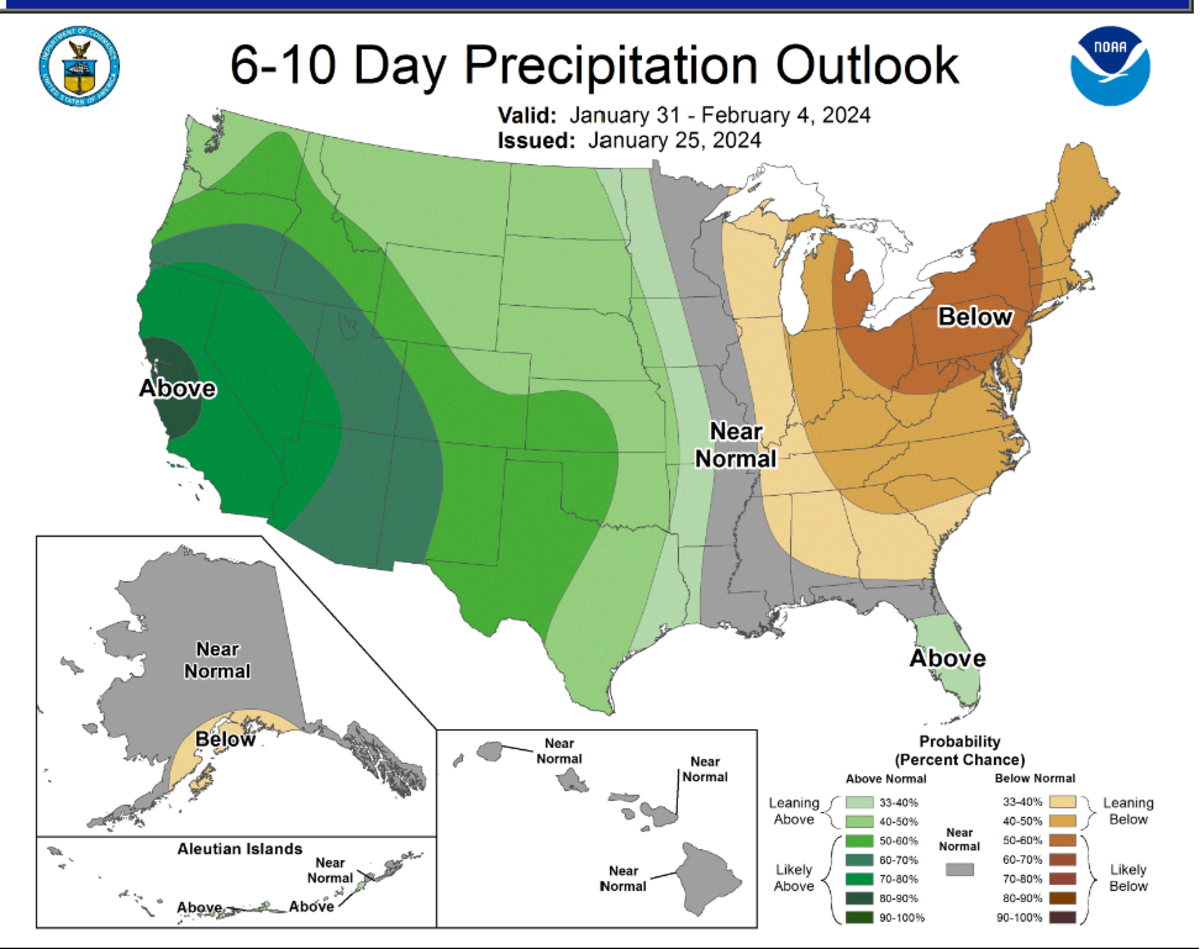
The Climate Prediction Center, a forecasting tool run by NOAA, predicts that western Washington will have a 40-50% chance of higher-than-average precipitation in the next 6-10 days.
What will temperatures be like?
If there’s one silver lining for Washingtonians, the atmospheric river will bring warmer temperatures.
The high temperature in the Puget Sound region on Friday is 48 degrees, a couple of degrees above the average for January. By Sunday, the high will be 59 degrees.
“We definitely will see temperatures coming up,” Kristell said. “And we just tend to see that with atmospheric river events. The air mass that they’re coming in with does tend to be warmer.”
Warmer temperatures will cause snow levels in the Olympic and Cascade Mountains to jump to about 7,000 to 8,000 feet, Kristell said. For reference, the peak of Mount Olympus, the highest point of the Olympic Mountains, stands at 7,980 feet.
This story was originally published January 26, 2024 at 10:53 AM.