2 full moons, meteors will shine in the sky above WA in May. When to look up
For night sky watchers in Washington state, May offers a “once in a blue moon” opportunity.
The full moon will both welcome and bid farewell to the month of May, according to NASA.
Stargazers may also be able to spot a meteor shower in the sky above.
Here’s when to look up:
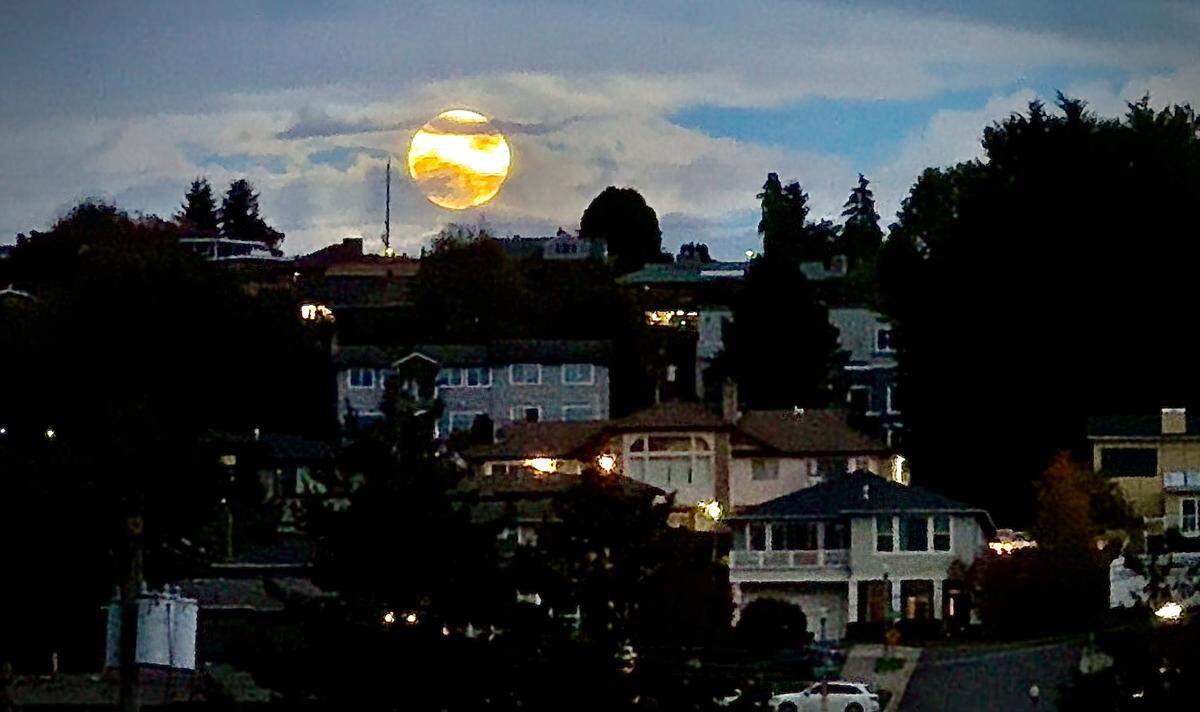
When to watch May’s first full moon in Washington
The fifth full moon of 2026 will reach peak illumination at 10:23 a.m. on Friday, May 1, according to online calendar Time and Date.
How did the flower moon get its name?
May’s full moon is known as the flower moon for a clear reason.
“Flowers spring forth across North America in abundance this month,” the Old Farmer’s Almanac said.
When can I see the blue moon in May?
May is gifting us with an extra full moon — a phenomenon that happens every two and a half years, according to the almanac.
On Sunday, May 31, the night sky will be lit up with a second full moon — a blue micromoon.
According to Time and Date, that moon will reach peak illumination at 1:45 a.m.
A new moon will fall in between this double feature on Saturday, May 16.
What is a micromoon?
The second full moon in May may look smaller than normal.
A micromoon occurs when the lunar body is at its farthest possible distance from Earth, or at its apogee, according to The Old Farmer’s Almanac. “It will appear slightly smaller and dimmer than usual.”
“The moon orbits Earth in an elliptical path, which means one side of the path is closer to the Earth than the other,” Time and Date said.
A supermoon occurs when the moon is positioned closest to Earth along its path.
Is the blue moon a different color?
Although you’d expect to see 12 full moons in a year, the moon doesn’t need 365 days to complete 12 cycles, according to The Old Farmer’s Almanac.
It only needs 354 days.
“Every two and a half years or so the difference adds up to an extra, 13th full moon occurring during the year,” the almanac said.
A blue moon occurs when there are two full moons in one calendar month, according to the Royal Museums of Greenwich.
“Don’t be fooled by the name,” NASA said. “This moon will not actually be blue in color.”
When is Eta Aquarid meteor shower?
A shower of shooting stars will blaze across the horizon in early May, according to NASA.
In 2026, the Eta Aquarid meteor shower will be active from April 19 to May 28, peaking overnight on Tuesday, May 5, and Wednesday, May 6, according to Space.com.
Although these speedy, long-tailed meteors are more visible in the Southern Hemisphere, skywatchers in the Northern Hemisphere could see up to 10 shooting stars an hour.
However, the meteors don’t shoot directly overhead.
“Earthgrazers are long meteors that appear to skim the surface of the Earth at the horizon,” NASA said.
The Eta Aquarids zoom at speeds of about 40 miles per second.
What’s the best way to view shooting stars?
To view the Eta Aquarids, you should “find an area well away from city lights or street lights,” NASA said.
“Lie flat on your back with your feet facing east and look up, taking in as much of the sky as possible,” the space agency said.
Your eyes should adjust to the dark after about 30 minutes, and you’ll begin to see meteors.
“Be patient,” NASA said. “The show will last until dawn, so you have plenty of time to catch a glimpse.
This story was originally published May 1, 2026 at 5:00 AM with the headline "2 full moons, meteors will shine in the sky above WA in May. When to look up."