He honors those who die homeless in Pierce County. This week was his largest memorial yet
Ed Jacobs has been at it for more than a year now. He’s as committed as ever, the local chaplain and volunteer pastor at Nativity House shelter downtown told me this week.
The calling he felt when he started is still just as strong.
“Within our community, people need to recognize that this is happening. In my vernacular, it’s in our faith,” said Jacobs, who over the last 15 months has taken it upon himself to conduct public memorials to highlight the number of people who died while experiencing homelessness in Pierce County.
“There is no question that this is happening, and something needs to be done about it.”
I first met Jacobs in September 2021. At the time, the 68-year-old former telecommunications professional turned pastor in retirement — who serves as a chaplain for West Pierce Fire and Rescue and the Tacoma Fire Department — was preparing to conduct his first public memorial service for people who died while experiencing homelessness.
A few days later, at a small gathering at People’s Park on Hilltop, Jacobs read the names of 27 people. Each of them, according to records from the Pierce County Medical Examiner’s Office and Tacoma-Pierce County Health Department, died over a two-month period that summer.
Since then, Jacobs has become a fixture in the world of Tacoma and Pierce County homeless advocacy, while his public memorials have provided a reminder of the life-and-death toll the crisis continues to take.
Jacobs now has performed “eight or nine” of the memorials, he told me on Tuesday, a day before his largest to date was planned.
Jacobs doesn’t anticipate being able to stop anytime soon. The city and county still have much work to do to address the underlying causes of homelessness and get people housed, he said.
“We’re seeing increases in homeless people that are somewhat dramatic. So my expectation is that we won’t have fewer (deaths), we’ll have more, because our population is bigger,” Jacobs said. “Would I love to see that we’ve reduced the deaths of homeless people? Absolutely. But I’m not sure how I would say we can do that, other than fix the homeless problem.
“I’m kind of here to make everybody aware that this is going on.”
‘Still some humanity in America’
On Wednesday evening, with temperatures outside hovering in the 20s, Jacobs held his latest public memorial at Shiloh Baptist Church in Tacoma’s Hilltop neighborhood.
He carried with him a list of 167 people who have died since December 2021.
With every 10 names that were read, a bell was rung, providing a solemn soundtrack to the nondenominational proceedings. Jacobs described it as a “long-standing tradition from Europe,” intended to honor the dead.
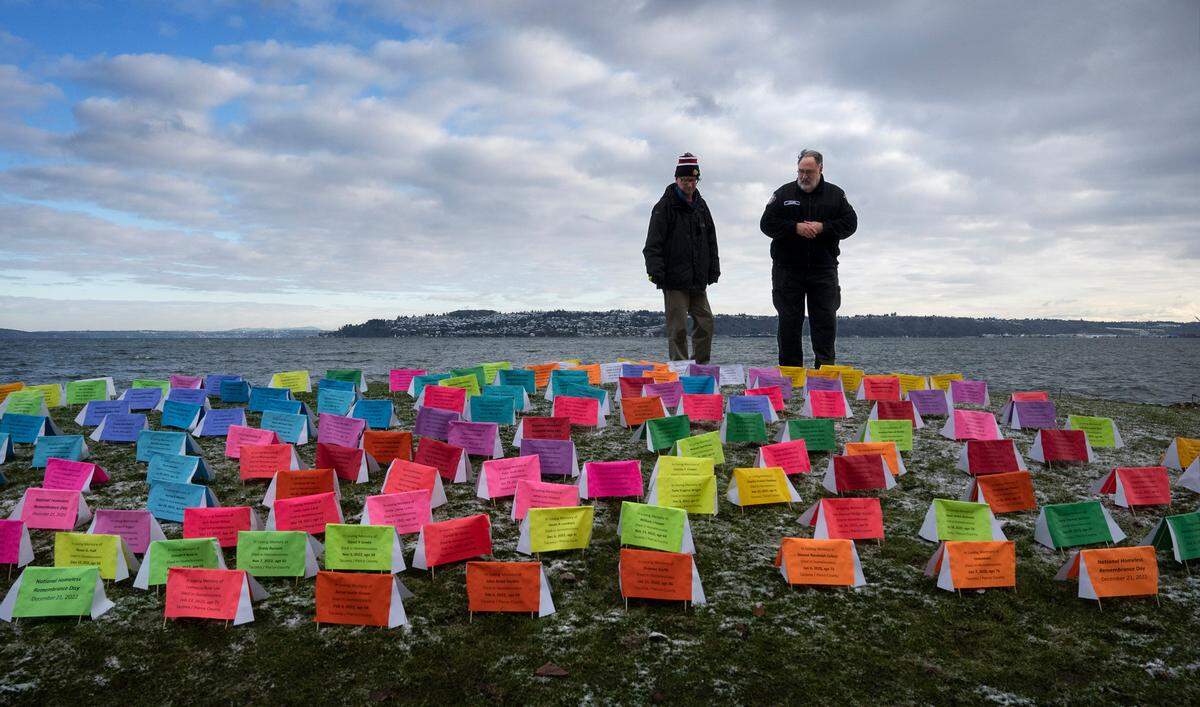
The timing was also purposeful. Dec. 21 wasn’t just the longest night of the calendar year; it’s the date that the National Coalition for the Homeless has designated as National Homeless Persons’ Memorial Day for the last three decades. Earlier in the day, local homeless advocates, including Richard Dorsett, erected a temporary memorial art installation to mark the occasion: 167 small paper tents, each bearing the name of someone on Jacobs’ list, displayed along Ruston Way.
If the goal is to shine unflinching light on the crisis of homelessness while honoring the dead, Jacobs’ memorials do just that, according to Shiloh Baptist Pastor Gregory Christopher
“I think that it shows that there’s still some humanity in America. To read their names and to have something said behind their names, for me, it is one of the most humane things that individuals can do for someone that they didn’t even know,” Christopher said. “Somehow, some way, it’s a message that has to get out, and more people need to hear it. If we don’t figure this thing out soon, it’s not going to get better, it’s going to get worse.”
For Jacobs, performing the public memorials is only part of it. There’s also the work that happens in advance, and the emotional toll it can take.
As I wrote in a column last year, Jacobs collects death data from the Pierce County Medical Examiner’s Office and Tacoma-Pierce County Health Department throughout the year, seeking to glean the fullest picture possible of how many people have died while experiencing homelessness in Pierce County. The names he finds represent anyone recorded as either “homeless,” “no address” or “unknown” at the time of their death, he said.
Much like the crisis itself, the sheer number of names he finds — representing the true scope of the problem — is often shocking. Sitting at his desk at home, Jacobs wades through the data. Often, he’s able to see not just who died, but how they died. Over the last year, it seems like he’s seeing more-drug related deaths and accidental drug deaths, Jacobs said.
The magnitude of the problem and the individual pain it inflicts are sometimes too much to bear, he said.
“There are times when I just have to get up and walk away. I have to go do something else because it’s overwhelming,” Jacobs told me.
Still, Jacobs said he plans to carry on.
His primary motivation remains the same, he said: making sure people experiencing homelessness know they’re not alone or forgotten, even in death, while hopefully inspiring action from those with a home to return to every night.
“When you get down to brass tacks, a funeral is not for the person who died, it’s for the people who are left. It’s for the survivors, and the people who are grieving,” Jacobs said.
Then he quickly added: “And if someone is against helping homeless people, I hope that this might chip away at their feelings a little bit.”
This story was originally published December 22, 2022 at 5:00 AM.