A roundabout threatens this small Pierce County town. There’s 1 big mistake to blame | Opinion
The decisions we make today can ripple — often for decades.
While it can be difficult to appreciate in the heat of the moment, the big ones put dominoes in motion, setting the stage for the issues we’ll grapple with in the years to come, even some that feel small or inconsequential to most people.
Take Tehaleh, for instance, the massive and ever-growing development on the Bonney Lake plateau.
Roughly 30 years ago, it was drawn up as the mythical Cascadia, a future home to thousands of residents and countless thriving businesses, the largest planned community in the state. Then the Great Recession hit, the developer went bankrupt and the bottom fell out, leaving newly paved roads without any homes or upper-middle-class families to occupy them.
It wasn’t until a new developer stepped in to revive the plan in 2012 — with the county’s blessing, despite traffic and infrastructure concerns expressed by Bonney Lake officials — that the pieces began to fall into place. Today, the expansive development is home to more than 5,000 people, with a median household income of nearly $123,000.
As always, the future calls for more, more, more. It’s like a suburban Disneyland. The only things missing are costumed cast members and daily parades.
The development has felt like an overly optimistic fig leaf for sprawl since the very beginning, at least in the estimation of many who followed the saga closely.
This brings us to a simple roundabout, coming soon to McMillin, a small rural community along State Route 162, in the Puyallup Valley and the shadow of Mount Rainier. It’s part of the long-foretold New Rhodes Lake Road East project, designed to establish a second route from Orting to Tehaleh, providing an alternative to 198th Avenue East, which to this day is still the only way in and out of the community built from scratch.
What do the two things have in common?
Everything.
In McMillin, residents fear that the new roundabout will forever change their cherished farming community, and not for the better, whether anyone cares about their hyper-local plight or not.
All of it — or nearly all of it — is a result of the decision so many years ago, one that allowed a shining new suburban enclave to be built on a hill in otherwise rural Pierce County.
File it away as a lesson for the future.
They say change is inevitable, and they’re right, but that doesn’t mean the options of today aren’t determined by what happened in the past.
In short: Without Tehaleh — and the thousands of vehicles that now come and go from it every day — there’s a decent chance the people of McMillin wouldn’t be in this pickle.
The town wouldn’t be facing what John Gardner, the longtime president of the McMillin Grange, describes as an existential threat in the form of a roundabout.
According to Gardner, the planned roundabout could spell the demise of an important civic organization he’s been part of for more than 50 years. At the very least, he knows a handful of 100-year-old maple trees — five of them, to be exact, planted when the Grange was established — will be chopped down, lost to supposed progress.
Gardner also knows it’s coming, whether he likes it or not.
The decision to install a roundabout, which the state Department of Transportation identified as the best way to accommodate increased traffic in the area, has long been made.
While the $150 million New Rhodes Lake Road East project is a largely Pierce County undertaking, with Tehaleh’s developer responsible for hiring the contractor and footing much of the bill, the roundabout falls under WSDOT jurisdiction, given its placement along SR 162.
According to WSDOT spokesperson Cara Mitchell, the calculations are based on extensive traffic studies and best practices for efficiently moving vehicles through a growing transportation corridor.
“We did a corridor study that started in 2015. There was broad community and stakeholder engagement on that, and that report basically spelled out what the guidelines are for any future expansion. It’s the guidebook you go back to,” Mitchell said. “The data pointed to roundabout, so that’s where the path forward started.”
Pierce County spokesperson Libby Catalinich referred questions about the roundabout and its local impact to WSDOT.
In the past, county officials have described the New Rhodes Lake Road East project as essential to mitigate increasing traffic demands related to Tehaleh and population growth in East Pierce County, though some elected officials — like Pierce County Council member Dave Morell — have opposed the construction of a roundabout.
Earlier this year, Pierce County Executive Bruce Dammeier was joined by Morrell and County Council member Paul Herrera at a groundbreaking ceremony for the New Rhoades Lake Road East project, held in Tehaleh.
Between a roundabout and a hard place
Gardner’s opposition to the planned roundabout is genuine and understandable.
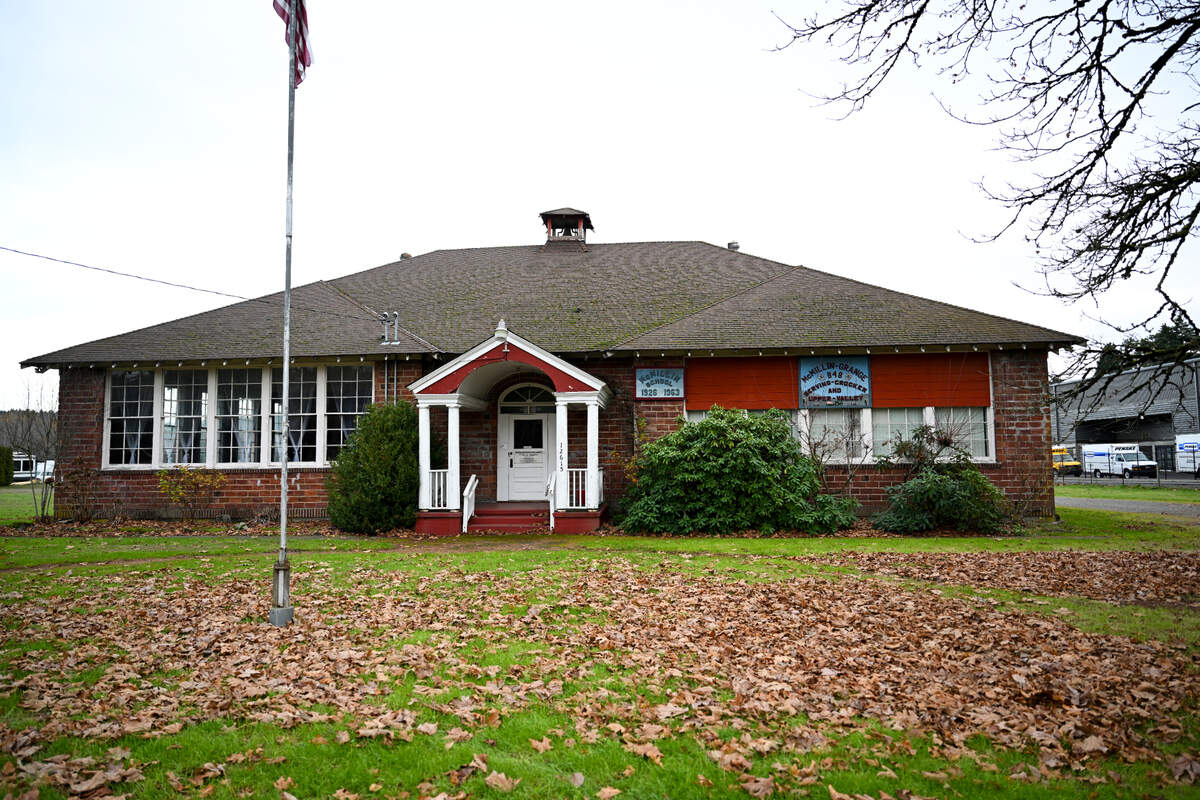
Construction will require the state to acquire a chunk of the McMillin Grange’s land, leaving the resulting intersection at SR 162 and 128th Street East only a few feet from its doorstep.
Gardner told me the McMillian Grange is in negotiations with the state for the purchase of the land, not that it has any choice.
The organization — which has historic roots in the small farming community, like local granges across the state and country — stands to be compensated at “fair market value” under state law, Mitchell confirmed.
Best case scenario, Gardner said the Grange will receive roughly $50,000 in return, a relative pittance, in his estimation, particularly for an important civic organization that was struggling to hold on long before the COVID-19 pandemic decimated its meager financial reserves. Roughly $20,000 of it will serve as compensation for the five maple trees that will be lost, he said.
Mitchell declined to provide specifics of the deal, citing ongoing negations.
“The roundabout in itself is going to make it difficult for us to get in and out of our property at the grange hall, and our biggest income is for renting out our building for weddings and parties and funeral gatherings,” Gardner recently explained by phone.
“We survive by people coming to the grange hall, and we’re afraid we’re going to be locked out,” he told me. “It’s going to keep people away from it.”
Gardner doesn’t just fear change in an abstract sense. His concerns include practical matters, he said, including the current condition of the old McMillin school house that’s been home to the grange for roughly a century.
Gardner is worried that construction and increased traffic related to the new roundabout will shake the old brick building to dust, and he might have a point.
“When they take the front of our property, we’re going to be within 35 feet of (the roundabout), and the bricks they used for the building are no longer suitable,” Gardner said.
“I don’t know how else to put it: it’s an inferior brick,” he added.
“We’re afraid that bringing those heavy trucks closer to the building will result in a lot of structural damage.”
Beyond McMillin Grange
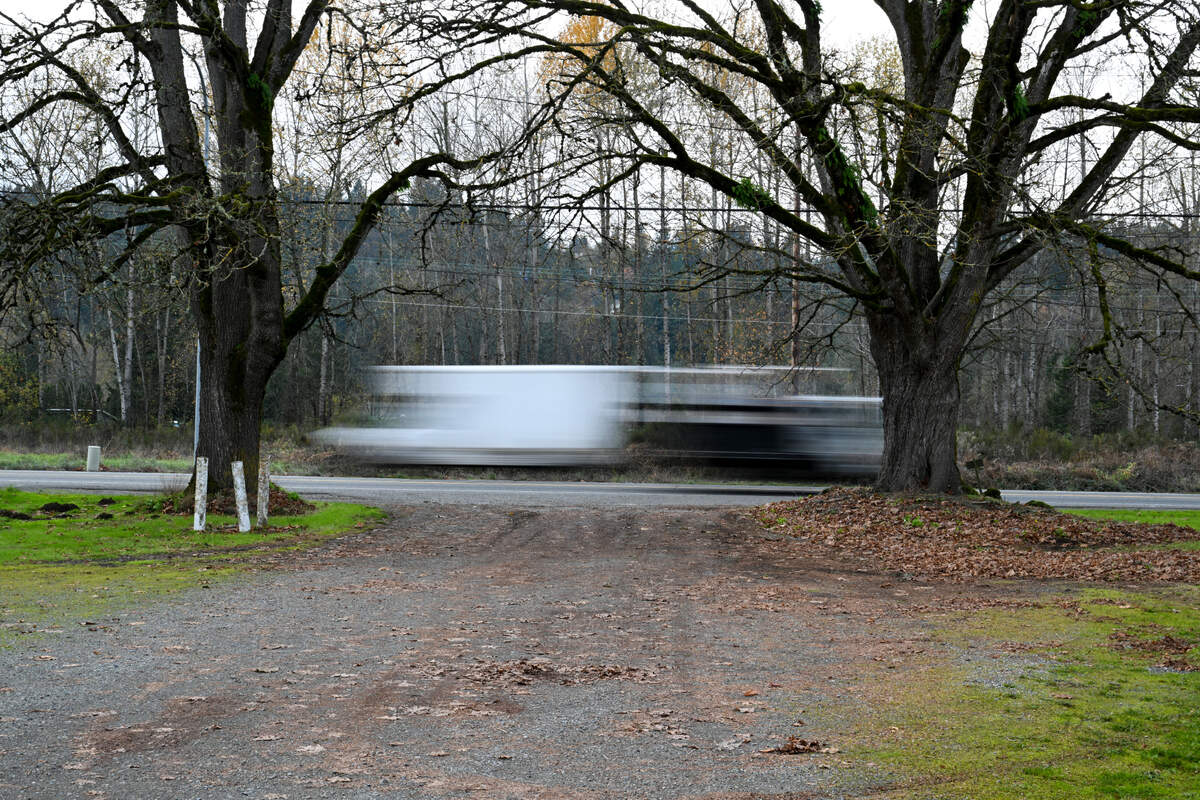
In a community with more acres of farmland than residents, Gardner isn’t the only person who worries about what the future will bring, or the only one harboring concerns.
For more than a decade — since long before the roundabout was a gleam in some traffic planner’s eye — people have been organizing in what has, at times, been a dispiriting effort to protect the place they love.
Maxine Herbert-Hill is one of them. Roughly six years ago, she helped to co-found the SR 162 Community Group, which fought the roundabout tooth and nail — ultimately, to no avail.
Herbert-Hill, 76, grew up near McMillin; she and her husband still live in the house where she was raised, she told me.
Since retiring as the director of Pacific Lutheran University’s internship office in 2014, Herbert-Hill’s passion for the area has inspired a new pastime, she explained: learning the ins and outs of road planning.
Herbert-Hill was recently appointed as a volunteer member of Pierce County’s Transportation Advisory Committee, and she knows more than most. She rattles off street names and traffic-design best practices like an old pro, even if her assessment of what’s best for McMillin runs counter to every explanation and data point WSDOT has cited.
Like Gardner, Herbert-Hill is resigned to the fact that a roundabout will be built where SR 162 intersects with 128th Street East, not far from her home, though she doesn’t like it.
She thinks congestion will make it impossible for residents to get in and out of their homes and worries that critical services, like fire and emergency responders, will no longer be able to adequately access her community. She worries that local businesses and farms will suffer. She’s concerned about pedestrian safety, particularly with the popular Foothills Trail nearby.
But that battle’s over, Herbert-Hill acknowledged.
Today, she spends much of her time and energy trying to make sure the impact on her small community is considered the next time a big decision is made.
There will be more roads to build, Herbert-Hill told me, and more land-use planning to do. People will continue to arrive.
The choices we make now, she said, will define how the future looks and feels — for better or worse.
Once you pave over rural farmland it’s gone for good, Herbert-Hill notes.
History suggests she’s right.
“If you want to wind back the clock 40 years, it was stupid for Pierce County to allow this to happen,” Herbert-Hill told me, describing the local impact of the Tehaleh development that now looms so large.
“But that’s ancient history. You’ve got to live with what you’ve got,” she added.
“In the future, it seems kind of idiotic to use this farmland for anything but what it can do best — and that’s grow food. It’s valuable, and it needs to be protected.”
This story was originally published November 30, 2023 at 11:53 AM.