A downtown park wallows in despair. For Tacoma, it was a bad idea from the start | Opinion
You have to hand it to my News Tribune colleague, Craig Sailor. He has a gift.
Where others see ho-hum monotony and slow, unremarkable urban decay, Sailor finds stories — staring right at us.
Late last year, it was the old Amtrak station on Puyallup Avenue. The property has essentially been abandoned for years — boarded up, covered with graffiti and charred by fire — but it wasn’t until Sailor cast a spotlight on the aging landmark’s plight that a city consumed by constant hardship stopped to take note.
Now, it’s Donald A. Pugnetti Park.
Even if you don’t know the 100-by-240-foot parcel by name, there’s a good chance you recognize its prominent location — smack dab in the center of downtown, along Pacific Avenue, overlooking the Interstate 705 Tacoma Spur.
Like the old Amtrak station, Pugnetti Park — which debuted to great civic fanfare almost 40 years ago — has fallen on hard luck and hard times.
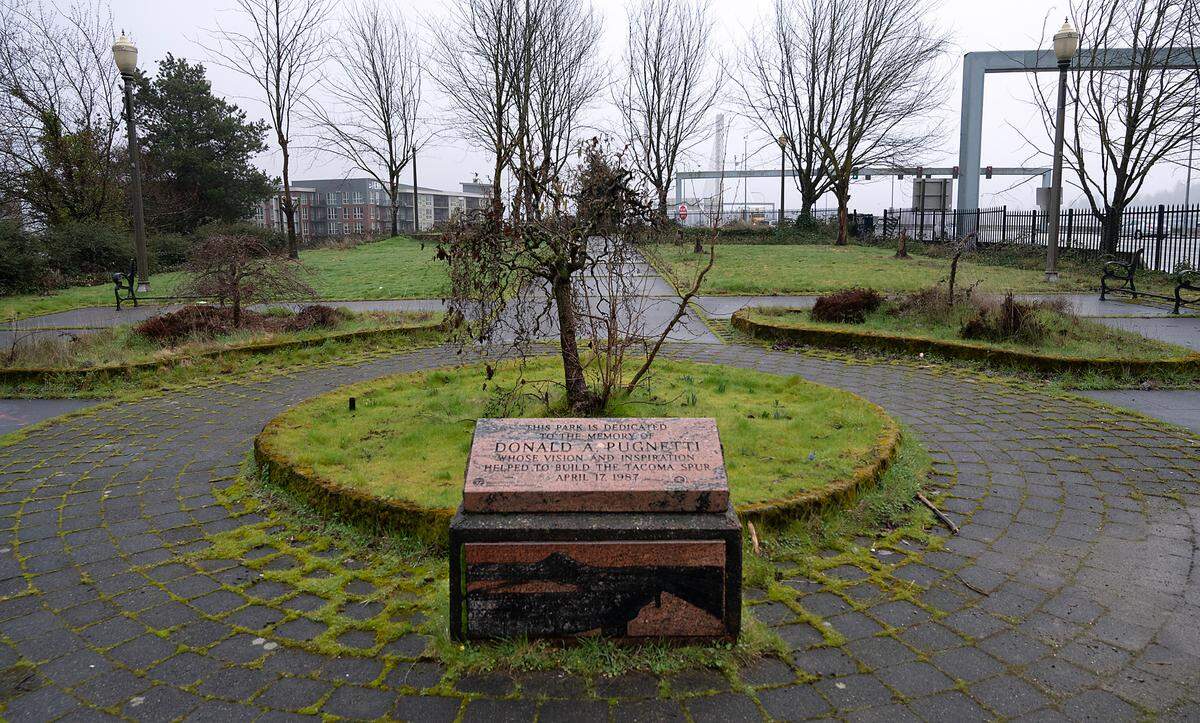
Today, it’s “a trash-filled, vandalized space devoid of people,” Sailor reported last week, with matter-of-fact clarity, illustrating how the park’s state-level ownership and a local jurisdictional malaise has contributed to its neglect.
“Brambles grow where flowers once did,” Sailor added, “and … once thriving trees have been hacked to pieces, presumably for firewood.”
In true Tacoma fashion, wheels of reclamation churn in the background, as Sailor’s story also noted.
If we’ve learned anything in the City of Destiny, it’s how to get off the mat and respond to a crisis.
State Rep. Jake Fey, who previously served two terms on the Tacoma City Council, has proposed legislation that would allow the state Department of Transportation, which owns Pugnetti Park, to rent or lease unused property — provided the land is put to public use.
The nearby Washington State History Museum has expressed a desire to see the park reclaimed.
The City of Tacoma and Metro Parks Tacoma also have clear stakes in the outcome, whether they’re ready to acknowledge responsibility or not.
Still, what if all the handwringing and hyperlocal angst over the state of Pugnetti Park ignores the obvious?
What if this park — for everything it could be and was supposed to be — was a mistake from the start?
For Tacoma to truly save Pugnetti Park — from neglect and from itself — what if it will require going back to the drawing board and reimagining this small but important downtown parcel?
“(Pugnetti Park), to me, does not come across as a point of entry for Tacoma, and the reason for that is the rushed nature of that cross-section. You are so focused on getting somewhere that the park is completely unseen,” said Ali Modarres, dean of University of Washington Tacoma’s School of Urban Studies.
“If this park is going to be a point of entry, it has to be designed that way. It has to have some markers that this park doesn’t have,” Modarres told The News Tribune.
“It’s a disconnected functional space. … And it’s not very inviting, the way it’s presented.”
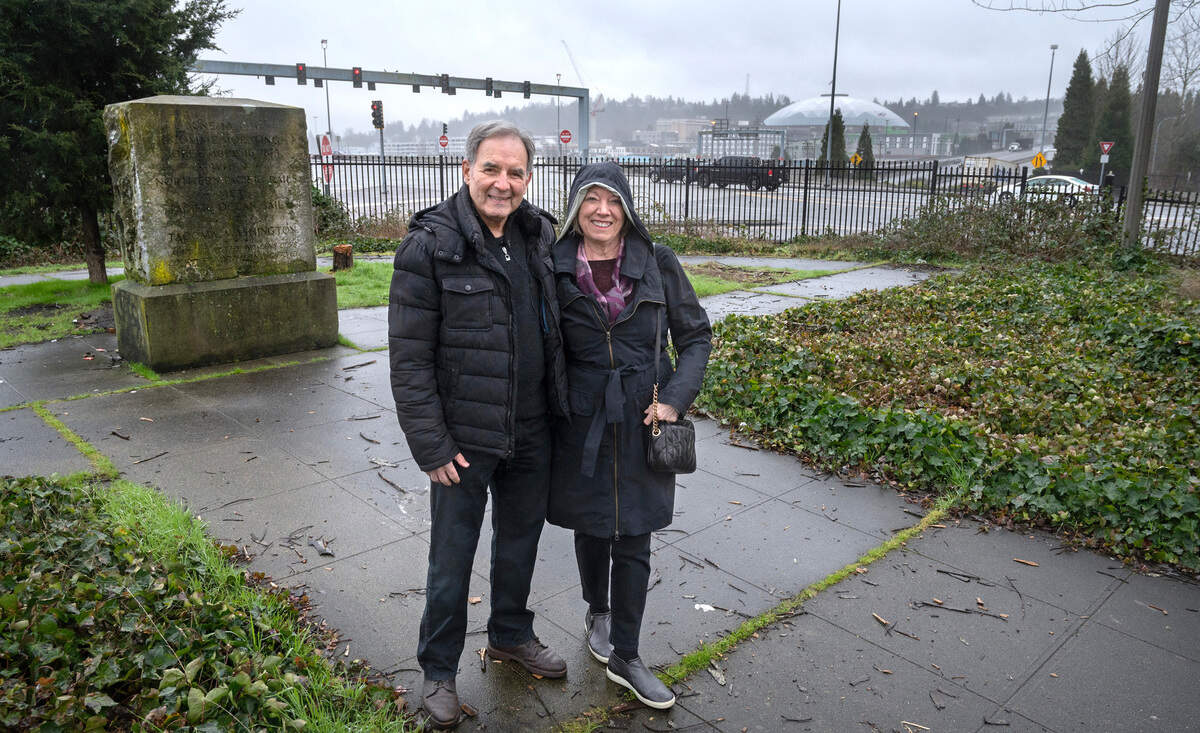
Pugnetti Park history
Before we dive down a rabbit hole of big dreams and what-ifs, there’s a complication to acknowledge.
There’s history at Pugnetti Park, and change would call for more than fresh ideas and political capital.
It would require contending with potentially delicate human emotions.
Described as a “mini-park” when the ribbon was cut in 1987, Pugnetti Park is named in honor of Don Pugnetti, a former News Tribune editor who, during his 13-year tenure leading the newspaper, championed the $125 million “Tacoma Spur” highway project that surrounds it.
The massive concrete and asphalt achievement, according to Pugnetti and plenty of like-minded Tacoma civic boosters at the time, was an essential component of downtown revitalization — capable of providing a spigot of motorized activity and economic growth piped directly into the heart of a city in desperate need of it.
Publicly dedicated on Friday, April 17, 1987, the following day’s News Tribune described the new park as “rimmed with 45 trees, including red maples, honey locusts and shore pines.”
City engineers, as TNT reporter Mark Higgins noted, optimistically believed Pugnetti Park would “serve as a lush focal point for motorists entering Tacoma.”
“There is an absolutely incredible view of the Spur rising into the downtown core,” Pierce County Council member Jim Salatino told the TNT in December 1987 after a visit to the site of the under-construction park.
“People will be driving in and looking at a pleasant environment, which obviously hasn’t been the case for the last 20 years,” he added.
Pugnetti retired from the TNT in 1985 and died the following year. He didn’t live long enough to see the Tacoma Spur through to completion or the public dedication of the $225,000 park that still bears his name.
Consider it a small blessing that he’s not around to witness what has come of the park.
In the words of former Tacoma mayor Bill Baarsma, it was once “a gem.”
Now?
“It is painful to see. … It’s just heartbreaking for the family,” Pugnetti’s son, Don “Jerry” Pugnetti, Jr., recently told The News Tribune.
The Pugnetti family would like to see the park restored to its former glory, Jerry Pugnetti said.
During the same interview, the second-generation ink-stained wretch turned local author described Tacoma and its residents as “the real losers in this.”
He’s right. But there’s a catch:
To create the kind of lush and inviting urban environment that the people who designed Pugnetti Park envisioned, the late editor’s family might have to accept something drastically different than the tribute as it was first drawn up, according to Modarres.
On Monday, Jerry Pugnetti said his family is amenable to new designs, provided the area is “preserved as a park” — and maintains his father’s name.
“That’s fundamental,” Pugnetti said.
“Whatever the design and whatever the features and use for a park might be, we’re wide open to that.”
In Modarres’ view, it will take more than fresh landscaping, new trees and regular maintenance.
“Right now, Pugnetti Park is just a bypassed space,” he argued.
“A program needs to be introduced, or the function of that place has to be completely changed, which I’m sure, for the family, could be a painful thing to do.”
‘Nobody wants to hang out there’
In life and urban design, good intentions don’t guarantee positive results.
According to Modarres, Pugnetti Park is a poster child of such folly.
If the park’s designers hoped to create a place that would attract people and activity — and an iconic entry point to Tacoma for visitors — they went about it all wrong, Modarres told The News Tribune.
A functional downtown park requires what he described as “a lingering capability.”
Due to its location and design — tucked next to busy roads and freeways, and lacking setbacks or buffers to dampen the surrounding traffic chaos — Pugnetti Park lacks it, Modarres said.
“This would have been a great place to have a small plaza and create a series of vending capabilities and public events,” Modarres said. “You need to have some retail capabilities there. You need to have some functions of food, fun and entertainment. It needs to be programmed.”
“People need to have stories with that space, and nobody has any,” Modarres added.
“As it stands, nobody wants to hang out there.”
David Boe, a local architect and former Tacoma City Council member, agrees with Modarres’ assessment — pointedly.
Boe told The News Tribune last week that the construction and original design of Pugnetti Park is part of a larger historical tendency of Tacoma “taking left-over spaces and trying to make them into public spaces that do not succeed.” (See: Tollefson Plaza.)
In Boe’s mind, getting Pugnetti Park right would require blowing it up and starting over.
“Good public space needs a good frame around it. Pugnetti Park does not have one,” Boe told me.
His answer?
“Pugnetti Park should be a signature gateway building with access from the Washington State History Museum driveway, with a landscaped park on the roof — (like) the city park … atop the Pacific Plaza building,” Boe said. “Engineers should not decide where a park should go. Most of us don’t want to sit and admire different means of transportation.”
Pugnetti thinks razing a park built in honor of his father — and in the spirit of making downtown somewhere people want to spend time — is “a ridiculous idea.” But he agrees with the underlying assessment: something must be done.
“It’s quite a historic district, and it’s devoid of green space. With the park, you have that,” Pugnetti said. ”It’s not a park for our family, it’s a community park, and it should be valued as such.”
According to Baarsma, this much is certain:
Pugnetti Park, as it currently stands, isn’t working for anyone.
It isn’t a tribute. It’s a slap in the face.
“When the park was first conceived and developed, it was something you could be proud of,” Baarsma said.
“In its current state, that park is an eyesore.”