He was sexually abused at Camp Seymour. Why does YMCA still honor the man he blames? | Opinion
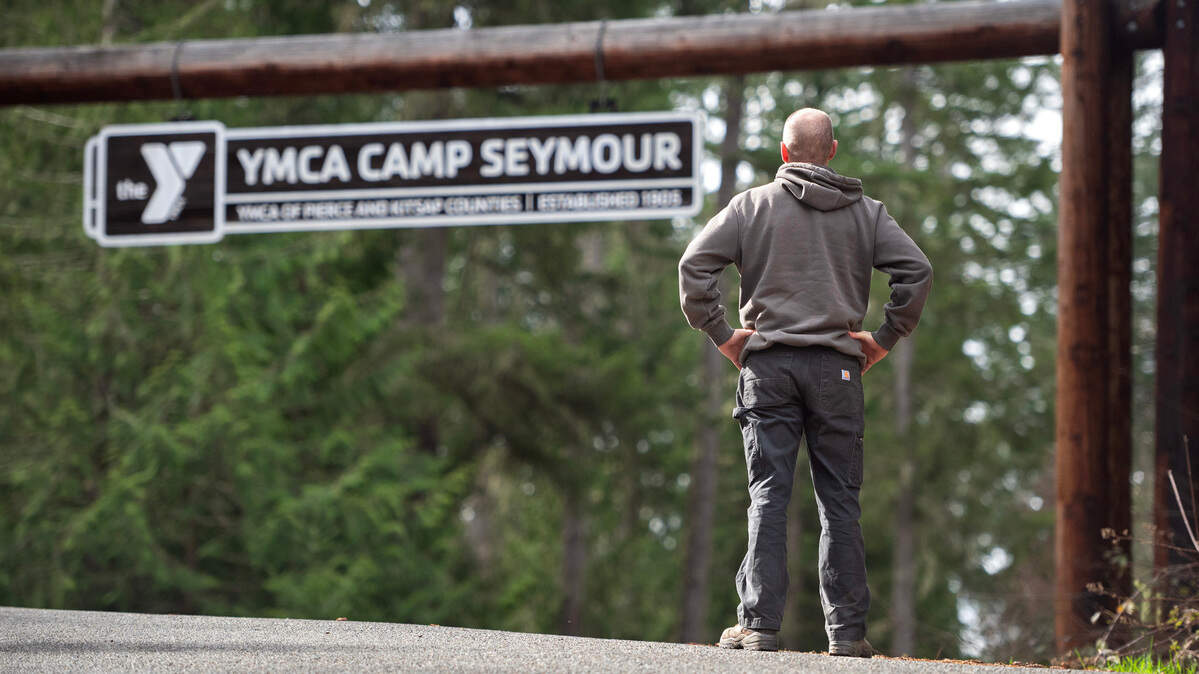
It was the news story that made him pick up the phone, but it’s the name on the building — John Morgan — that still sparks his outrage.
His parents sent him off to camp decades ago, but the damage that was done that summer, like the shame he bottled up for so much of his life, surfaces quickly.
He’s in his late 50s now, still local. He owns a successful business, has a wife and kids, maintains a well-kept lawn. In most regards, including many he considers meaningful, he’s blessed.
The court documents, however, where he’s identified as “K.S.” — to protect his identity as one of many victims of sexual abuse at YMCA’s Camp Seymour in the 1970s — paint a different picture.
What happened when he was eight years old changed him forever, K.S. explained last month.
He called me not long after The News Tribune reported the $7.5 million a Pierce County jury awarded a man known in court records as T.B., another victim of sexual abuse at Camp Seymour.
K.S. was awarded $150,000 by a jury in 2020 as part of a separate civil suit.
Reading about the latest case set him off, he explained.
Morgan, who served as executive director of the YMCA from 1969 to 1989, was in charge throughout what’s now acknowledged to be a lengthy period of sexual abuse at Camp Seymour, a Key Peninsula youth retreat the organization has owned for more than a century.
In 1996, after Morgan’s retirement, the YMCA location on Pearl Street in Tacoma was renamed in his honor, a title the facility still holds today.
The YMCA has not disputed that abuse occurred, which is tied to two former Camp Seymour counselors accused by multiple victims of orchestrating a half-decade of molestation.
Morgan died of cancer in 2014.
To this day, K.S. remains adamant:
The YMCA Pearl Street branch — which is specifically designed to serve local children and families — should not be named after a man he blames for turning a blind eye to horrific abuse.
“[Morgan] was supposed to run this organization and keep us all safe, and his name is sitting on that building,” K.S. told me.
“It makes me feel like the YMCA doesn’t care — like they’re not sorry.”
Abuse at Camp Seymour
As court records from his 2018 lawsuit reveal, K.S.’s abuse occurred one night in 1974, the first he spent at Camp Seymour.
By contrast, documents filed in T.B.’s civil case suggest that what happened to him spanned four summers, between 1976 and 1979.
Randy Tollefson, one of the counselors identified by Camp Seymour victims, was later convicted of sex crimes in Pierce and King counties. Tollefson was imprisoned for 16 years, according to The News Tribune archives, before being ordered to the state’s center for sexually violent predators on McNeil Island.
K.S. believes Morgan was warned about the counselors’ behavior and could have done something to prevent others from experiencing the trauma he endured.
Multiple Camp Seymour victims, including T.B., have made similar accusations over the years.
In a separate 2018 lawsuit, a 49-year-old man identified as P.N. alleged that Camp Seymour’s former director was aware that two counselors were sexually abusing young boys but kept recommending they be rehired.
As The News Tribune reported at the time, the suit cited a 1983 affidavit signed by a former counselor at the camp, indicating that Morgan had been personally warned in the mid-1970s.
According to K.S., his parents also tried to warn the late YMCA executive director during the same time period, even though he kept his abuse secret for more than 20 years.
Not long after he returned from a trip to Camp Seymour, they suspected something terrible was happening to young boys at the camp and sought to intervene, K.S. told me. His older brother tipped them off, he said.
“I know they went and talked to John Morgan. I believe it was in 1975 or 1976, but it could have been as early ‘74,” said K.S., whose mother provided a deposition in his 2018 lawsuit against the YMCA.
“I don’t know what Morgan knew or exactly when, but my mom’s not making that up,” he added.
“She’s not confused.”
By phone, K.S.’s mother, now 81, corroborated her son’s story.
“We went in to see Mr. Morgan and said, ‘Hey, there’s a problem here.’ At that point, we did not know what had happened to [K.S.], but we knew something was wrong,” she told me.
“I guess [Morgan] blew it off, he let it go,” she said. “We assumed it had been handled … but now we know it just continued.”
In a written statement provided to The News Tribune last week in response to K.S.’s concerns, YMCA of Pierce and Kitsap Counties CEO Charlie Davis said the organization is “saddened and disturbed by the actions of some staff members at Camp Seymour in the 1970s.”
“We extend our deepest sympathies to their victims,” Davis said. “That any children in our care would have been subjected to such mental and physical violations is entirely unacceptable, no matter how long ago.”
Asked why the YMCA Pearl Street location still bears Morgan’s name, a YMCA spokesperson declined further comment.
This month, the YMCA plans to begin construction of a new Pearl Street facility, designed to replace the Morgan branch, the spokesperson confirmed.
The facility will be known as the Scott and Sis Names Family YMCA, in recognition of the local philanthropic foundation’s support.
Five decades after he was abused at Camp Seymour, K.S. believes he deserves more.
“Four years ago in court, I looked [YMCA of Pierce and Kitsap Counties CEO Charlie Davis] straight in the eye and said, ‘This building is killing me. It’s really hurtful.’ And they still haven’t done anything,” K.S. told me.
“Sure, they’re changing the name now, but only because they’re getting money from some other family,” he added.
“That doesn’t feel like an apology to me.”
‘A good target’
K.S.’s call wasn’t entirely random. Years ago, we worked together. I know his family well.
Still, until K.S. reached last month, I had no idea what happened to him, unaware, like most, of the secret he’s carried since childhood.
Throughout several conversations, K.S. explained how a male counselor coerced him into a shared sleeping bag on his first night at Camp Seymour, claiming the cabin he’d been assigned to had been mysteriously “overbooked.”
In hindsight, it was one of many red flags, he said.
The night of sexual abuse left him broken and traumatized, K.S. told me.
In particular, the guilt still gnaws at him.
On his second night at Camp Seymour, K.S. switched sleeping assignments with another camper, forced into what he described as “survival mode.”
“Prior to this happening to me, I was a very outgoing person, very trusting. I was a good target,” K.S. explained. “I’ve had this somewhat successful life, but … I remember who I was before this happened, and I know I was destined for something more.”
“I woke up in the middle of night and his hand was down my pants. That’s it. That’s what happened to me, in terms of being molested,” he continued.
“It’s amazing how something that seems so simple was so devastating for my life.”
K.S. acknowledges that what happened to him at Camp Seymour in 1974 pales in comparison to the abuse others endured.
At the same time, there are striking similarities between his story and the horrors described by other camp victims in court filings over the years.
The News Tribune archive indicates that at least 11 men who attended Camp Seymour as children in the 1970s have filed lawsuits against the YMCA, alleging abuse spread over at least six summers at the camp.
K.S. believes the true number of victims is almost certainly higher.
It’s one reason he still gets so mad when he hears Morgan’s name.
“If this happened to me in ‘74 and it was still happening to T.B. in 1979, that’s years — times how many boys?” K.S. told me. “That’s the part I don’t think anybody understands.”
“This is a big deal,” he continued.
“Morgan was in charge. He should never have been honored.”
This story was originally published April 2, 2024 at 10:57 AM.