
Want to remember Jay Inslee’s 12 years as governor? Look at the side of WA freeways | Opinion
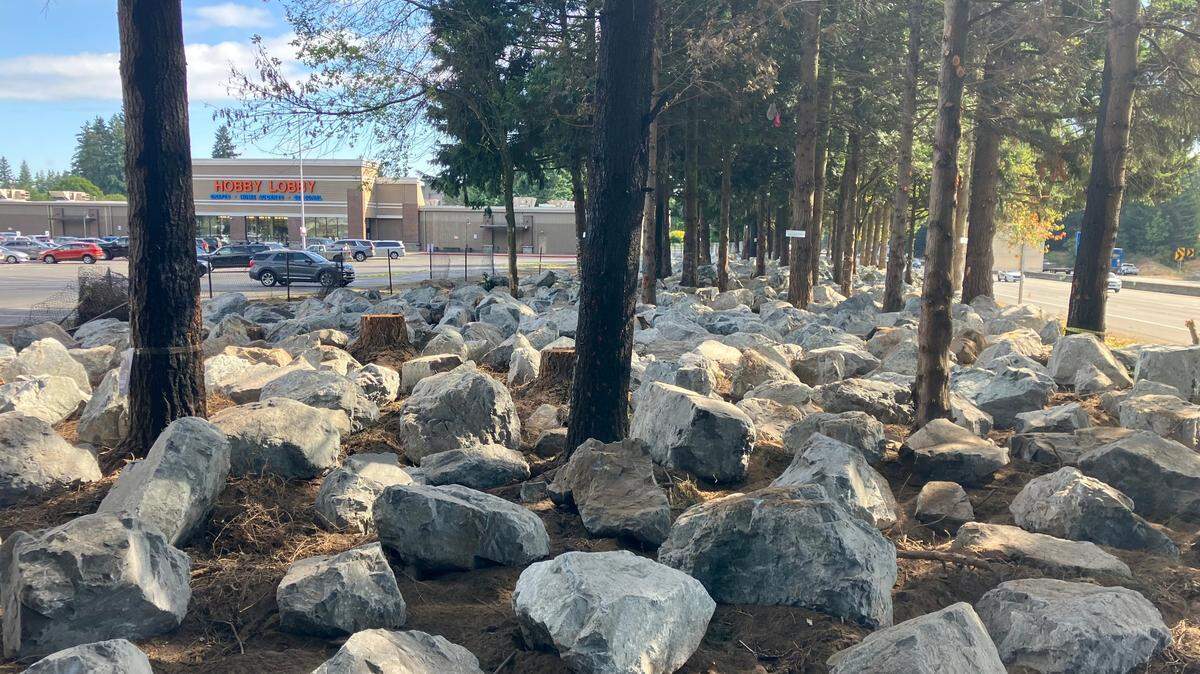
Even though Jay Inslee doesn’t vacate the governor’s office until January, his monument has already been erected in Washington. Perhaps you’ve seen it. Along stretches of Interstate 5, what look like careless art installations of boulders commemorate Inslee’s 12 years of failed homeless, mental health and drug policies.
Of course, the intent of the boulders is not to memorialize Inslee’s term, but to transform a public space into ground unsuitable for homeless encampments.
It is the same thinking that leads to spikes on the heads of statues, so birds won’t settle and defecate there.
But we are dealing with human beings, not starlings and seagulls, and those boulders are not helping some of the most vulnerable among us.
According to Inslee’s administration, spending hundreds of thousands of dollars on rocks is part of the state’s effort to “transition persons residing on state-owned rights of way to safe housing opportunities with an emphasis on permanent housing solutions.”
If we judge the success of these boulders and the larger campaign by how many people have been moved into permanent housing so far, the program’s a failure.
Since 2022, Inslee’s Right-of-Ways Safety Initiative has spent between $144 and $149 million and permanently housed a total of 183 people, according to data provided by the state Department of Commerce.
When a McClatchy reporter asked the governor if spending thousands of dollars on boulders was a good investment, Inslee replied, “I really wish we could provide housing and safe corridors for zero dollars, I really do, but that’s just not the reality.”
It’s also not answering the question.
When KIRO Radio asked him whether spending $149 million to permanently house so few people was a good use of money, the governor responded: “I wish everything was free. And we all believe in Santa Claus. But Santa can’t take care of this problem; we need to make investments.”
What a goof.
In Inslee’s defense, in addition to the 183 people the initiative has permanently housed, the Inslee administration’s rights-of-way initiative has now temporarily housed roughly 900 individuals. So, rather than spending more than $800,000 per person, the program’s actual cost is closer to $140,000 per person. Feel better?
You shouldn’t — because the state’s right-of-way program tackles the visibly ugly result of homelessness, not its causes.
For 10 years I worked as a volunteer overnight manager at a homeless shelter, learning first-hand there are many reasons people are unsheltered. Many of those reasons are not entirely related to housing costs.
Some people have experienced a combination of divorce, addiction and unemployment. Some never thought they’d be homeless. Others admit they are because of their bad choices, and are struggling to piece their credit and personal lives back together. These are the most straightforward people to help lift off the streets.
Others have bigger challenges, like being physically or mentally abused or abandoned. We have established programs to provide safe shelter and housing assistance to many of the most fragile in our midst.
While sufficient affordable housing and transitional housing would keep many people from living in shelters — and often their cars — in my experience these are not the people living along freeways.
I’ve walked some tent encampments. Not counting those who are preying on the unsheltered, many people living in such conditions appear to have mental health or addiction issues, maybe both.
Confiscating a tent, replacing it with boulders and providing people with a shelter bed will not keep them off the streets for long — because it doesn’t address the reason many are there in the first place.
We should have a statewide zero tolerance for unauthorized camping or extended parking in public spaces.
That policy must complement a coordinated statewide strategy to help people so they don’t return to the streets. Dumping boulders simply forces people to camp somewhere else.
The Rights-of-Way encampment removal and safety initiative provides some of the services needed to get people into permanent housing, but addressing their needs and reversing the state’s failures requires so much more.
For starters, Washington must improve its mental health system, which is currently ranked in the bottom third in the nation. Washington also suffers from a higher than acceptable prevalence of mental health illness, ranking 43rd among 50 states in this telling metric.
While we’re at it, Washington must also eliminate its permissive drug culture. New legislative and judicial approaches to addressing mental illness in public spaces — in addition to the re-criminalization of hard drug use and the creation of more transitional housing units — are keys to actually helping people who think they don’t need help.
As expensive, politically thorny and legally fraught as it will be to compel people into addiction or mental health treatment, keeping them in housing after treatment will be just tough.
Imagine growing up sleeping on friends’ couches or the floors of church basements. Imagine if the adult you grew up with never worked at the same place for more than a few months and spent their paycheck within days. Imagine never having a checking account.
For some, just holding a job and regularly making rent and utility payments is a daunting challenge. After removing people from encampments, after getting them addiction and mental health counseling, we need to provide individuals with basic life skills and technical education.
All of this is complicated. It demands a governor’s sustained attention and a uniform statewide approach.
It also requires measuring a program’s success by the number of people it lifts off the street, rather than resorting to ridiculous throwaway lines about Santa Claus.
Next January, if anyone starts talking about honoring Inslee’s term as governor, point out the 12 years of increased homelessness, drug addiction and mental illness across the state.
Then point to the $149 million monument — Washington’s freeway tombstones — memorializing the governor’s failed policies.
Bill Bryant, who served on the Seattle Port Commission from 2008-16, ran against Jay Inslee as the Republican nominee in Washington’s 2016 governor’s race. He contributes a monthly opinion column to The News Tribune.