He shot Pee-wee’s Playhouse and ‘We Are the World.’ Now he’s in Lakewood — eager to talk
When Wayne Orr gets going, he slips into third person and uses the present tense. He starts describing key moments of his life like scenes from the hit television shows he once worked on, searching for the perfect framing and light.
For example:
“Wayne Orr’s dad is in the clothing business. He’s the head of men’s clothing at a big department store in Cleveland,” the 82-year-old retired TV cameraman told me last week, early in a conversation that eventually spanned hours.
“Wayne’s dad wants him to be a doctor or lawyer,” Orr continued.
Then, for a moment, he abandoned the cinematic voice for a more honest version.
“I wasn’t cut out for that,” Orr admitted, his father and the company he worked for long dead.
“We were at odds a lot, which was unfortunate. … He wanted me to be something I wasn’t.”
For roughly 50 years, Orr was one of the best money could hire, no matter what his father had hoped for. That’s why I showed up at his door. He shot the Carol Burnett Show, the Price is Right and the iconic 1985 recording of “We Are the World.” At the height of his career, he directed 11 episodes of Pee-wee’s Playhouse, including a star-studded made-for-TV Christmas special in 1988.
Today, Orr lives in anonymity on a cul-de-sac not far from the freeway, in a home with a blossoming cherry tree out front. He purchased the suburban property with his wife in 2016, he told me, shortly after the couple relocated to Lakewood from the San Fernando Valley.
He’s a long way from Hollywood, the seven-time Emmy winner acknowledged.
Sometimes, Orr gets frustrated. Names and details elude him now.
More than anything, he desperately wants to get it right.
“Wayne is starting to make connections in L.A., and there’s a woman by the name of Rita, and she’s his angel,” he later explained of one of the many Hollywood connections he made over the years from a small bedroom office, pictures of Ann-Margret, Gregory Peck and Bette Midler decorating his walls.
“Rita works for one of the premier production companies in town, with two guys who wrote the book on variety shows and musicals,” Orr continued.
“For Wayne, this is big.”
From the beginning, Orr dreamed of making his mark in the industry, with a focus that hedged toward obsession. He’s hardwired that way, I learned, for better or worse, and it’s served him well; his resume serves as a testament.
Still, if Orr’s stubborn ego and confidence helped him stand out in Burbank or Beverly Hills, they haven’t made his life easy, particularly at home.
It’s all part of the story, and Orr is eager to share, equipped with a one-liner for nearly every occasion. Shooting Elvis was like, “Working with a wax mannequin,” he cracked. Cher was his “girl.” His ouster from Pee-wee’s Playhouse was “political,” at least in a Hollywood sense of the word.
At the same time, the weight and stakes of our conversation clearly gnawed at him, like he was wrestling with a stark realization: If he doesn’t tell this story, no one will. Legacies only exist if someone remembers.
“I don’t think anybody has done this for him, where they talk just about him and his career. So it is very important,” Orr’s wife of nearly six decades confided in me later.
“I think he sees, too, that it’s getting harder and harder for him to remember this stuff,” she said.
“A lot of people aren’t that interested, so I know he really appreciates what you’re doing.”
From Cleveland to L.A.
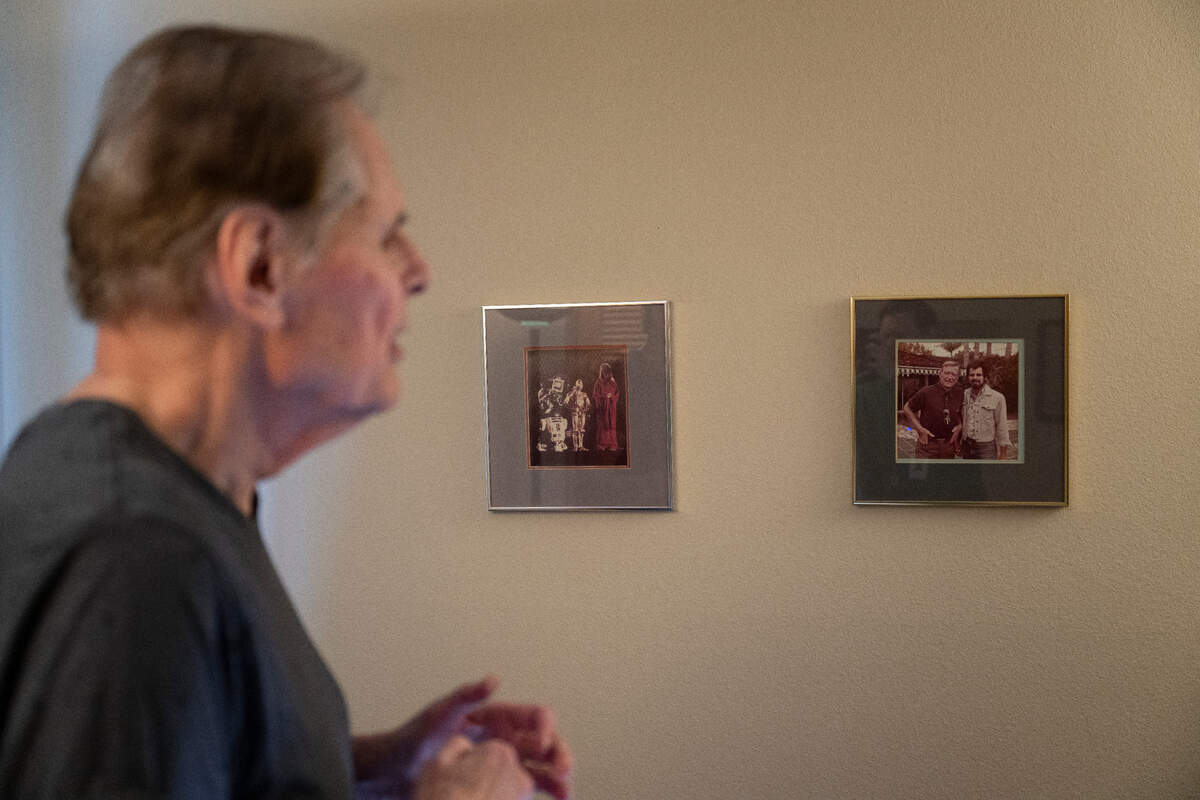
I wanted to talk about the photo on his wall — the one with John Wayne. Orr was having none of it.
To understand, he suggested, I needed the full picture.
This would take time, he cautioned.
Orr is from Cleveland, Ohio, you see. That’s where it starts. In college, he worked at a bar called The Deck where he hustled three-two beer to kids hoping to avoid Vietnam, much like he managed to do. In his mind, he’s still that blue-collar kid, and he hasn’t changed that much.
With the money he earned, Orr attended Kent State, where he was introduced to broadcasting and met his wife. He still calls her Bunny, he explained — like her sorority sisters did — even though her real name is Barbara, which she mostly prefers.
His first legitimate gig was WEWS channel 5, an operation with “two Neanderthal” station managers known at the time to “pinch every dollar,” Orr recalled.
With a young, adventurous wife by his side, he escaped the Midwest for Los Angeles as fast as he could, determined to make it, and eager to escape the scrutiny of a father he could never please, he said.
First, he got a job for ABC. Then CBS. Then he landed at PBS.
Finally, for-hire freelance work gave Orr the freedom he’d always wanted; that’s where Rita, his angel, came in. She helped make it possible. He was behind a camera for multiple Academy Awards shows, Bill CIinton’s inaugural gala and the infamous 1978 two-hour Star Wars Holiday Special so ill-conceived it aired again, not that it was his fault. Today, he refers to it as “the biggest stink bomb ever.”
Later, I asked again about that photo with John Wayne in his office, both of them smiling wide, Orr sporting a robust beard straight from the era.
It was taken during the Duke’s final interview, with Barbara Walters, shot on location from Wayne’s ranch in Newport Valley, California, I discovered.
Two months later, John Wayne died of stomach cancer.
“He was in pretty good spirits, which was great because word was he could really be a tyrant,” Orr recalled.
“Look at us,” he emphasized, pausing to reflect.
“We’re so happy.”
Wayne and Bunny
Born in 1972, Orr’s only child, Joanna, doesn’t remember everything about her father’s career, but she remembers enough.
She’s in her fifties now, and lives in the same house as her parents. The upstairs is hers.
While Joanna Orr admits that her childhood in L.A. was filled with glitz, glamor and once-in-a-lifetime opportunities — like trips to the set of Pee-wee’s Playhouse and on-location Disney specials — mostly, she remembers the more mundane details of her life as a kid.
Sure, she attended the same high school as Ricky Schroder — he was a few years older — but her upbringing was fairly normal, she insisted, at least by local standards.
Joanna told me that her father’s is really a love story, with two characters, her mother at the center. Without “Bunny,” there is no Wayne Orr, she said.
Everything her father accomplished was made possible by the support he had at home, including the sacrifices that entailed, Orr’s daughter believes.
She chalked her father’s drive and ambition up to his strained relationship with his own father, who she described as emotionally distant and verbally abusive, and a childhood she called “really terrible.”
“My father is a director. He’s going to tell you how everything should go. He’s obsessive. He’s a control freak, and she’s his cheerleader. He put 100% into his career,” Joanna Orr told me, recalling the times her father spent working on location, far away from home.
“I don’t know why it works, but it did,” she added.
“My mom took care of my dad, and to this day, she takes care of him.”
Last week, Barbara Orr told me her life with her husband is much quieter now in Lakewood. He used to play tennis at the local club, but lately he’s stayed close to home, keeping mostly to himself.
His final assignments — including shooting Dancing with the Stars — didn’t go well, she confided. He was slipping and he knew it, so he bowed out, afraid of embarrassing himself.
These days, Barbara has her cats, including a 16-year-old rescue named Toby, which helps with the loneliness, she said.
Wayne Orr has his stories.
“I miss the work and I miss the camaraderie,” he said of his remarkable and unlikely career.
“This is what I was always meant to do.”
This story was originally published April 15, 2024 at 5:00 AM.