
Fallen JBLM GI is more than footnote of Afghan war
The number of American service members killed in Afghanistan over the past 1 1/2 decades stood at 2,381 on Monday.
The first name in the grim honor roll is Sgt. 1st Class Nathan Ross Chapman, a soldier from Joint Base Lewis-McChord. He was shot to death in eastern Afghanistan on Jan. 4, 2002.
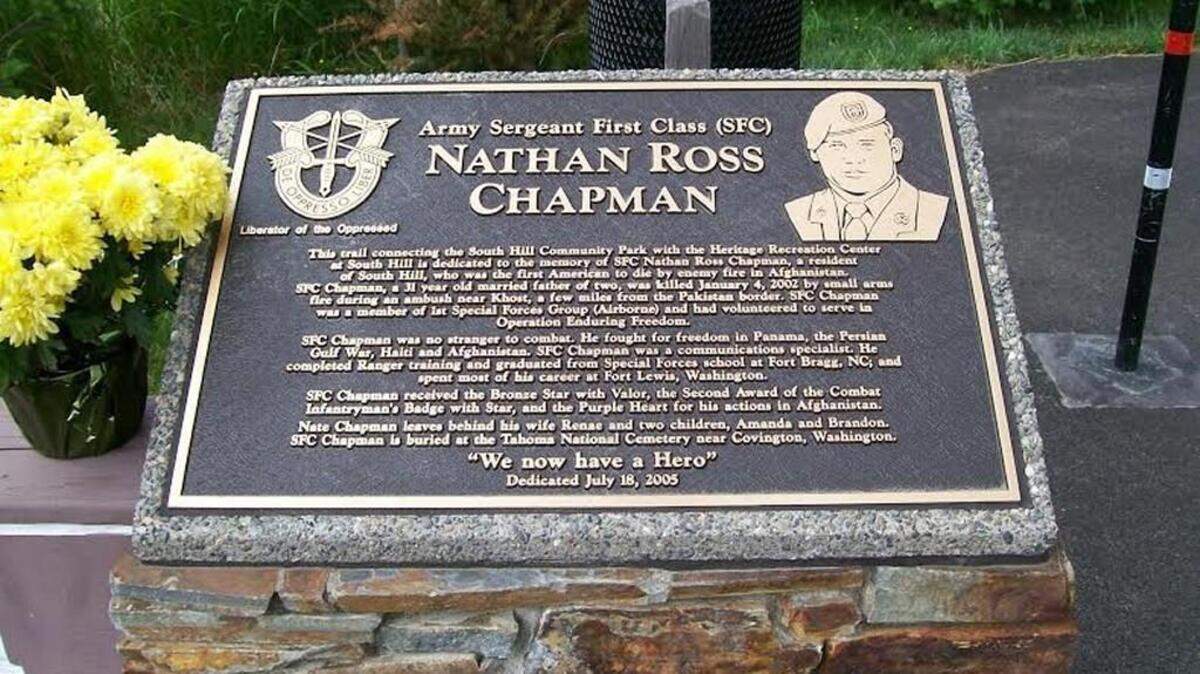
Chapman's name is preserved on a memorial trail in South Hill, the community where he lived with his wife and two children. People who use the trail and nearby park can learn a valuable lesson in heroism by stopping to read a plaque that tells of their fallen neighbor, a Green Beret who spent most of his career at Fort Lewis.
But the plaque captures only a fraction of Chapman's story. Little has been publicly released about the ambush near the Pakistan border that killed him. It happened during a fast-developing moment of U.S. military policy when the 9/11 attacks were raw and the hunt for Osama Bin Laden was in its hotblooded early stages.
Because he had been assigned to a top-secret Central Intelligence Agency team, the 31-year-old didn't receive a memorial star at CIA headquarters until a year ago — and even then, it was an anonymous tribute.
A story by Washington Post writer Thomas Gibbons-Neff, published in last week's News Tribune, sheds needed light on Chapman's final days. It would be a dishonor were he remembered only as a historical footnote: the first U.S. serviceman killed in the seemingly endless war on terrorism.
Chapman's death set a terrible marker at JBLM, as well. But it was something of an aberration; over the next two years, only two more soldiers from the local base would be killed in Afghanistan — Sgt. Jay Blessing and Cpl. Pat Tillman, the former professional football player about whom at least two posthumous biographies have been written.
As the American war effort shifted to Iraq , so did most of the JBLM casualties — until 2009, when the Afghanistan war took a bloody turn. In all, 316 men and women from the base have lost their lives in Afghanistan.
Reality showed up when Nate died.
Sgt. 1st Class Jason Koehler
U.S. combat operations there officially ended in 2014, but fighting continues. In December, Staff Sgt. Matthew McClintock of the Washington National Guard was killed while fighting alongside Afghan allies. Before joining the Guard, he served several years at JBLM in Chapman's 1st Special Forces Group.
The country’s chronic instability was underscored last week by a brazen Taliban suicide bombing and gun attack in the capital city of Kabul, which killed 64 and wounded 300, mostly civilians.
Afghanistan remains a generational obligation for the U.S., a point reinforced when President Obama pledged to keep 5,500 troops supporting Afghan forces into 2017. That's about five times more than he'd previously committed. The four leading presidential candidates also generally agree on maintaining a presence in the country.
It's understandable that American leaders, faced with a resurgent Taliban and al-Qaida and the rising threat of ISIS, will not give up the fight. But it's unconscionable that hundreds of Afghanistan veterans and survivors – including Chapman's widow, Renae – have had to wage their own interminable battles, pressing the government for benefits they deserve.
Scandals involving the VA bureaucracy and medical wait lists are some of the worst legacies of both Afghanistan and Iraq – wars that should count Jan. 4, 2002 as a watershed date.
“The mystique went away and reality showed up when Nate died,” a comrade said in this month's Washington Post article.
Sadly, that reality still shows up like an ulcer for active service members and combat veterans, and certainly for families of the fallen.
This story was originally published April 25, 2016 at 9:01 AM with the headline "Fallen JBLM GI is more than footnote of Afghan war."