
Nurturing ‘The Big Lie:’ What Germany 100 years ago teaches about America today
The short-lived Weimar Republic (1919-1933) in Germany has become a paradigm of democratic collapse. In our current era of democracy under assault, does the fate of Weimar provide us with instructive parallels and important warning signals?
In its first four years, Weimar was under constant attack, above all from the “Big Lie” that it was a totally illegitimate government.
Allegedly it was the product of a “stab-in-the-back” delivered by “November criminals” (Marxists and Jews) who allegedly betrayed Germany’s war effort and imposed un-German democracy.
It was not just Hitler and the Nazis but the entire German Right that incessantly disseminated this message of illegitimacy.
But it was Hitler and the Nazis who attempted the Munich Beerhall Putsch in November 1923; they hoped to set off a chain reaction in which the Weimar Republic would implode and be replaced by an authoritarian government.
Hitler was charged with treason, but his defense strategy was to use the trial to amplify the “Big Lie,” claiming that it was not him but rather the “November criminals” who were the real traitors.
The conservative judicial system was sympathetic, and Hitler served just 13 months in prison.
Most important, what conservatives did not do was seize the opportunity to rid themselves of this dangerous ally by expelling him from the country as an unwelcome felon of Austrian citizenship.
Given the chance at a political comeback, Hitler knew he now had to pursue a “legal revolution” rather than a violent one to overthrow the government. The Nazis surged in the wake of the Great Depression.
In January 1933, unable to be remotely competitive without the Nazis “base,” the Old Guard in Germany legally installed Hitler as chancellor under the illusion that they could control him.
So there are three obvious lessons from Weimar: (1) The entire German Right irresponsibly disseminated the ubiquitous “Big Lie”; (2) They failed to end Hitler’s political future in Germany forever in the wake of his treasonous uprising in 1923, and (3) They ill-advisedly renewed the alliance between traditional and populist conservatives.
What might these lessons portend for American politics today?
Since 1992 the Republicans have won the popular vote in presidential elections only once. However, the constitution provides them an uneven playing field in the form of the Electoral College and the Senate. The Democrats must win by a significant popular vote margin to prevail in either.
The Republicans have tipped the scales further through various measures of voter suppression, and we can be confident that in every state government controlled by Republicans, a flood of new voter suppression measures is forthcoming, especially against voting by mail.
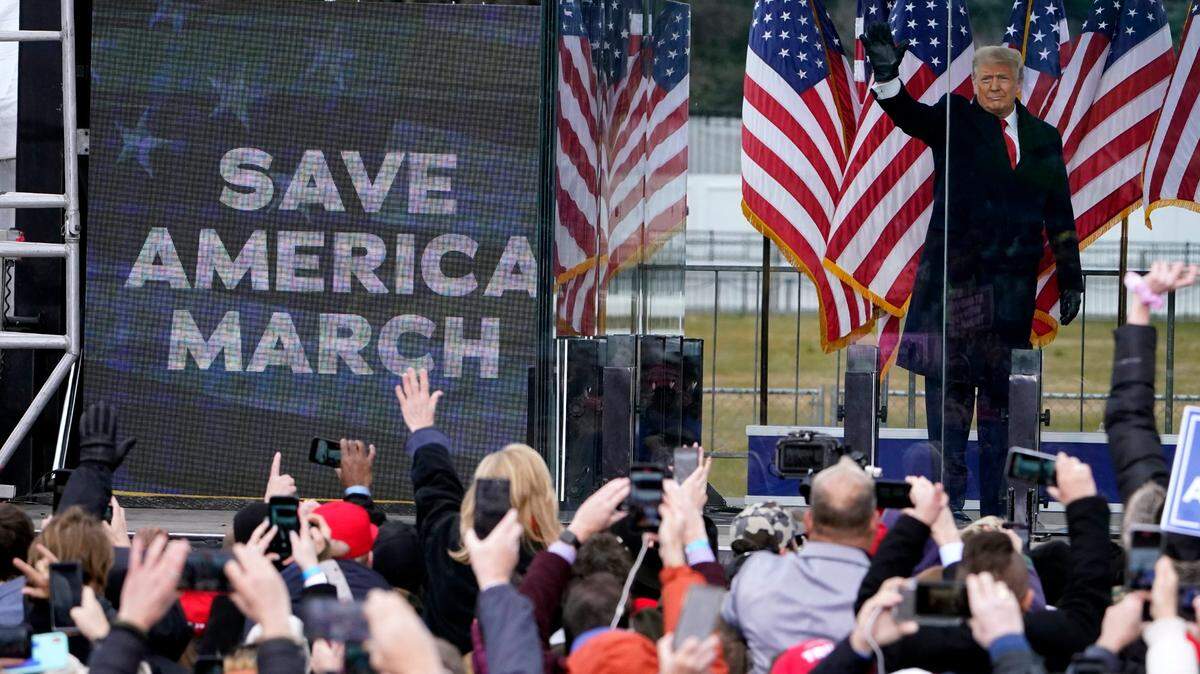
But these two elements — uneven playing field and voter suppression — were inadequate in 2020. With the Democrats winning the popular vote by more than 7 million votes and taking six key battleground states, the election results could not be overturned, especially as President Trump left the attempted coup in the hands of incompetents like Rudy Guliani while Trump took a prolonged golf vacation.
Now the Republicans know they cannot simply rely on preventing eligible voters from casting ballots; they also have to be able to disallow ballots cast against them.
The Republican equivalent of the “legal revolution” will be to replace the thin layer of low-level Republican electoral officials who put electoral integrity before loyalty to Trump.
In states that Republicans control, there will be no Raffenspergers and Sperlings refusing to “find” votes in Georgia, no Michigan legislators refusing to approve an alternate set of electors, but rather only those handpicked to reverse — or at least confuse — the outcome in the next close election.
The next close election could well be one in which the outcome cannot be resolved in a manner acceptable to more than half the nation.
Christopher R. Browning is a historian of Nazi Germany and the Holocaust who taught at Pacific Lutheran University (1974-99) and University of North Carolina (1999-2014). He recently returned to Tacoma to retire.