
Spring tides expose octopuses in Tacoma. Here’s what to do if you see one
As spring inches closer to summer, beach-going Pacific Northwesterners might notice Puget Sound tides inching farther out, exposing more of the sea floor during the day.
Thanks to Earth's 23.5-degree tilt, the angles of the sun and the moon shift between the summer and winter solstices. That means that in the summer, the Northern Hemisphere tilts toward the sun, exposing its lowest tide in the middle of the day, and in the winter, it tilts its lowest tide toward the sun at night. Which makes for some perfect Northwest beachcombing during low tides on spring and summer days.
Spring tides occur twice a month at the new and full moons, when the Earth, sun and moon are aligned, resulting in more dramatic tides (”spring” has nothing to do with the season, it’s the action of “springing forth”).
Most recently, they occurred in the Pacific Northwest May 17-19 when the low tides around Commencement Bay were -3.86 feet, -4.10 feet and -3.81 feet, respectively.
If you didn’t make it out for this month’s spring tides, you might have seen photos pop up in Tacoma’s various social media communities of crabs, sea stars and anemones sprinkling the rocks, ever so much farther out than normal.
And a lot of octopuses.
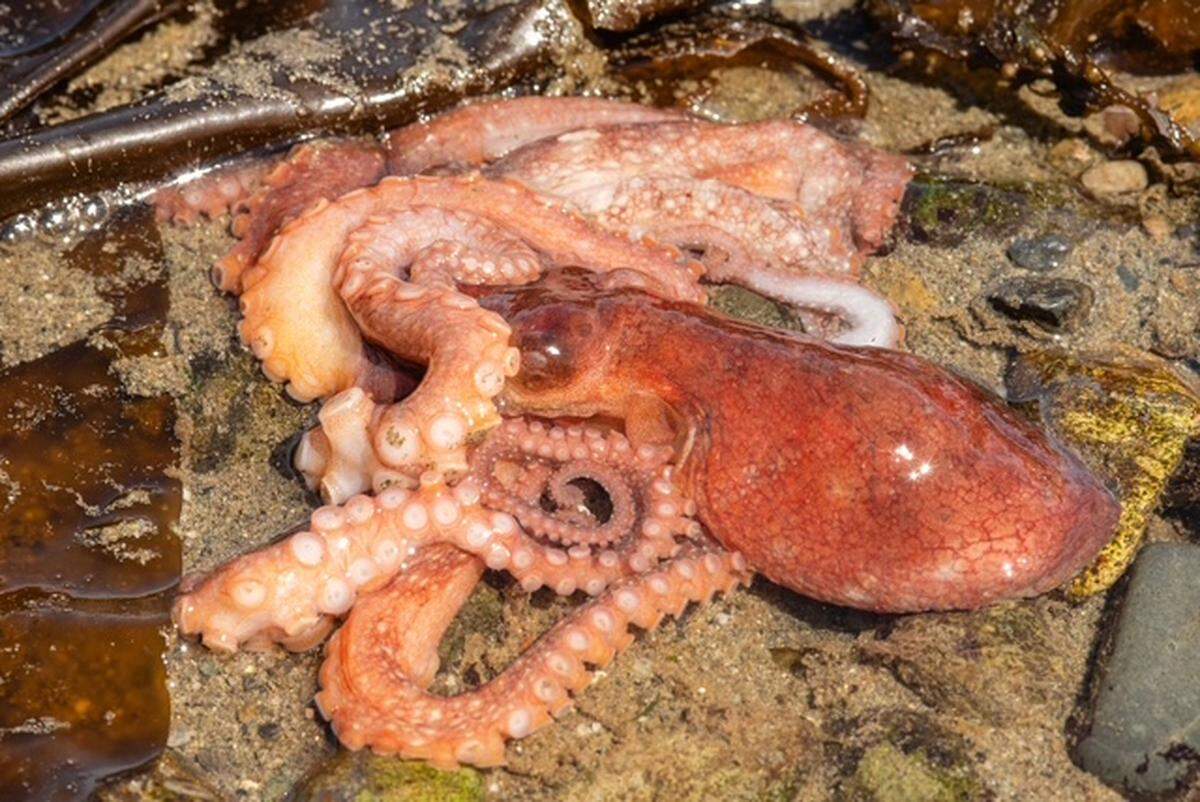
Spotting an octopus can feel a bit like seeing a mythical creature, and when there’s more than one of them crawling around the rocks, it can make Owen Beach feel like Narnia or Atlantis.
Just ask Trevor Ducken, a mail carrier from Proctor.
On Sunday, Ducken attempted to take his 3-year-old son to Owen Beach at low tide, but his son really wanted to go to the zoo. Ducken didn’t want to pick a fight with his boy, so the zoo it was.
Luckily, Ducken had the next day off and headed to Owen Beach on his own. Immediately after parking his car and walking onto the rocks, he was met with multiple octopuses.
“It was crazy, there were several small octopuses crawling around,” Ducken told the News Tribune. He took some photos, then walked down the beach a little ways, when suddenly some bystanders he had been chatting with called him back.
“This lady was like, ‘Come back!’ so I ran over there, and they’d found a giant one. It didn’t really want to be seen, so it kept stirring up the sand and kicking the water.”
Ducken says the octopus (species undetermined) was about the size of a “mid-sized pumpkin that you’d carve for Halloween” and had been in a pool of water under a slab of concrete that someone had turned over.
Ducken didn’t want to touch the octopus, but, driven to communicate, he put his hand in the water. He says the octopus reached out at that moment and grabbed his finger.
“I just kind of let it wrap around my finger, and it felt like a suction cup. I had to gently remove my hand because I didn’t want to hurt it,” he said.
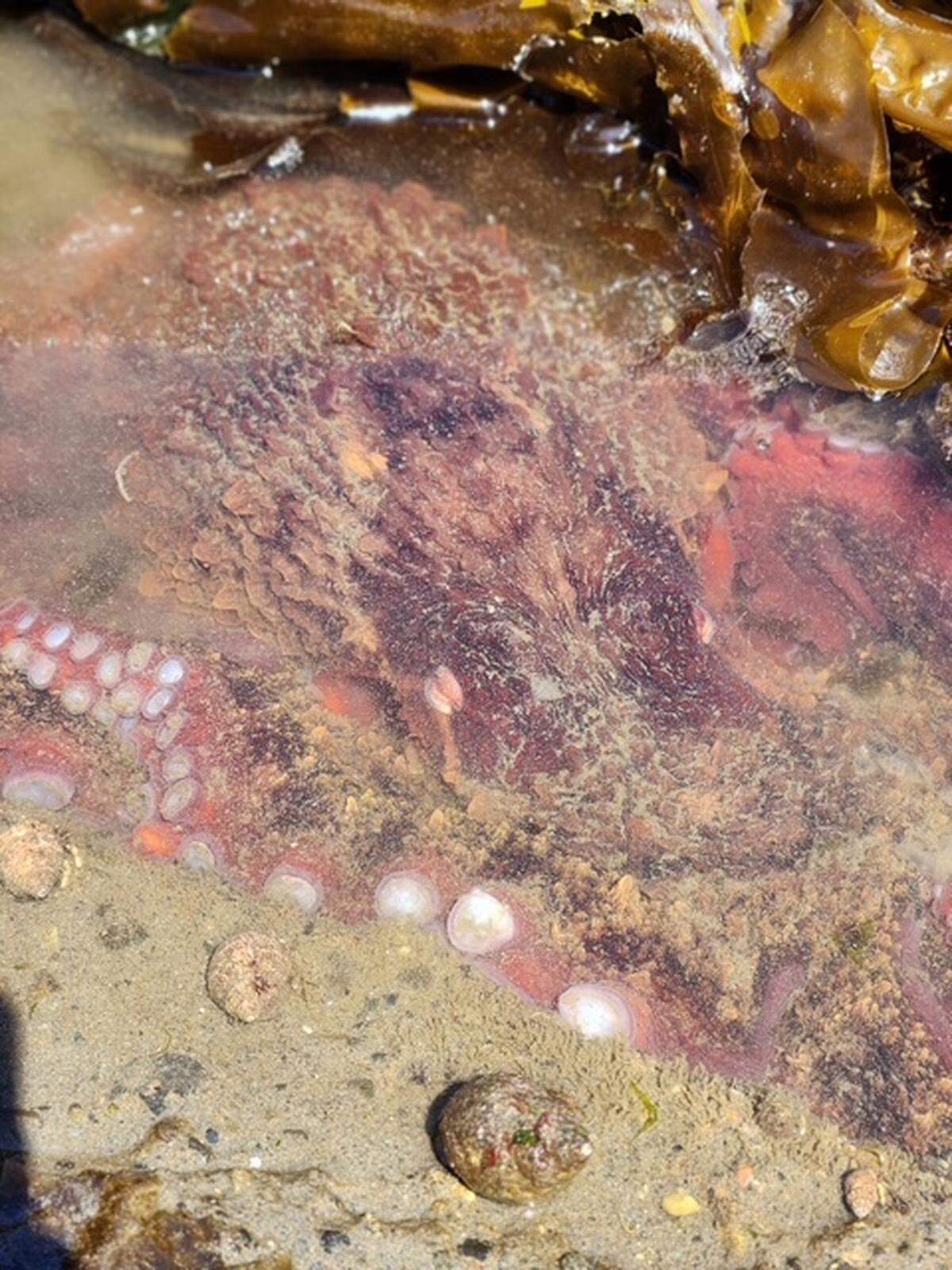
The crowd could tell the octopus was stressed, so they picked up the slab and moved it back into place.
That raised the question: What are you supposed to do when you see an octopus on the beach?
For that, we reached out to Brianna Charbonnel, education coordinator at the Tacoma Nature Center.
“My first answer is probably not the one that people want to hear,” Charbonnel told the News Tribune. “It’s the cycle of life, and an octopus exposed at low tide has tentacles. If they need to, they can crawl down to the water. If it is exposed at low tide, though, it’s a really good opportunity for birds and other animals to feed on it and get food that they might not regularly get.”
Charbonnel says it’s different if humans intervene.
“If you flip a rock over and expose an octopus, that’s quite a bit different from an octopus being up on the beach on its own accord,” Charbonnel said.
She’d like people to flip that rock back over and not touch that octopus.
“Octopus bites are quite painful,” she warned.
Charbonnel says the Tacoma Nature Center believes in touching and connecting with marine life, but it must be done safely and with intention.
“When you’re on the beach, there’s a practice that we always want people to follow, and that’s always to touch marine life with wet fingers,” she says. “Because dry fingers are like sandpaper. Touching and interacting are how we learn; we just want to do it responsively.”
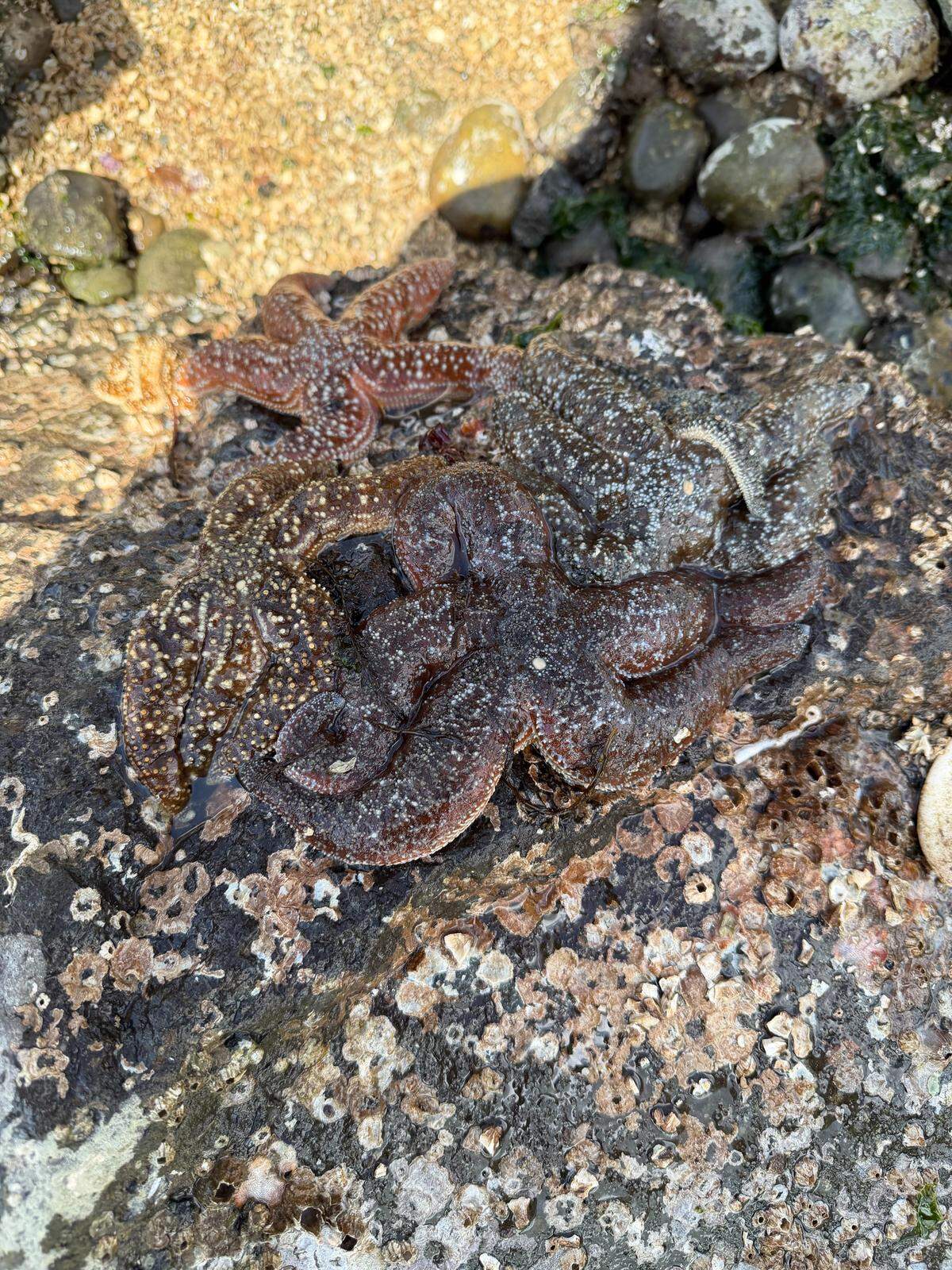
“We can engage and touch sea stars, anemones, and sea cucumbers. But in ways that are more thoughtful than maybe the ways my generation did.”
She then gave an example of a crab being lifted higher than a skyscraper and dropped. Or having a giant come rip the roof off of your house.
“We want to hold the crab close to the ground, and put the rock back after we’ve moved it,” Charbonnel said.
Katt Merilo from North Tacoma was on a walk with friends on Owen Beach on Sunday when she came upon an octopus as well. She did not touch it.
Her 3-year-old daughter didn’t want to get any closer to it, so they watched it crawl back towards the water.
“There were a lot of marine birds out, but they all seemed to be interested in something else further towards the marina,” Merilo told The News Tribune. “I think it made it back to the water.”
There were people with dogs nearby, so Merilo warned them to keep an eye out for the marine life.
“No one wants to see a dog grab an octopus,” she said.
The next spring tides arrive in Tacoma June 14-16 with daytime lows of -3.90 feet, -4.30 feet and -4.30 feet, respectively. Bring your dogs, but please keep them on a leash.
This story was originally published May 22, 2026 at 5:00 AM.
.jpg)