
Mariners takeaways: Toro’s torrid start, Kelenic’s swing adjustment paying dividends
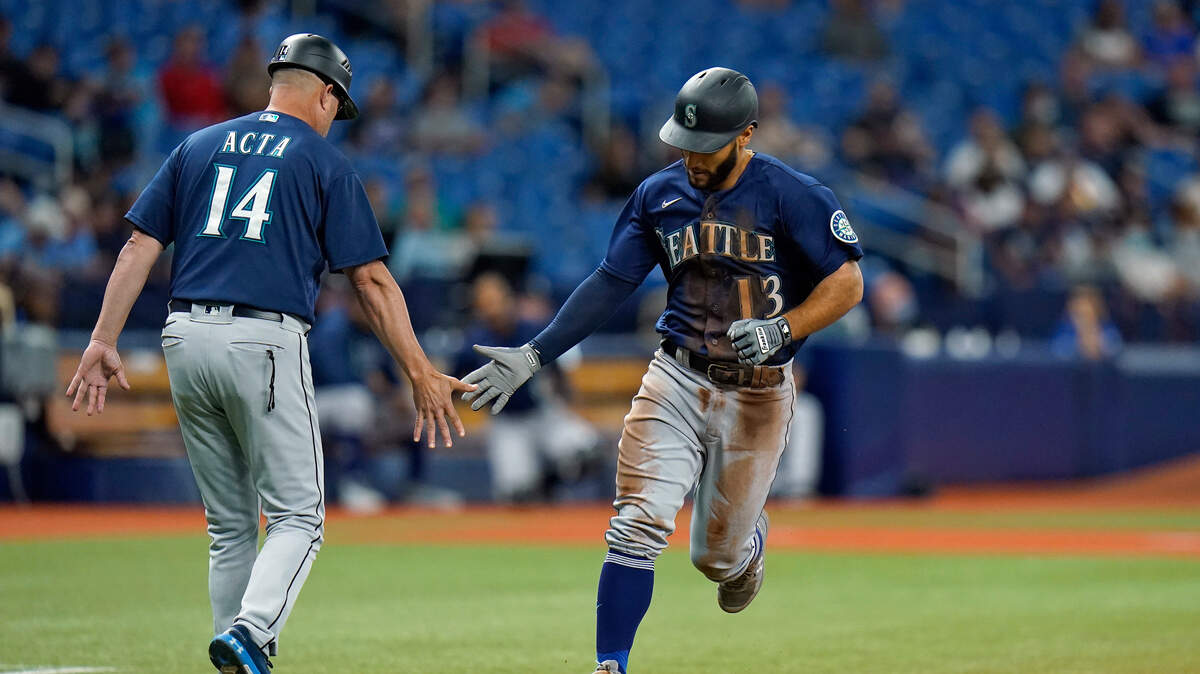
Minutes after taking batting practice and finishing a pregame meal, Abraham Toro was called into Astros manager Dusty Baker Jr.’s office. He had been traded to the Mariners, the team he had prepared to play against that night. And because they were already inside T-Mobile Park on July 27, Toro packed his bags and walked across the field.
From that point on, the newly-acquired Mariner would spend the following two weeks not only at a new position, but as one of the most valuable hitters in baseball.
In his first game in a Mariner uniform, Toro hit a ninth-inning, pinch-hit double against the team he arrived at the stadium with. He became the first player in major league history to homer in the same ballpark on consecutive nights on different ball clubs.
Toro was only getting started.
In his first 10 games with Seattle, Toro amassed a .432 batting average, and reached base at a .488 clip. He mashed three homers, drove in six runs, and was considered the third-most valuable hitter in baseball over that span, per FanGraphs.
“To come here and just have the chance to play every day and just show what kind of player I can be… it’s having a lot of confidence in me and letting me do my thing,” Toro said during Seattle’s east-coast road trip. “That’s what I like a lot over here.”
His playing time with Houston before the trade was patchy. An Astros infield composed of Alex Bregman, Carlos Correa, and Jose Altuve log jammed Toro’s progression to everyday play, and the 24-year-old appeared in only 35 games as a result.
Seattle’s front office found an opening. Dylan Moore and Shed Long Jr., for the majority of the season, platooned the position. The acquisition of Toro filled two needs; to upgrade the roster without trading future prospects, and to stay young as the team reaches what they hope is a window for playoff contention.
The Mariners no longer resemble a team that was once so reliant on the top of their order earlier this year.
“We started plugging Toro in there at the five hole, and then Fraley comes up and then you get the younger guys,” Servais said. “The Kelenic’s, the Raleigh’s, and you mix Torrens or Murph, whoever is in there at the bottom. Now you’ve got real depth, and it’s not just leaning so heavily on those guys at the top.”
But the acquisition of Toro brought a new challenge for the infielder: a transition from his natural position of third base. With Kyle Seager as an anchor at the hot corner in Seattle for over a decade, Toro would have to play second, a position he had only played once in his big league career.
Before every game, Toro spends time with infield coach Perry Hill to ease the transition. In Tampa Bay, Servais noticed him taking pregame drills from Hill in a hallway underneath Tropicana Field.
Through Saturday, Toro had yet to make an error in 33 defensive chances after spending 77.2 innings at his new position.
“(It’s) been more of a short-arm... throw to first, instead of that long throw when I’m at third base,” Toro said. “I’m working on that, and also with the transfer from the double play and trying to be quick instead of just throwing the ball hard.”
What stood out Servais in the opening weeks of Toro’s Seattle career was his calm demeanor. He gets in the batter’s box, and he’s not in a hurry. He trusts his eyes, and his swing stays in the strike zone.
“And the fact that he can switch-hit, he’s a tough guy to match up against no matter who you’re putting out there,” Servais said.
Kelenic’s swing adjustment continues to pay dividends
Under the lights in his Yankee Stadium debut, Jarred Kelenic found a mistake over the heart of the plate. It was Chad Green’s misplaced 84 mile-per-hour breaking ball, and Kelenic found it. His eyes lit up, and with a new-and-improved swing, lasered a home run over the short porch in right field.
For a moment, it broke what was a 2-2 tie in the seventh. A half-inning later, Joey Gallo would reclaim New York’s lead with a three-run home run of his own. But for Kelenic, the blast was his second in three games. It raised his batting average in the month of August to .294, and through five games, he had reached base nearly 43 percent of the time.
Throughout Seattle’s previous homestand, Kelenic adjusted his swing and stance. Upon his major league debut, the 21-year-old stood in the box hunched over, with a noticeable rock in his shoulders. He struggled to hit breaking balls, and pitchers took advantage of that inability.
Now, Kelenic stands upright. He minimizes the shoulder rock, and lets his hands do more of the work in his swing. He’s striking out less, and hitting more.
“It’s something small, but it really makes a big difference,” Kelenic said last week. “Being more upright allows me to let my hands work a little bit. It’s... freer. Less of a (shoulder-reliant) swing. Just kind of throw the hands, and I think that’s what I’ve been really focusing on lately.”
And Kelenic, one who has seen more than his fair share of left-handed pitchers, says the adjustment helps equally against southpaws, too. His new stance — and subsequently, new swing — allows his hands to stay inside pitches, particularly those that sink in the zone.
As Kelenic battled through an 0-for-42 slump, he fouled off a lot of his pitches straight back. Once there were two strikes, pitchers got him to chase on breaking balls, and his strikeout rate neared 30 percent.
“He only gets so many good pitches to hit,” Servais said. “You need to put them in play, and that’s what he’s starting to do more consistently.”
The rookie struck out just seven times throughout Seattle’s ten-game road trip. His swing path is more consistent, and he’s not chasing balls in deeper counts.
He’s making pitchers throw to him, and Chad Green obliged with a gift of a breaking ball to the outfielder on Thursday.
“I’m just trying to stay positive and continue to work my tail off,” Kelenic said. “That’s something that I can control. I have always been someone that has worked extremely, extremely hard, and that’s never changed. … I’m going to live off today, and hopefully bring it into tomorrow, and the next day, and the next day.”
France carries July hot streak into August
On Saturday afternoon inside the walls of Yankee Stadium, Ty France was hit by a pitch for the 19th time this year. He jogged to first base, officially a co-owner of a Seattle franchise record for most hit-by-pitches in a single season.
His toughness, like it has been all year, was tested in the Bronx. Before a wrist injury in May that sidelined the infielder for ten games, he found himself in a 6-for-56 hitting slump. And despite the 18 other times he took a pitch to the body, he rebounded.
In July, France appeared in 24 games, and hit safely in 21 of them. He hit .319 through the month, and covered first base in what has become a season-ending hip injury for gold-glover Evan White. August has been more of the same, as France sported a .346 average throughout the month’s opening six games.
“Honestly, I think (I’m) just getting back to feeling 100% healthy again,” France said over Seattle’s recent road trip. “You know, not having that little thought in my head where something might be off with my wrist or anything. So just getting back to being healthy and just playing my style of baseball.”
From the moment he was acquired in last summer’s seven-player trade with the Padres, Seattle’s front office knew France could hit. Manager Scott Servais attributed barrel awareness to the cause. He can handle different pitches, and find the barrel regardless of pitch location and velocity.
“He can dial it up against the guy who throws really hard,” Servais said. “He can slow it down at times if he knows that guy’s really good pitch is a slider, and take it the other way.”
But under France’s flashy hitting numbers is unsung praise for his defensive efforts. He’s known to turn the crucial 3-6-3 double play, and can pick balls out of the dirt. He may step behind the bag, or make an athletic adjustment in case of inaccurate throws coming his way.
And despite above-average slugging numbers, Servais expects a boost in power numbers.
“As he gets to know the league a little bit more… you’re going to see more power numbers come,” Servais said. “Because he’s got power. We’ve certainly seen it… so there’s a lot to like when (he) gets to the batter’s box.”
UP NEXT
After finishing their 10-game road trip with a 4-6 record, the Mariners return home to T-Mobile Park. Seattle returns home Sunday night, has an off-day Monday, and begins a six-game home stand Tuesday.
The Mariners won two of three from the Rays at Tropicana Field last week, but lost three consecutive games to the Yankees. In all of them, they held a lead through the sixth inning or later.
They avoided a four-game sweep in Sunday’s 2-0 win, and while they remain in the postseason hunt, their odds of ending a 20-year playoff drought have fallen to just 1.2 percent, per FanGraphs.
“These guys believe in themselves,” Servais said. “I believe in them. That’s all you need. As long as the guys in the room believe, we’re in good shape.”
Logan Gilbert takes the mound Tuesday for the Mariners to kick off a three-game set against the last-place Rangers. They’ll play three more against the Toronto Blue Jays over the weekend before starting another road trip.
“We’re right in every game,” Servais said after Sunday’s win. “We played really good baseball, for the most part, and we’re looking forward to coming back home.”