On team buses Seahawks’ Bobby Wagner learns winning — and the business of the NFL
You already know about the first-class seats the veteran Seahawks get to swipe from coaches on the plane rides home from road wins.
It’s why Bobby Wagner bellows throughout the locker room following each victory away from Seattle: “First class!”
The All-Pro linebacker and captain has another example of travel arrangements that have contributed to Seattle’s best-ever road record entering Sunday night’s NFC West test against the Rams in Los Angeles.
“The one-bus thing,” Wagner said Wednesday.
It’s a change coach Pete Carroll made this season. He did it in consultation with Wagner, fellow franchise cornerstone Russell Wilson, longest-tenured Seahawk K.J. Wright and other veteran leaders. Carroll consults with them as a leadership counsel to make team decisions ranging from uniform-color combinations to practice schedules and beyond.
“On the road, we typically had two buses,” Wagner said. “We had an early bus and a late bus, which is normally a later bus because the special-teams guys, they tend to go out earlier (on the field) than anybody else (pregame).
“But the one-bus thing was kind of for everybody to be more connected. So instead of separating the groups (offense, defense, special teams), having everybody come (to the stadium) together, everybody preparing together, everybody coming out together.
“I feel like it speaks to that closeness. When you are around the guys so much, it kind of makes you learn who you are playing with. It builds that camaraderie.”
Wagner said the Seahawks made the change beginning on their way from the team hotel in Pittsburgh to their win in the first road game this season, in mid-September, because of all the new players on the team.
“Instead of educating everybody separately,” Wagner said on how the Seahawks do things on the road, “we got them together.”
Together works.
Playoff berth close at hand for Seahawks
The Seahawks (10-2) enter Sunday night’s chance to clinch a playoff berth with a win at the Rams (7-5) off to the best road mark in the franchise’s 44-season history: 6-0. A victory in Los Angeles would set the team record for road wins in a regular season.
Seattle would be 11-2 for the fourth time. The last two times, in 2005 and 2013, ended that season in the Super Bowl.
Sure, winning makes teams closer. A 10-2 team is going be—and describe how they are—far more tightly bonded than a 2-10 one.
Nobody is trumpeting how close the Cincinnati Bengals are right now.
But Carroll and players such as Wagner, Wilson and Wright have been talking since training camp this summer how uniquely close this team is.
Carroll has said it might be one of the most tightly-knit squads he’s had in his coaching career. And that began when Richard Nixon was the president, in 1973.
When did Wagner notice this closeness among these Seahawks?
“In OTAs,” he said, referring to organized team activities, the offseason workouts in May. “Just the way guys were taking the time. For us, it was Coach (Ken) Norton (the defensive coordinator) coming up with ideas to compete against each other. We created different teams to go against one another.”
That competition is in free-throw shooting contests before team meetings. There is a regulation height and size hoop bolted into the stage of the main auditorium of Seahawks headquarters. There were dance contests. Even mundane drills, such as foot-quickness work through soft ladders laid flat on the side of the field at the start of practices, have become heated competitions over whose feet are quickest.
Wagner routinely claims to be the most balletic moving through those drills, often to the dismay of Norton and fellow coaches and to the howls of his teammates.
Wagner said the losing teams of these drills and competitions took the winning mini-teams out to dinners that stretched into the summer and fall.
“And, so, doing dinners, doing different group activities, everybody was showing up,” he said. “Nobody was fighting on whether they could make it or not. Everybody would show up.
“I felt like from that, and then growing as a team on the field, we just got closer and closer.”
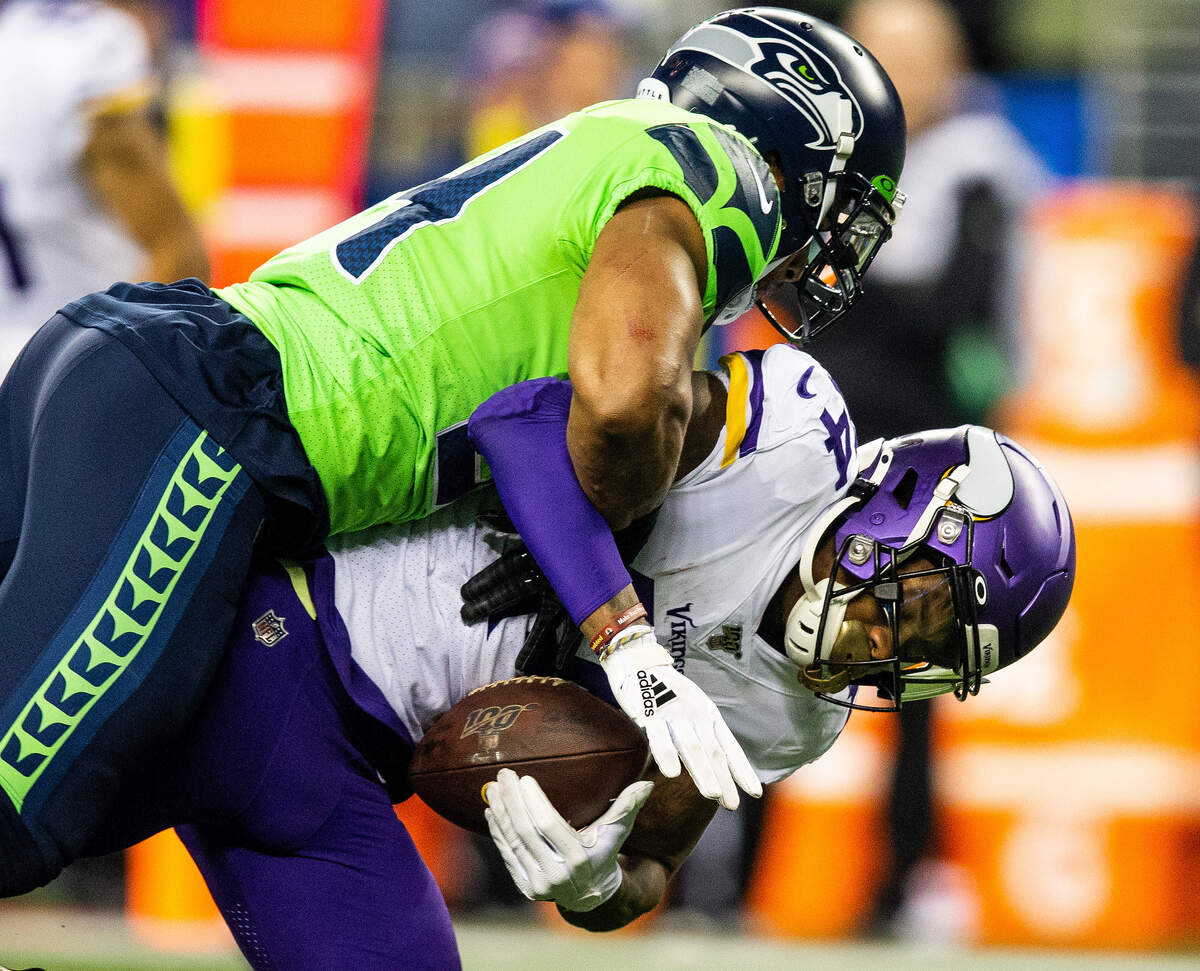
Business is much more than hitting quarterbacks
Wagner, 29, has been growing personally since his first rookie spring and summer in 2012. That’s the year Seattle drafted him in the second round.
He represented himself, without an agent, in negotiating with the Seahawks a new contract this past offseason. That worked out OK for him: a new, $54 million deal in late July, the richest deal in the sport for an inside linebacker.
Recently, he surprised shoppers at a Safeway in West Seattle by buying all of their Thanksgiving groceries for more than 30 minutes. He was in the store filling donation bags for homeless people living in the tiny homes project of encampments around Seattle he began partnering with this summer.
The book Wagner is currently reading: “The Game of Life and How to Play It” by Florence Scovel Shinn.
This week he made the 2020 Forbes 30 Under 30 list of top young entrepreneurs. The financial publication tabbed Wagner because of his self-learned business acumen and his urging fellow athletes learn the business of their sports.
Forbes likes to say its annual 30 Under 30 “carries a lifelong reputation of embodying the revolutionary, innovative and entrepreneurial spirit that the organization represents.”
Wagner likes the sound of that.
“It was something I wanted to do off the field. I didn’t know how I was going to do it, but I wanted to be on Forbes magazine,” he said. “It’s not the cover, but I’m getting close. It’s on the pages. I’m working my way up.
“It was cool. I’ve really tried to focus on not just being a good football player, but being a good all-around person. And I’ve mentioned it multiple times: wanted to make the transition away from this game, hopefully 10 or 15 years from now, an easy one. I work really hard in the offseason to try to be smarter, to be very aware.
“So it was cool that they recognized that.”
Wagner strongly believes players in the NFL, in all sports, need to seize control of their entire financial outlook. To be far more involved and proactive than just hiring financial planners and agents to handle their money for them.
“It started when I got to the league,” he said. “I remember going to the (NFL) rookie symposium. I remember spending three days—I don’t know where we were, I think Ohio...they were basically telling us, ‘Don’t trust your agent. Don’t trust your financial advisor. Don’t trust your family. Don’t trust your coaches and the GM.’
“By the end of the day they asked, ‘Does anybody have any questions?’ I remember, I forget what the guy’s name was but he was from Stanford, he stood up and he said: ‘So what’s good about the league? Because all we know is you can’t trust nobody.’
“So you get to the league and they tell you that you are only going to last three years, if you are lucky. And after that 80 percent of the players go broke and are divorced. I’m like, that’s not really good stats, either. I was like, man, a lot is stacked against you.
“So you start to figure out, ‘OK, how do I get to be in that 20 percent? What are those guys doing that are still with their woman, that are still financially stable, and are able to make it past the three years? What did they do?’”
Lessons never stop coming
Wagner said what he learned was the football was obvious. The guys that took care of their bodies, that worked hardest, that showed responsibility and studied game film, etc., were the guys that made it.
“But as far as the financial stuff, and making it off the field, it was: Who was going to take the time to learn money,” he said. “I felt like a lot of guys come from different situations, but you don’t have money—and then you have money. I remember the first time I got the taxes taken out, I thought someone robbed me.
“I thought the Seahawks took me. I was going to go up to the third floor (of team headquarters) to see where my money’s at.”
So he taught himself the business side of football, through watching older, wiser veterans. He studied their ways. He asked questions and took advice of former teammates such as Russell Okung and Richard Sherman, who also eventually represented themselves minus agents in contract talks with the Seahawks and other teams.
“I took the time to learn,” Wagner said. “We are taught when we get this money give it to the financial adviser. Well, you are never going to learn about the money if you just give it away. And you don’t know anything about a contract because we put our trust in the agents, and not have them take us through everything.
“So, if you are going to spend so much time being in this business, you might as well learn every aspect of it. So I tried to learn every aspect from the moment I got here...
“And try to be the 20 percent.”
This story was originally published December 4, 2019 at 3:57 PM.