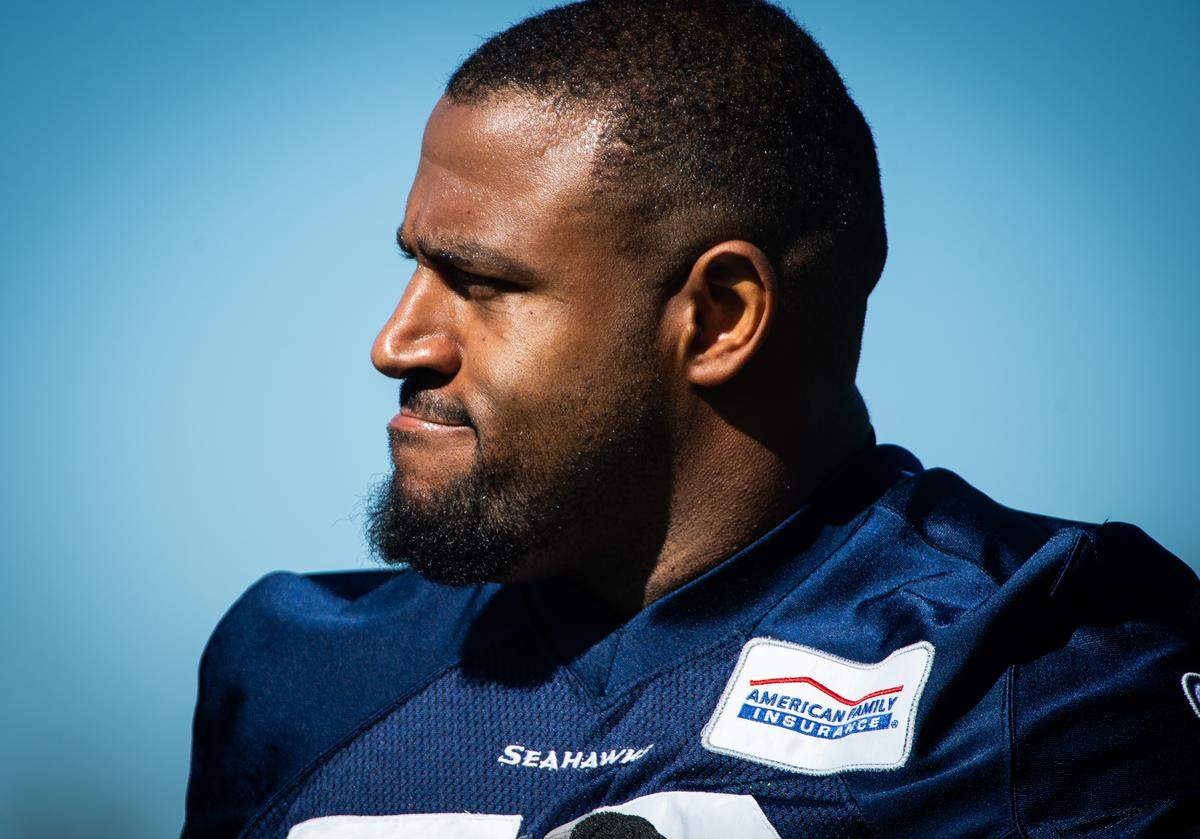
We all could benefit from the new workout approach of Seahawks 13-year veteran Duane Brown
No need to remind Duane Brown he turns 35 this summer.
Or that he is coming off knee surgery. Or that he played months through a biceps injury last season.
All of that and more is why the Seahawks’ Pro Bowl offensive tackle, one of Seattle’s best and highest-paid players, has invested this offseason in a new training regimen.
The massive Brown is now something of a budding yogi. Flexibility with the aims of injury-prevention and longevity are his new goals.
It’s yoga and stretching over brute strength.
For a 6-foot-4, 315-pound giant described by Seahawks general manager John Schneider as “a mountain of a man” who’s job is to be stronger than the guy he’s blocking, that’s saying something.
“One thing that I’ve worked on this offseason is mobility, just being more flexible,” Brown said Wednesday while on a Zoom online call from his home in Houston. “A lot of my career I’ve just focused kind of focused on, you know, speed, strength, quickness, things like that. I’ve really been big on mobility this year, just being more flexible.
“I’m working on my hips more. More body maintenance, being more proactive about my body than in years past.
“I’ve worked very hard.”
The autonomy of this offseason
Brown is entering his 13th NFL season. He says he’s been working out five days per week at home this offseason and during the coronavirus pandemic.
The COVID-19 virus has kept all NFL players away from closed team facilities since March. That’s meant no formal offseason weight lifting and training with teammates at their headquarters, as Brown had done for his first dozen springs in the league (2008-16 with the Houston Texans and since his trade to Seattle during the 2017 season).
So it’s been up to each player to stay in shape in home workouts tailored as he and his personal trainer see fit.
Brown sees yoga as his better fit now. The Seahawks need him to be right.
They are paying Brown $8.75 million this coming season with a $12.56 million salary-cap charge that is Seattle’s third-highest for 2020 (behind Russell Wilson and Bobby Wagner). His and each player’s responsibility to show up in NFL-ready shape for the start of the preseason is even more pronounced during this unprecedented, pandemic offseason.
If Brown says yoga and flexibility is the way to go, the Seahawks are all for it. What he’s done for the last 12 years has worked. He’s become one of the league’s top tackles while never playing fewer than 12 games in a 16-game regular season. The lone exception: the 2017 season when he held out for the season’s first two months. That was over a contract dispute with the Texans, which led to his trade to the Seahawks.
“The older you get, you have to match that (training) with the same level of body maintenance,” he said. “Not get your muscles too tight, and things like that. So that’s been the big thing for me.
“Definitely been doing yoga. Just stretching a lot. Like, I probably stretch three times a day, for about 15 to 20 minutes. And just the workouts I’ve been doing.”
Since he’s been in high school, Brown’s done what every football lineman does, religiously: endless regimens of Olympic weight lifting. The traditional bench presses, deadlifts, shoulder presses and other movements that focus on the larger muscle groups for raw strength.
Brown’s new idea is one many in weight training believes is the way to go: to develop more his smaller, foundational and quicker-twitch muscles such as core, calves, gluteals, hip flexors and adductors. Increasing scientific evidence points to focusing training on those often-overlooked muscles leads to increases in overall speed, strength and explosiveness—with the huge, added benefit of fewer injuries to longer, more flexible body parts.
“Now, I’ve been hitting more of the smaller muscles,” Brown said. “Just working my flexibility throughout my workouts.
“Instead of going in and just doing bench press, squats, power cleans, I’m working in smaller muscle groups and working in flexibility in between my lifts. Stretch my muscles out and not shorten them, things like that.”
Brown hopes lengthening his muscles will lengthen his career.
The key to a changed line
Brown has this year and next remaining on his contract. He turns 35 in August. He will be coming off his knee surgery in December on top of the biceps injury he played through most of last season.
He says both his biceps and his knee are good, and that his knee is “great,” in particular. He said he didn’t need additional surgery on the knee nor one on the arm.
The Seahawks need all of Brown in 2020. He could be the only starter returning to the almost completely changed offensive line.
Brandon Shell signed from the New York Jets for two years and up to $11 million to replace Germain Ifedi at right tackle. Ifedi left in free agency this spring, on a one-year deal to Chicago. Fellow tackle George Fant left in free agency to the Jets for three years at an average of $10 million per season.
The Seahawks signed former Steelers center and guard B.J. Finney to a two-year deal that could be worth up to $9.5 million. He’s in line to replace Justin Britt. Seattle released its starting center in a cost-cutting move last month.
The Seahawks also released starting guard D.J. Fluker for the same reason they cut Britt. They selected Damien Lewis in the third round of last month’s NFL draft to be the new right guard.
The team brought back veteran Mike Iupati, signing him later in free agency. He started at left guard for Seattle in 2019. But Iupati turned 33 this month. He played through a foot injury last season. Then he missed both of Seattle’s playoff games in January with a nerve issue in his neck. He could be a secondary option to start in 2020.
The Seahawks are eager to see what Phil Haynes has at left guard. They drafted him in the fourth round last year to play there, but then Haynes missed his rookie season because of a core-muscle injury and surgery.
All that change leaves Brown as the lone returner with his job assured.
And it leaves the Seahawks in a less-than-ideal spot. Without offseason practices to acclimate, they are trying to improve their pass protection that has been awful in recent years. Wilson has been unable to consistently do what he does best—throw accurately deep down the field—because he’s often been getting chased by defenders as one of the league’s most pressured quarterbacks.
Schneider has said this spring in explaining all the changes on the offensive line the Seahawks want “grown men” to better protect Wilson.
Seattle’s “grown men” are almost all new. In the cases of Lewis and Haynes, they are completely unproven. And the Seahawks don’t have offseason organized team activities (OTAs) and minicamps to develop the chemistry and continuity Brown says is vital to having a good offseason line.
OTAs and minicamps have been canceled by the pandemic. It’s likely the first time this new line will be on the field together will for the start of training camp, whenever states’ efforts to contain the COVID-19 virus allows training camps to begin.
“A major factor is just chemistry, you know, and continuity. We lost a big chunk of our starting pieces that past offseason,” Brown said.
“So we’ve got some new faces. We’ve got some guys that have been in the system. We’ve got some guys who haven’t been here. So, just getting to learn each other, learning the terminology, communication, you know, just learning how we do everything here, all that stuff’s important. ...
“It sucks not being able to do that (on the field all offseason). But that’s the position we’re in, so we got to make due with what we have. The thing about it is, every team is dealing with it.”
This story was originally published May 27, 2020 at 1:18 PM.