Leadership from Captain Bobby Wagner as key as All-Pro’s play in Seahawks’ COVID-19 season
Linebacker Bobby Wagner may not mean as much to the Seahawks’ success in this unprecedented season as Captain Bobby Wagner does.
Given Wagner is a perennial All-Pro and best in the sport at his job on the field, that’s saying something.
Specifically, that’s saying the example the 30-year-old franchise co-cornerstone with Russell Wilson sets, and the messaging he gives teammates this season while the NFL attempts to play through the coronavirus pandemic, are going to be crucial to the Seahawks’ chances of keeping a full team. And, thus, crucial to Seattle’s chances of winning.
Wagner has been the captain of the Seahawks’ defense the last four seasons. Two days into a training camp like no other, Wagner knows his value in leading especially younger Seahawks such as rookie fellow linebacker and first-round draft choice Jordyn Brooks through this season.
Off the field, as well as on.
“I think it’s extremely important to think that this year is going to be a year that we’ve never experienced before,” Wagner said via a remote Zoom call online Wednesday, the second day of the players’ testing in tents outside team headquarters in Renton for the COVID-19 virus.
“Especially for a rookie. A rookie doesn’t even know what to expect going in. It’s going to be nothing like any of us has seen before. So I think discipline is going to be the biggest thing, understanding that we aren’t really going to be able to do the things that we normally do. And we have to think about not just ourselves but our families, other people’s families, and understand that if we do something reckless or something that goes against what we are trying to do, that doesn’t just affect your family. That affects everybody else.
“So we’ve just got to be really smart about it. Understand the challenge at hand, the task at hand, and really think about others when it’s time to think about (what you do).”
Wagner says: “It’s players being on top of players, understanding that, you know, letting them know, again, it’s going to take a lot of discipline to get this done, and really being on top of everybody and really just keep pushing that message forward. ...
“At the end of the day, it’s going to be a lot of self-discipline.”
Wagner, a native of Southern California, sees an advantage in the Seahawks playing in Seattle as opposed to, say, Los Angeles, New York, Chicago, Atlanta or Miami.
In saying so, he took a playful jab at Seattle’s nightlife.
“We are not going to be able to go and do the things that we do,” Wagner said.
“Luckily, we are in Seattle, so there aren’t really any clubs or things of that nature that...you know, to go out to.
“But just understanding that you need to be more conscious in your surroundings. You have to really be mindful of who you trust, as far as, what are they doing outside of the (team) building. You have to earn your trust in this situation. You have to make sure you are mindful of the guys around you, make sure you are mindful of the people that you keep around you, and understand what’s at stake.”
Coach Pete Carroll and general manager John Schneider said in April, in the early weeks of the NFL and nation being shutdown by COVID-19, they planned to this year add specific, personal maturity and responsibility to Seattle’s roster.
Specifically, they drafted players they believed had experienced life challenges that would better equip them and the Seahawks for the tasks of playing while staying smart off the field during this season amid a pandemic.
Brooks, the star linebacker at Texas Tech, was once homeless.
Second-round pick Darrell Taylor, the pass rushing defensive end from Tennessee who is also joining Wagner’s defense, watched as a young boy growing up in Virginia his father get incarcerated. Taylor’s mother died of breast cancer in 2013, when he was an early teenager. He credits his aunt, his high-school football coaches, “my whole city” of Hopewell, Va. for “pretty much (being) there for me every step of the way.”
Taylor is also a father. His young son turned 2 this month. Taylor says being a dad has taught him patience—and, frankly, the value of being a better father than he had growing up.
Carroll and Schneider selected Damien Lewis from LSU in the third round in April’s draft. They expect him to take departed D.J. Fluker’ job as Seattle’s starting right guard over the next month.
Lewis is 23 years old. He had zero offers from a four-year college out of Canton High School in Canton, Miss. So he went to play for Northwest Mississippi Community College.
While doing all that his father, Damien Dozier, was like Taylor’s father: incarcerated through his son’s teen years. Lewis’ father was in prison on drug-related charges from when Lewis was in eighth grade until about the time he enrolled at LSU in 2018.
Damien Lewis became basically a father to his three younger brothers, now 17, 12 and 11, while Damien was in high school trying to get out of Canton.
“I had to grow up real early, you know,” Lewis said on a Zoom call from his Southern home the night the Seahawks drafted him. “At that time, I had my had two youngest brothers that, my father not being there most of my life, I had to grow up real early. I had to just set the tone for them, how to be a pro at everything. If they see me do it, they’ll do it.
“They are right here with me right now. My baby brother, he’s crying. ...It kind of touches him. I’m just real thankful for that, being in the position to help them.”
When seventh-round pick Stephen Sullivan signed his first NFL contract on Tuesday upon reporting to Seahawks camp, the tight end from LSU posted online “I believed in myself.”
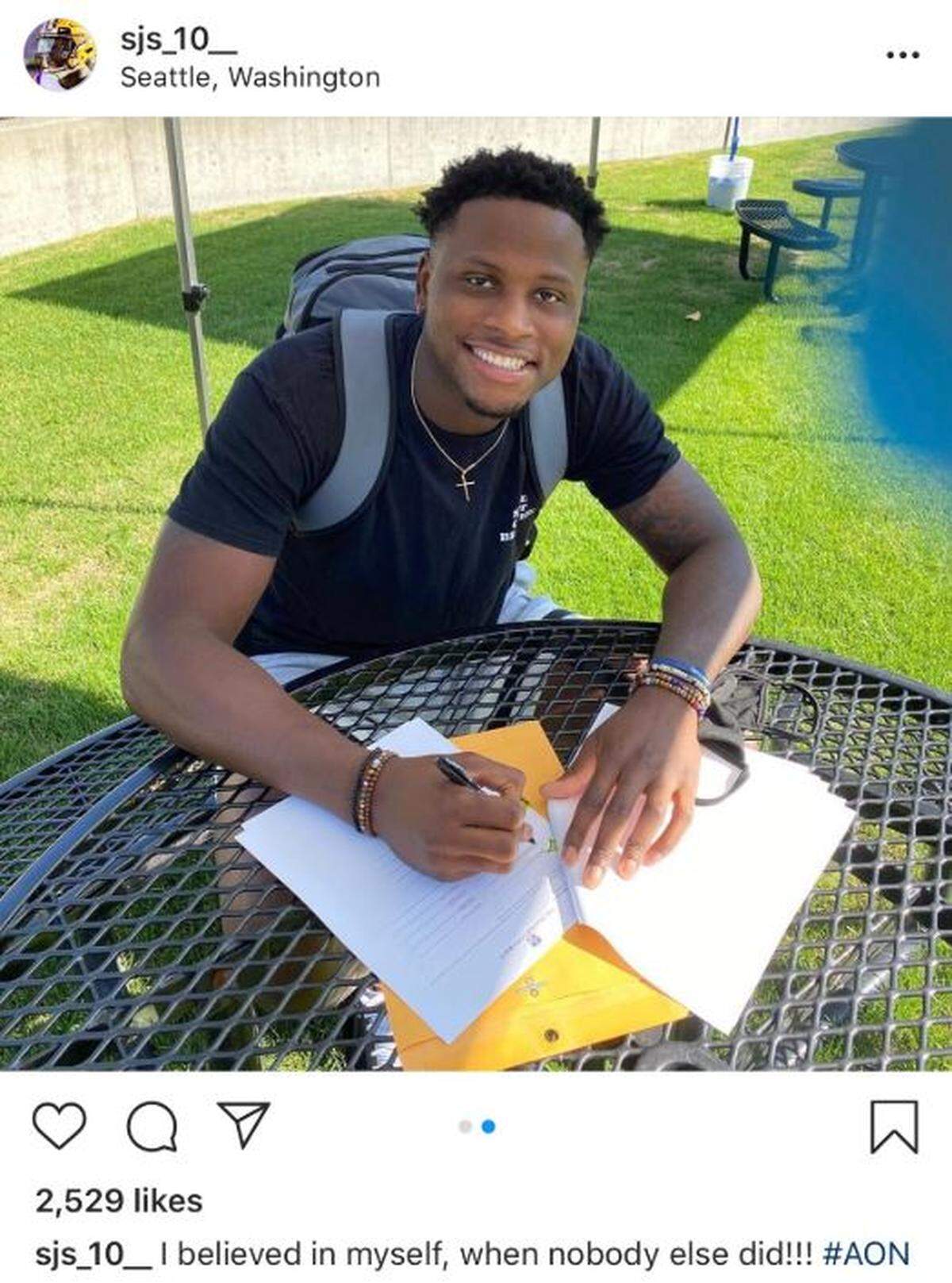
Believe him.
Sullivan still remembers his father beating his mother. He remembers his dad using cocaine in front of his mom, his brothers and him.
He can still see his mom and dad being taken away to jail. He remembers the fear of being taken from the hotel they’d been living in temporarily, the one from which his school bus picked him up every day. He can still feel the cold, scared nights trying to sleep under a freeway overpass.
“I kind of became a man on my own just from learning and watching. Watching coaches. Watching families, and things like that,” he said in an unforgettable Zoom interview online in April.
“I’ve been through so much adversity. I’ve stayed under a bridge a few nights before. I saw my mom and dad get incarcerated. I saw my dad do cocaine in front of my mom. I saw my dad beat my mom. I saw my brothers and my dad get in a fight.
“It’s just so much that I’ve been through.
“Every single day, I think about that and I think about my situation growing up. You can say that motivates me. It does, actually. It motivates me every single day. Just me thinking about my past and thinking about so much that I’ve been through, it’s a long time coming. It’s been some nights where I didn’t know where my next meal was going to come from, it’s been some nights where I didn’t know if I was going to have clean clothes for school. Just hearing my name called, it’s really a dream come true. I can’t really ask for nothing more.”
Chances are lower than with most 23 year-olds that Sullivan is going to risk all he’s gained by going out recklessly during the pandemic in his rookie season.
Carroll, Wagner and the Seahawks are counting on it.
“These guys’ life experiences mold you, one way or the other,” Carroll said. “The guys that have been able to have the support when they needed it or just the ‘stick-to-it-ness’ when they were up against the big challenges. If they make it through it, it makes them stronger. ...
“I think it’s a clear statement about how the challenging and difficult times can really make you stronger and make you better, and these guys are examples of that. If they learn the lessons, then they bring along that willfulness that can make them unique and special. And we really feel like these guys can all come in with a chip on their shoulder. They’ve got something to prove. They’re not going to be denied. They’re not going to let anybody get in their way and take it away from them.”
Now the rookies are with Wagner, Wilson, Wright and the veteran Seahawks. They are getting three COVID-19 tests in the first four days of camp. They will get tested for the virus every day for two weeks. It will be mid-August before they actually practice football on a field.
Then when Seattle’s games begin Sept. 13 at Atlanta, Wagner, Carroll and the Seahawks are counting on all players, rookies and veterans, to do right off the field protecting themselves from the coronavirus.
“This is something that we have not experienced,” Captain Wagner said Wednesday.
“You have to think about more than just yourself in this situation. You have to think about your family. There are a lot of people out there...that have family that live with them, family that stay with them, kids, spouses, that have certain medical conditions, and you have to be mindful of that. ...
“There’s a lot at stake. And I want everybody to be healthy.”
This story was originally published July 29, 2020 at 1:44 PM.