What’s changed for Bruce Irvin since his first Seahawks go-round? His real-life why
Pete Carroll calls Bruce Irvin the best strongside linebacker he’s had in his decade running the Seahawks.
He also calls Irvin perhaps his best success story.
“It’s all the years that he’s put behind him since we had him (the first time),” Seattle’s veteran coach said. “This is a great story for us to get him to come back. I tried to get him a couple times, you know. Couldn’t get it done, in past years.
“Just to bring him back to us, he’s just grown up so much. He’s so mature about his world and his family. The whole thing.
“Really, it’s a great story.”
It’s one of the NFL’s most unlikely ones.
Eight years ago, Carroll and the Seahawks drafted the hard-living, 24-year-old Irvin as a derided first-round pick. Now the 32-year-old Irvin is back for his second go-around with the Seahawks?
What’s changed since he was last a Seahawk?
“I’ve got more kids,” Irvin said Monday.
“My why kind of transitioned from—you know, a younger B.I. my why was cars, jewelry, stuff like that.
“And my why now is my wife and my kids. My family. Generational wealth.”
Yes, his $48 million in career earnings are now for his kids’ kids and their children. It’s not for cars and jewelry and blowing it anymore.
The boy who grew up homeless for a time and in jail as a teen has returned as a man to where his unlikely NFL career began. After stints with Oakland, Atlanta and then last season Carolina, Irvin is back with Seattle and with Carroll, the coach who drafted him eight years ago. Irvin returned this spring on a one-year, $5.5 million contract.
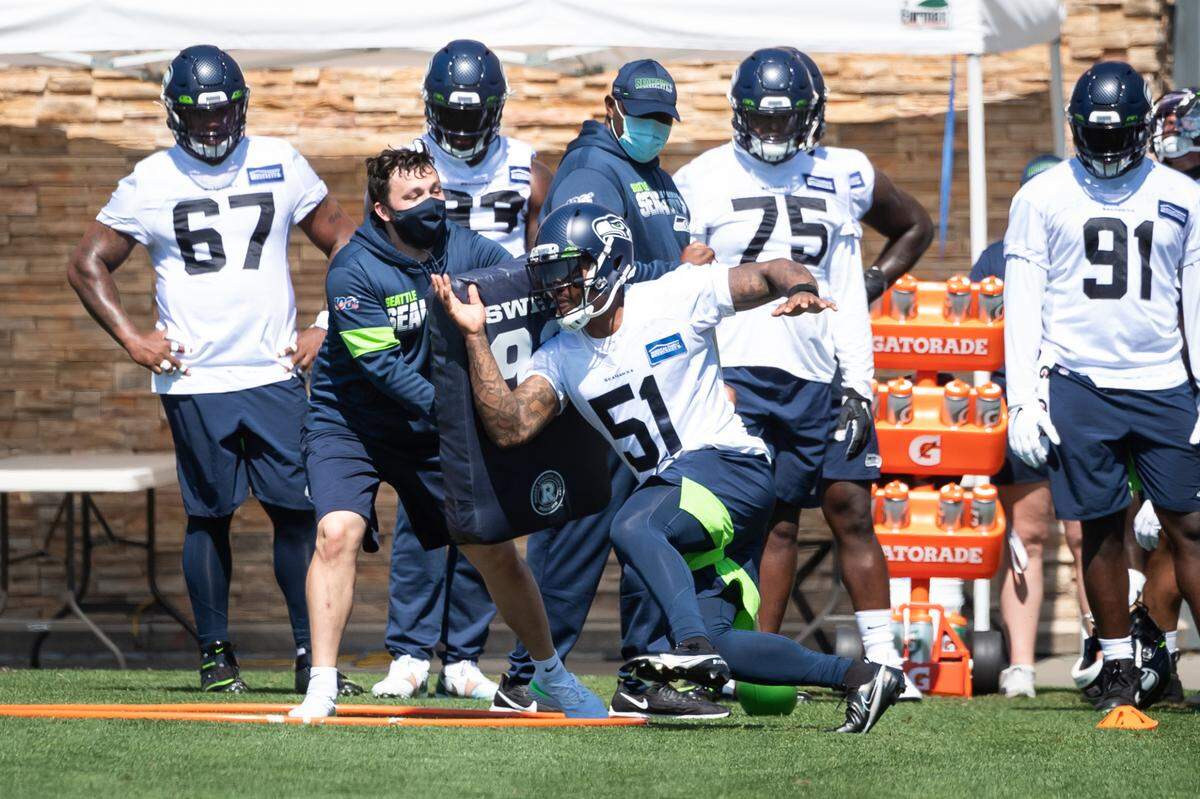
His new-old team is counting on him. Heavily. The Seahawks are guaranteeing him $5 million to be the speedy, edge pass rusher he was for them from 2012-15. They are relying on Irvin to largely make up for the loss (so far) of still-unsigned Jadeveon Clowney from the league’s second-worst sack unit in 2019.
And they are experiencing a changed man.
A hard road
Doubters—there are always those, particularly in Irvin’s life—point out it’s folly to depend so much on Irvin this season because he will turn 33 during it.
Irvin will point out he wasn’t supposed to turn 18.
“Oh, man, sometimes I am in a game, during a timeout break, and I just look into the crowd. A lot of people said I wasn’t going to be here, you know?” Irvin told The News Tribune in January 2015. “Sometimes I doubted it myself to think I was going to be more than what I was. I mean, it’s a blessing. I thank God every day. I thank God when I go out here to practice.
“Because Lord knows I was supposed to be in jail or dead somewhere.”
When Irvin was 17 he had essentially dropped out of high school. He was hanging out in trap houses around Atlanta. He carried a gun. He sold drugs.
When Irvin was 19 was jailed for almost a month, for burglary.
When Irvin should have been graduating from high school, he was taking a General Educational Development test, in a somewhat desperate attempt to try to play football in junior college. Two schools rejected him. But a third accepted him. He enrolled to play at Mt. San Antonio College, east of Los Angeles. He won a national junior-college championship at Mt. SAC.
When Irvin was 24, he had gone from Mt. SAC to become a star pass rusher in 2010 and ‘11 at West Virginia. He had the speed and size NFL teams covet to pressure quarterbacks. But most scouts saw him as a one-trick specialist, a risk on whom to perhaps take a mid-round flier based purely on raw athleticism.
Carroll and Seahawks general manager John Schneider saw someone different. They saw Irvin as an every-down NFL linebacker. They also saw a young man who needed direction, and believed they ran a team that provides it. They envisioned Irvin sacking quarterbacks, tackling running backs AND covering receivers on pass routes down the field.
So the Seahawks drafted the high-school dropout with a GED certificate in the first round of the 2012 draft.
The rest of the league laughed. They also chuckled at Seattle for taking in the second round of that same draft some small linebacker from Utah State named Bobby Wagner. They really howled at the too-short quarterback from Wisconsin and North Carolina State the Seahawks drafted in round three. Some guy named Russell Wilson.
Two years later, Wilson, Wagner and Irvin had Super Bowl rings. Irvin was that every-down starting linebacker Carroll, Schneider and Ken Norton Jr., his position coach, believe he’d become with Seattle.
When Irvin was 27, he clinched another NFC West title and top seed in the playoffs for the Seahawks with his first career interception return for a touchdown.
That was the week he said he should be in jail or dead.
Gone, now back again
A month later, the Seahawks were 1 yard from Irvin and his teammates winning another NFL title. But Wilson threw the infamous interception at the goal line to Malcolm Butler. The New England Patriots won Super Bowl 49 instead.
Irvin ended that Super Bowl ejected for fighting on the field with Patriots after a kneel-down play. In the Seahawks’ locker room moments later at University of Phoenix Stadium in Glendale, Arizona, Irvin screamed to anyone with ears how Seattle’s coaches took away his and his defense’s second consecutive rings.
A year later, Irvin left. He signed with Oakland, to reunite with Norton; Seattle’s linebackers coach had become the Raiders’ defensive coordinator. Irvin signed a $37 million, four-year contract with the Raiders.
Now, four years and three stops later, he’s returned. He’s with Seattle to be Carroll’s strongside linebacker again, on early downs. That’s where he’s been in base 4-3 defense during the first two weeks of training camp, next to fellow linebackers Wagner and K.J. Wright. Just like it was eight years ago.
On passing downs, Irvin will move up a few feet and put his hands on the ground as a rush end. That’s what he was last year for the Panthers. They were in nickel defense with Irvin as a rushing lineman most of their 5-11 season.
But Irvin’s return to Seattle is about more than football. It’s a story about a lost life found. And truly fulfilled.
Carroll, Wilson, Wagner, Wright and who were with the Seahawks for Irvin’s first go-round see a noticeable difference in his maturity, as a player and as a person.
Irvin can’t help but see he’s in a totally different role this time with the Seahawks. It’s a leadership one. Young defenders such as rookies Jordyan Brooks, Alton Robinson and Darrell Taylor plus second-year players Cody Barton, L.J. Collier and others look up to Irvin. They ask him advice. It’s the same way Irvin looked up to end Red Bryant on his first Seahawks defense in 2012.
“S***, they are calling me ‘OG’ in the locker room!” Irvin said Monday, marveling.
That’s what he used to call Bryant, Seattle’s former defensive end. “OG—Old Gangsta.”
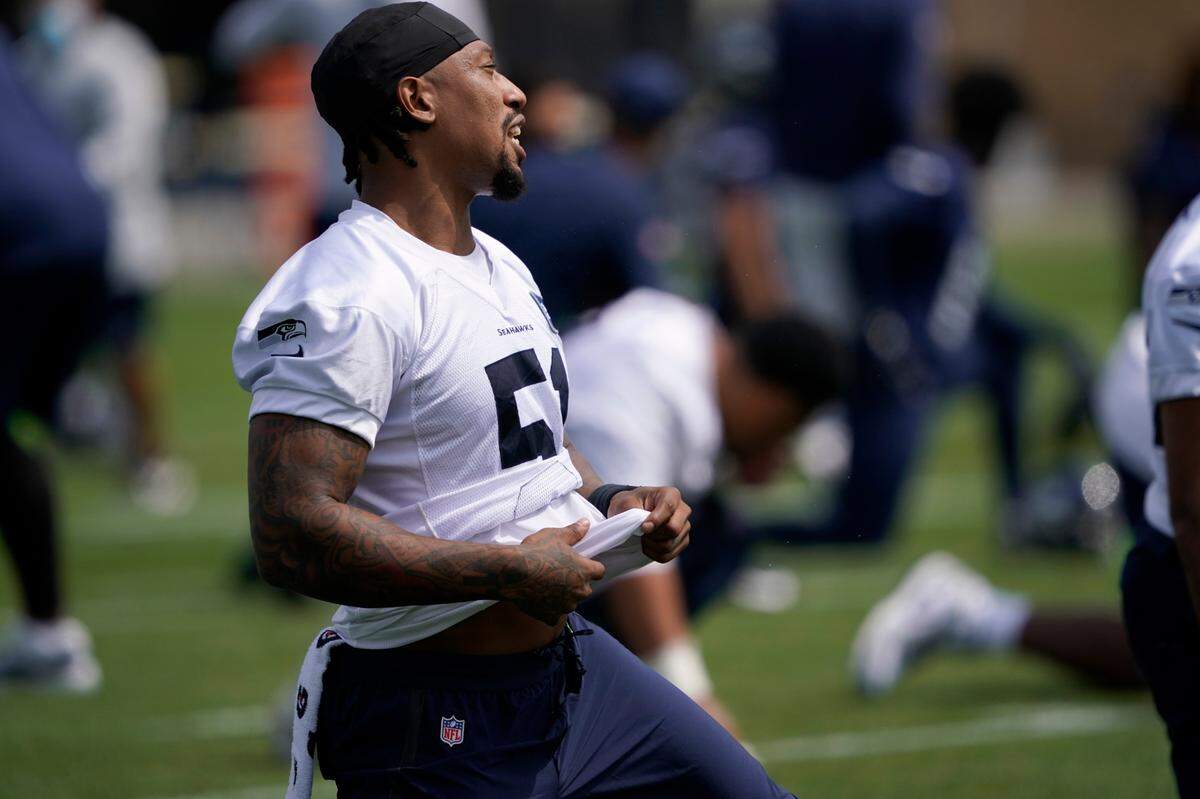
A changed person
Irvin admits in his first stint with Seattle, though he was older at 24 than most rookies, he was self-absorbed, shallow.
That wild card who ripped his coaches in that post-Super Bowl 49 tirade is wily now.
The teen who sold drugs and landed in jail is now a husband to former University of Charleston tennis player Alyssa Hackworth-Irvin and a father to their children. The high-school dropout went back to West Virginia while in the NFL to finish his college degree. He graduated with a Bachelor of Arts degree in WVU’s College of Education and Human Services.
In that way, Irvin really has made it.
“It’s just a different mindset now, man,” he said. “I’m just thankful that I was able to mature and see that.”
Around the NFL and in life, Irvin sees contemporaries who are what he used to be.
It makes him appreciate where he is now.
“Most guys be 31, 32 years old still out here chasing women, buying a lot of cars, stuff like that,” he said. “It’s just I was fortunate enough to see the light and kind of transition away from that, and just focus on what really matters—especially, you know, I’m on the back end (of my career).
“So the jewelry and stuff won’t matter when I’m done. My kids and my wife, that is the stuff that is going to matter. That is the whole reason I’ve matured and really transitioned to who I am now.”