Suddenly no one is talking about the Seahawks’ offensive line. Because they’ve been good
Offensive linemen are used to this.
Football’s unsung behemoths know the deal. They get blame, not credit.
They are like referees, and polling stations. They are doing a good job when no one notices or is talking about them. They don’t even talk about themselves.
For years, everyone was talking about Seattle’s offensive line. Anyone who knew the Seahawks’ colors were blue and green knew their line was bad. Russell Wilson didn’t make plays because of his O-line. He made plays in spite of his O-line.
Wilson for most of the last few seasons solidified his standing, now along with Kansas City’s Patrick Mahomes, of being the NFL’s best and most dangerous improvisational quarterbacks. They throw amazingly accurate passes while scrambling.
Wilson didn’t do that because he always wanted to. It was because he often had to.
This season, Wilson is getting heralded nationally as the leading candidate to be the league’s MVP for the first time. He has 26 touchdown passes, one short of Tom Brady’s NFL record through seven games. Already this season Wilson has four games with four or five touchdown passes. He had three such games the previous two years combined.
The Seahawks are 6-1, atop not only the NFC West but the entire conference. They lead the league in scoring (34.3 points per game). Their offense is third in the NFL in yards per game (414.4). It was first last week.
Through all that, very little is being said about Seattle’s offensive line.
And that means it’s SO much better than it’s been.
Sunday, following the quarterback’s latest four-touchdown day and another 37-point uprising by the offense in beating defending NFC-champion San Francisco, everyone wanted to talk about DK Metcalf’s career day catching the ball.
Wilson and coach Pete Carroll both had to bring up his offensive linemen, unsolicited, to get some attention on them.
“You know, I thought it was an unbelievable game by the offensive line,” Wilson said after Seattle’s 37-27 win over the 49ers. “The offensive line gave me great time to make some plays and throws.”
Wilson has been throwing far more often from the pocket, on time, in step and synch, per the game plan, with his receivers. They are running far fewer improvisational, break-off routes, because Wilson is running for his life less often.
“I didn’t say anything, but I should mention this: I thought that the offensive line against those guys did a great job (Sunday),” Carroll said after the 49ers game. “Pass-protection wise, giving Russ a chance to do the stuff that he needed to do. The run game, it wasn’t asked to do a lot today. But in the pass-protection game—and they knew they had to pass pro. I thought it was a really, really good job executing by those big guys, and really fired up about that.
“Our offensive line is better than we’ve been. This is better than we’ve been in recent years.”
What changed
What’s changed this year?
Sixty percent of the line: center, right guard and right tackle.
And the approach.
Ethan Pocic seized the center job in training camp from B.J. Finney, whom Seattle signed in free agency this offseason from Pittsburgh to replace injured and expensive Justin Britt. Like Britt, Pocic failed for three years as a guard and tackle. Like Britt, Pocic has excelled at center.
It’s the position he played at LSU. He knows the offense and Wilson’s line calls from three years in the Seahawks’ system.
And, Carroll says, offseason surgery fixed a sports issue that bothered Pocic for years, since college.
Pocic’s been so good, Finney never played an offensive snap for the Seahawks. They traded him last week with a seventh-round pick to Cincinnati to acquire pass rusher Carlos Dunlap.
In April the Seahawks drafted Damien Lewis in the third round from LSU to replace injured and expensive D.J. Fluker at right guard. Lewis has locked down the job since day one of training camp in August.
Right tackle Brandon Shell has been perhaps the most important, overlooked acquisition of the Seahawks 2020 offseason. They signed him from the New York Jets to a two-year, $11 million contract this spring to replace former first-round pick Germain Ifedi, after Seattle let Ifedi’s contract expire.
Shell has been what Ifedi was not: quick and athletic enough to get to fast edge rushers without false-starting, and strong enough to repel them without holding.
It’s hard to quantify how much better Wilson has it throwing now that he doesn’t consistently have a 6-foot-5, 260-pound defensive end sprinting free into his face from his front side as he begins his drop backs to pass.
Left tackle Duane Brown remains Seattle’s best blocker at age 35. He had knee surgery last winter, so the coaches and training staff are giving him Wednesdays and Thursdays off from practice between games.
Teammates are playfully teasing Brown at what a great life he’s living between games. But his mashing blocks, his pulls outside to vanguard running backs and his consistency in games have earned him those midweek spoils.
“He been SO consistent,” Carroll said. “He’s playing really good, solid ball. He’s such a specialty player, in that he’s so gifted on the perimeter and able to get out and do some things most guys at that position can’t do. We continue to try to put them in those positions, and he keeps excelling.”
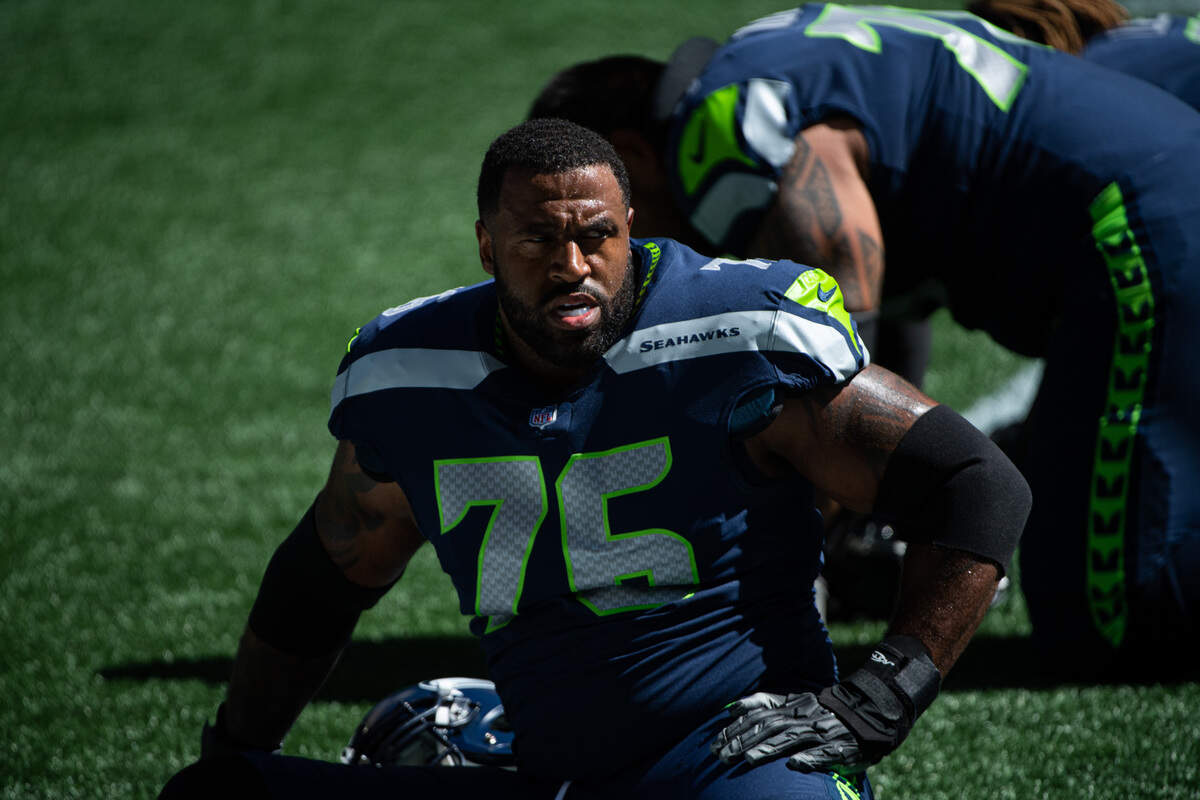
Left guard Mike Iupati returned for 2020 at age 33 on a one-year contract. He’s been steady next to Brown. He’s been out with a back injury the last two games, and his heir Jordan Simmons has continued his years of impressive play as an injury fill-in at either guard spot.
They haven’t been perfect. No line is.
Lewis had committed the second-most penalties in the NFL (six) through eight weeks of league play, including three false starts and two holding fouls. The rookie also went the wrong way on a key third down run by Carlos Hyde that failed late in the fourth quarter two games ago in the team’s overtime loss at Arizona. Lewis went left when everyone went right, at the point of attack. If that third-and-2 run had gained the first down Seattle would have won in regulation and would be 7-0.
Shell has four penalties in seven games, three for false starts.
And Wilson’s been sacked 19 times in seven games. That’s 10th-most in the league.
Yet it’s not a stretch to say Seattle would be at least 4-3, or worse, instead of 6-1 without this improvement in pass protection in particular on the offensive line.
Wilson has two, game-winning touchdown passes this season that with his protection from 2019 and ‘18 he would not have had time to make.
Against Dallas in week three, Seattle trailed 31-30 and had a third down with 1:55 left. Shell stonewalled Cowboys edge rusher Aldon Smith, who had three sacks earlier in the game. Smith got so frustrated during the game’s decisive play he started batting at Shell. On the other side of the line Brown stood up defensive end Everson Griffen’s bull rush. Then Brown blocked Griffen’s move inside, then outside.
That all took five seconds. That’s an eternity compared to how long Wilson typically had to throw in 2019 and ‘18. Wilson had to time look left, look right, look middle and look left again, at four different receivers. DK Metcalf had time to turn his simple in route from outside wide left into a diagonal sprint from left side to the right Wilson’s pass hit Metcalf in full stride past the goal line and past Dallas cornerback Darian Thompson for the touchdown. The Seahawks won, 38-31.
Down to Minnesota with 20 seconds left and on fourth down two weeks later, his line gave Wilson had time to take a shotgun snap from Pocic then an eight-step drop. That allowed Metcalf the time to cross with fellow wide receiver Freddie Swain from opposite directions in the front of the end zone.
Wilson’s dart stuck away from the defender stuck to Metcalf in the end zone for the touchdown, and the Seahawks won 27-26.
According to plan
This is what the Seahawks sought when they signed Shell, chose Pocic over Finney and drafted Lewis to replace Fluker. Less road-grader run blockers they have favored for years. More athletic and quicker pass protectors, to give Wilson real time to throw from the pocket while the 31-year-old QB is still very much in his prime. Those offensive line decisions this spring came at the same time Carroll and offensive coordinator Brian Schottenheimer talked with Wilson about, well, letting Russ cook more this season throwing the ball earlier in games.
It’s working.
“This is a chance for us to continue to get better. We’re not even halfway through the season yet with these guys,” Carroll said of his remade, revitalized offensive line suddenly almost no one is talking about.
“It is very encouraging.”
This story was originally published November 3, 2020 at 7:56 AM.