Ethan Pocic playing through concussion shows NFL’s enhanced protocols can still have holes
Ethan Pocic continues to be sidelined from the concussion he got two games ago — and played through.
The starting center’s unknown status for the Seahawks’ key NFC West game against Arizona Thursday night, and how he got there, shows the NFL’s enhanced concussion awareness and protocols still have potentially dangerous holes.
Those protocols can still be dependent solely on a player reporting he’s got one.
Coach Pete Carroll said Monday that Pocic remains in the league’s concussion protocol. His fill-in at center for Seattle’s loss at the Los Angeles Rams last weekend, banged-up Kyle Fuller, might be starting for Pocic again Thursday against the Cardinals.
The NFL has a five-phase, return-to-play protocol for concussions it started in 2009 and has repeatedly modified since — including in 2018. That was months after Russell Wilson went right back off the sideline into a game at Arizona in 2017 after getting hit in the head. He missed only one play.
The league has since assigned three neurologists or neurosurgeons, what it calls unaffiliated neurotrauma consultants (UNCs), to each game. One is on each team’s sideline. Another is in the press box monitoring the television feed and replays, getting angles the sideline monitors can’t see. All three doctors are independent from the teams. Their jobs are to identify potential player head injuries during games and assist in the start of evaluation.
The sideline UNC usually is recognizable by wearing a red cap with an NFL logo atop his sports coat and tie while he (I’ve only noticed them to be males) stand on the edge of each team’s bench areas. His job includes preventing a player who just endured head trauma from immediately returning to a game.
The Seahawks got fined $100,000 for Wilson’s quick return to that Cardinals game in 2017.
So Seattle’s team is particularly keen to every step of the NFL’s concussion protocol.
All this raises the question: How did Pocic play all 65 offensive snaps of the Seahawks’ loss at Buffalo Nov. 8 and hasn’t played since?
Carroll said Monday it became obvious to doctors after that Bills game the center played it after sustaining a concussion.
“He did. He made it through the game,” Carroll said. “He reported some symptoms after the game, and the (medical) guys took a look at him and weighed it as we were going through it. And (they) could tell, yeah, that he had had something that happened. He had an episode in there.
“So we are going to take great care of him and make sure that we treat him well to get him back. Take whatever time it takes.
“This is a very serious area that we are always really concerned about.”
The UNC in the press box apparently didn’t notice a TV angle or replay that showed when Pocic might have sustained a head injury. The monitor in the press box has the power to call down to the field to the referee to stop the game and remove any player suspected to have a head injury.
Not that the monitor would notice a center having a concussion. Offensive and defensive linemen charge and bang their heads into each other in close quarters 60-80 times per game, every game, on any normal football play. It’s the nature of the sport. Center is a position particularly dangerous for head blows. A defensive tackle or nose tackle lines up directly over his head or a foot or three beside it across the line of scrimmage for every snap of every game.
The UNC on the Seahawks’ sideline that day in Buffalo also apparently didn’t notice anything about Pocic that would have triggered an evaluation for a possible head injury. The sideline monitor also has power per NFL concussion policy to remove a player from a game to evaluate him further if he suspects head trauma.
Without the UNCs suspecting anything — and without Pocic telling anyone, in a league where consistent availability is a player’s most valued trait to his team — he played on.
“He didn’t report it during the game,” Carroll said, “so we didn’t know.”
The protocol
The first, immediate parts of league’s protocol with a player suspected of having a head injury begins on the sideline. UNCs there, with doctors beside them, ask what are known as “Maddocks questions” — such as “What half of the game is this? What stadium is this? Did you win your game last week?” Those are named after Australian clinical neuropsychologist David Maddocks, who studied concussions in Australian Rules Football players in the mid-1990s.
The NFL’s return-to-play protocol for concussions Pocic is in has five, explicit phases he must complete to get back on the field.
“Each player and each concussion is unique. Therefore, there is no set time frame for return to participation or for the progression through the steps of the graduated exertion program set forth,” the league’s protocol states. “Recovery time will vary from player to player.”
Phase one involves only light physical activity such as stretching, balancing and light aerobic exercise under the supervision of an athletic trainer.
Phase two involves “graduated cardiovascular exercise under direct supervision of the team’s medical staff.”
If the player experiences no symptoms through those, he passes to phase three: no more than 30 minutes per day of football-specific exercise.
Phase four is non-contract football drills and the completion or neurocognitive and balance testing. The goal of this phase is for the player to show he is back to his baseline results from the preseason cognitive testing.
Phase five is clearance by the team physician to full football activity. The player must be examined by an independent neurological consultant the league assigns to each team. Only after that independent consultant agrees with the team doctor’s findings can a player exit the protocol and return to practice fully, and to playing.
Pocic remained out of practice Monday, eight days after he reported his symptoms.
Arizona’s challenge
Fuller replaced Pocic then got what Carroll described as a high-ankle sprain during the second quarter of Seattle’s loss at the Rams last weekend. Yet Fuller also played on, in his first career start at center. The coach praised him for playing through an injury that often sidelines players for a multiple weeks.
“Kyle did fine. He hurt his ankle, and he’s going to be hobbling ... to get back for this week. We think he can make it,” Carroll said. “But he did get banged a little bit.
“Just toughed it out, and did a really nice job hanging in there.”
Backup guard and tackle Jamarco Jones, drafted by Seattle to be a left tackle, is the third option at center if Pocic remains out and Fuller can’t play against the Cardinals. Jones has never started a game at center.
With Fuller, rookie right guard Damien Lewis plus Mike Iupati, Jordan Simmons and Jones playing left guard against the Rams, the Seahawks succeeded in keeping All-Pro defensive tackle Aaron Donald from dominating the game as he usually does. Donald had no sacks of Wilson. He entered Sunday with 12 in his career against the Seahawks, his most against any NFL team. Donald did hit Wilson as he tried to throw deep down the right sideline for a big play to Tyler Lockett, ruining a potential touchdown pass.
“I thought we did as good as job as we’ve ever done against Aaron,” Carroll said. “He’s an incredible player, and didn’t get the marks he normally gets.”
Carroll said Fuller “had a lot to do with it.”
But the Rams did what Buffalo did the week before, and what Arizona did in the desert last month: they disregarded the Seahawks’ running game. It was without lead backs Chris Carson and Carlos Hyde again, and featured Alex Collins up from the practice squad for his second game since 2018. The Rams relentlessly swarmed Wilson on the edges with pass rushers who sacked him six times and hit him 12 more.
Wilson has been hit 34 times the last two weeks. Want to search for why the former front-runner for the NFL MVP award early this season has committed seven turnovers the last two games? Start with how much he’s been getting hit without Carson and Hyde threatening defenses with balancing runs, and in L.A. without Pocic anchoring the line.
“Yeah, they got after us pretty good as the game wore on,” Carroll said of the Rams. “The first half we were in pretty good shape, felt like we were controlling it. And then there were just a couple things that happened with a couple players that we need to do better on.”
Carroll called the Rams “a good, attacking group.”
Here comes another.
The Cardinals blitzed through Seattle’s offensive line and battered Wilson when the Seahawks had Pocic and its regulars in the teams’ first meeting last month. Wilson got knocked down 11 times while he threw three interceptions in Seattle’s overtime loss at Arizona Oct. 25.
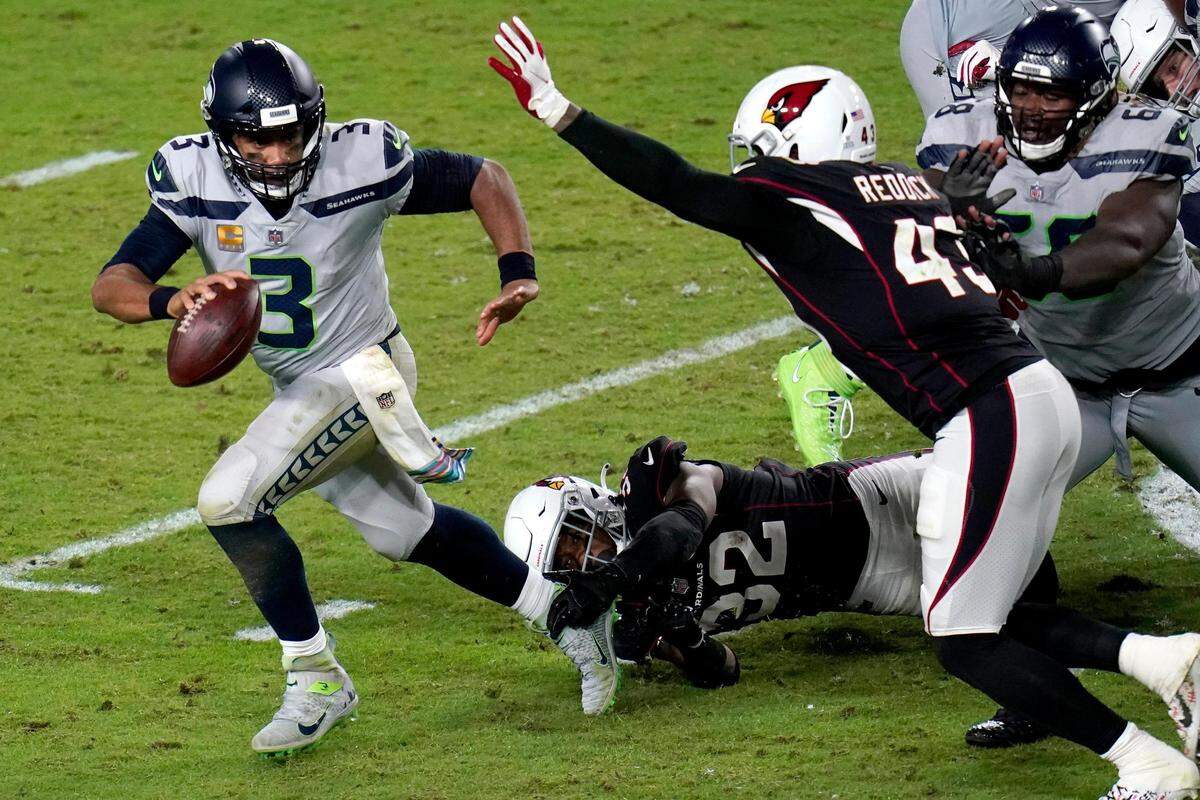
The Cardinals overwhelmed the Seahawks with increased blitzing in the fourth quarter of that game. That was after Seattle lost Carson and Hyde to injuries earlier that night. Without a proven run threat, Wilson and Seattle’s offense stalled late under all of the Cardinals’ blitzing. Arizona rallied from a 10-point deficit in the final 3 minutes of regulation, then won in overtime.
What the Bills then Rams did to batter Wilson the last two weeks will encourage the Cardinals.
Plus, Carson and Hyde may not play in this game, either, though Carroll said he feels Hyde will return from his strained hamstring. Hyde playing would give Arizona more pause to consider Seattle’s running game than it did at the end of the last meeting. That could slow down the Cardinals blitzing in as freely on Wilson’s drop backs to pass.
Having Pocic back at center also would improve how the Seahawks pick up and block all the blitzes.
But playing the entire game after sustaining a concussion two games ago isn’t increasing his chances he’ll play against the Cardinals.
This story was originally published November 17, 2020 at 12:06 PM.