Seahawks chalk talk, preview: roots of new offense go back to Bill Walsh and ‘The Catch’
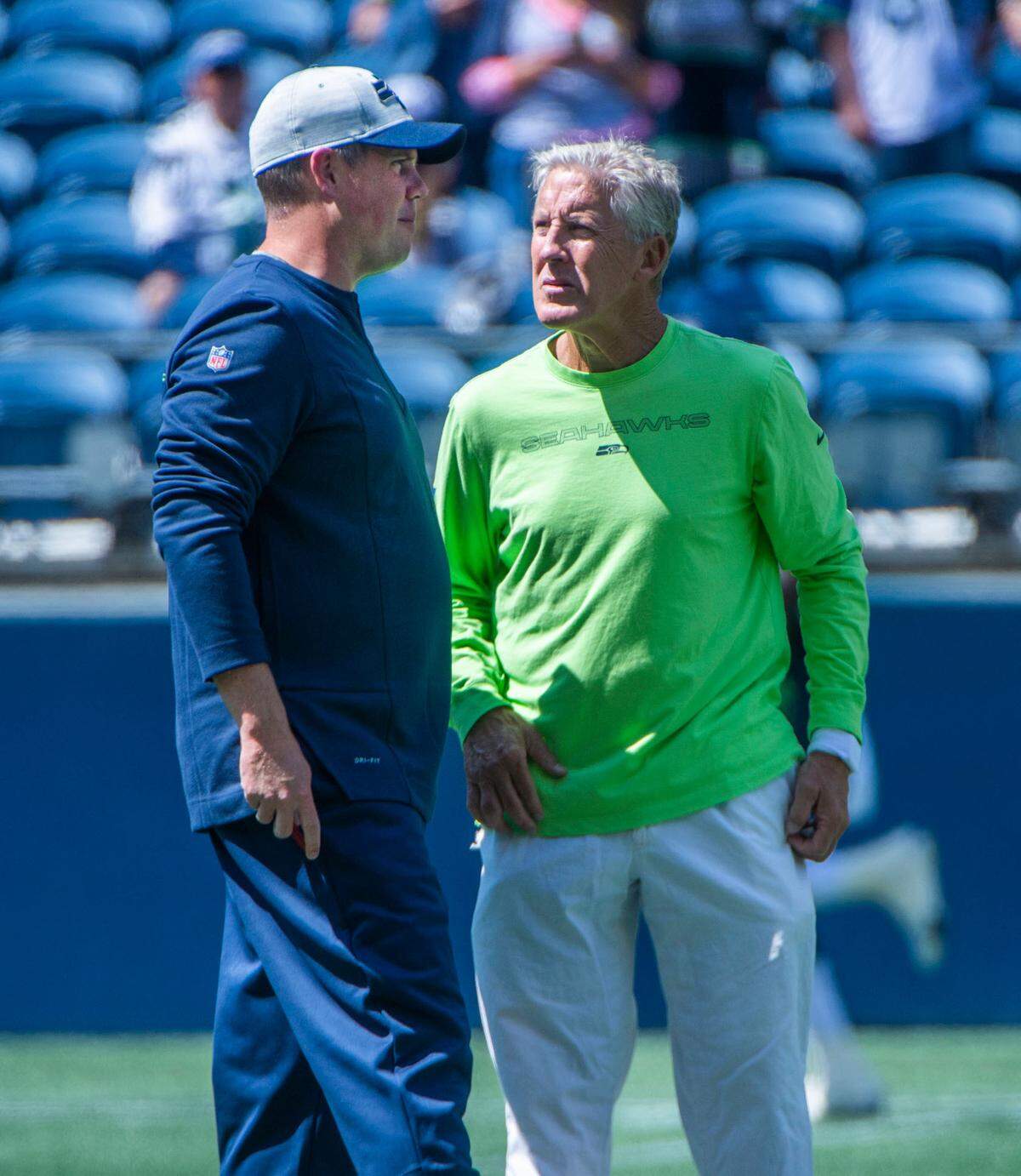
Shane Waldron’s new Seahawks offense isn’t a West Coast offense because the first-time play caller just arrived in Seattle from Los Angeles.
It’s not a West Coast offense because it strictly adheres to all the principles Mike Holmgren used to turn the middling Seahawks franchise into a Super Bowl team 16 years ago, either.
Holmgren’s was as close to the immortal Bill Walsh’s West Coast offense as Seattle — and the NFL — has had since Walsh masterminded the San Francisco 49ers into a dynasty from 1979-88. Holmgren was a former quarterback. His system was viewed as exactly as quarterback-friendly as that of Walsh, his mentor.
“The fundamentals of the ‘West Coast’ is the quarterback system,” Seahawks coach Pete Carroll said. “Really, what Bill Walsh was so famous for is making it so that the quarterback could be successful. That has to do with the expectations of the position, how you organize it, so his reads fit.
“So the quickness of the passing game and the reliance of the short passing game to catch and run, all of those things to make it quarterback friendly. That was the heart of it. The (legendary offensive line coach) Bobb McKittrick running game that went along with it was out of this world. It was so far out there. He was so unique, and he added that to Bill Walsh’s stuff.”
Where Holmgren evolved his teacher’s West Coast offense was in the running game.
Walsh’s schemes were heavy on split backs, halfbacks side by side and often on either side of the quarterback, the same distance behind the line of scrimmage. A split back formation started the most famous play in 49ers history — one of the most famous in all NFL history — “Brown Left Slot, Sprint Right Option,” Joe Montana’s touchdown pass to Dwight Clark on “The Catch” in the 1981 NFC championship that sent San Francisco to its first Super Bowl.
Holmgren modified Walsh’s schemes with more I-formations, with a fullback directly in front of a tailback, and single-back sets. Shaun Alexander became an NFL Most Valuable Player for Seattle 16 years ago in Holmgren’s tailback-heavier version of Walsh’s West Coast offense.
Like Walsh, Holmgren hated the shotgun formation. Matt Hasselbeck, the Seahawks’ first Super Bowl quarterback in the 2005 season who is going into the franchise’s Ring of Honor with Holmgren next month, had a shotgun formation in Holmgren’s playbook. But Holmgren almost never called it in his decade leading the Seahawks.
Shotgun, of course, has become as inherent to today’s NFL game as color-rush jerseys and beer commercials.
So what is Waldron’s offense that Russell Wilson and his Seahawks are about to unveil Sunday in the 2021 season opener at Indianapolis?
How close is Waldron’s version — which is really the version of Sean McVay, Waldron’s boss with the Rams until Carroll hired him to run Seattle’s schemes in January — to Walsh’s original, pure West Coast offense?
“That’s a really good question,” Carroll said.
And not just because no one who watched any of the Seahawks’ three preseason games saw Wilson run Waldron’s schemes. Wilson didn’t play a snap in Seattle’s preseason. Waldron barely showed any of the new offense.
To see it, you had to watch the six weeks of training-camp and preseason practices at the team facility in Renton.
The News Tribune did.
This story is about what we saw, and how closely Seattle’s new offense resembles Walsh’s original West Coast offense, or the variations developed over the decades.
It may prove to be closer to Walsh’s original West Coast than Carroll — and Wilson — have had in Seattle.
The origins
Carroll is less than two weeks from turning 70 years old. He’s been coaching football since Richard Nixon was president. That was back when Walsh was hatching his West Coast offense that revolutionized the NFL, college and even high school football in the 1980s, ‘90s into the 2000s — to today.
Walsh began refining and perfecting the West Coast offense as a top assistant to legendary Paul Brown with the Cincinnati Bengals from 1968-75. Walsh’s aim with the West Coast was to spread defenses from sideline to sideline with short, well-timed and orchestrated and relatively safe passes. Passes on hitches, slants, quick outs and outside curls effectively served the purpose of traditional sweeps and outside running plays. Once stretched, defenses became vulnerable to deeper, game-breaking throws down the field to win games.
“My philosophy has been to control the ball with the forward pass,” Walsh wrote in a piece called “Controlling the Ball with the Pass” in 1979. That was the year he went from coaching the Stanford Cardinal to his first year transforming the 49ers.
This new Waldron Seahawks offense isn’t that. Don’t expect Wilson to look like Montana. Carroll hired Waldron to re-establish the Seahawks’ running game with lead back Chris Carson this year.
But the way Wilson will be dropping back to pass from direct snaps under center, the quick throws to shorter patterns by receivers...there are similarities between Waldron’s new West Coast and Walsh’s original version.
“The origins of this offense really go back to San Francisco,” Carroll said of the 49ers teams he coached as an assistant under George Seifert.
Seifert was another protege of Walsh, and the mastermind’s successor leading the 49ers into the mid-1990s. Carroll was San Francisco’s defensive coordinator under Seifert, in 1995 and ‘96.
Mike Shanahan was one of Seifert’s offensive coordinators with the 49ers, through 1994. Shanahan took Walsh’s and Seifert’s West Coast offense from San Francisco, tweaked it with the zone-running game, and won consecutive Super Bowls leading the Denver Broncos. John Elway quarterbacked and famed offensive line coach Alex Gibbs perfected the zone-blocking system with Denver.
“I’ve always given Mike Shanahan a lot of credit, maybe not so much openly, but the credit to take what they’ve done in the West Coast offense — the principles of the throwing game, getting the ball out, and quarterback friendly stuff — and matched it with a different running game than the San Francisco days,” Carroll said.
“He brought in Alex Gibbs, and they put together the zone-running game.”
When late Seahawks owner Paul Allen summoned team CEO Tod Leiweke to Los Angeles in 2010 and lured Carroll out of having restored a college football dynasty at USC, Carroll hired Gibbs to come be his assistant head coach and offensive line coach in Seattle. Gibbs spent Carroll’s first Seahawks season establishing the zone-blocking and running system. It was Gibbs’ last full-time coaching job in football.
The guru of zone blocking died this summer, in July, at age 80 in Phoenix from complications from a stroke.
So how does Carroll describe this new Seahawks’ offense?
“To me, it’s the new version of the ‘West Coast offense,’” Carroll said, meaning Walsh’s original “because that term gets thrown around a lot.
“I fortunately got a chance to see part of it way back in the day. The roots are there. And that’s about timing, being quarterback-friendly, the mix of the running game, and the rhythm of the passing game. All of those things are very similar.”
For Carroll, this new, 2021 Seahawks offense is as much like his national-championship offenses at USC as he’s had in his 12 years leading Seattle. That’s precisely why Carroll hired the 41-year-old Waldron. He was the Rams’ passing-game coordinator under McVay’s West Coast system in L.A.
Carroll’s first USC team began the 2001 season 2-5. Then he brought the West Coast offense to the Trojans.
“In my second year at USC, we transferred into that whole mentality,” Carroll said. “Year one didn’t happen that way.
“But year two did.”
Carroll’s USC teams won 67 of their next 74 games, two national championships and played for a third title after the change.
“From that time on, we used the same principles and the foundations of those aspects that came out of the ‘West Coast,’” Carroll said.
“It’s the upscaled and new versions of the zone-running game. Shane was raised in that system, so he’s very comfortable with it. There are a lot of similarities.”
Waldron, ever the student, gives full credit for what he knows and the plays he calls to Walsh. The pre-49ers Walsh, even.
“First of all, that is the original,” Waldron said of Walsh’s West Coast. “From Cincinnati to the West Coast, there’s a lot of great history within that offense and there’s a lot of teams and terminology that’s directly derived from it.”
Asked if that means Carson will be Seattle’s Roger Craig this season, Waldron laughed. But he didn’t take the bait. He didn’t compare the Seahawks’ leading rusher to the NFL offensive player of the year for San Francisco and Walsh in 1988. Craig ran the ball with his signature high knees and caught quick passes while winning three Super Bowls with the 49ers.
“They’re each individually unbelievable players in their own right,” Waldron said, demurring — and keeping his Seahawks plans for this season obscured.
Dropback and throw, quickly
One way Waldron’s system mirrors Walsh’s original West Coast schemes: Waldron is going to have Wilson receiving direct snaps under center more than the quarterback has in many Seattle seasons.
Walsh, who died in 2007 at age 75, believed the quarterback needed to take direct snaps under center, then take three-, five- or seven-step drops. Walsh didn’t want his quarterbacks standing as sitting targets for pass rushers while waiting on wide receivers to finish their routes Walsh had precisely prescribed.
Walsh relentlessly drilled the exact synchronization between the quarterback’s drops back to pass and the receiver’s routes. An 8-yard route had to be run exactly at 8 yards. Receivers that ran it at 7 1/2 or 8 1/2 yards, because of how defensive backs may have been playing them? Walsh cut those guys.
“We like the drop-back pass,” Walsh wrote 42 years ago. “We use a three-step drop pattern, but more often we will use a five-step drop pattern of timed patterns down the field. From there we go to a seven-step drop. When our quarterback takes a seven-step drop, he’s allowing the receivers time to maneuver down the field. Therefore, we will use a three-step drop pattern when we are throwing a quick out or hitch or slant which, by and large, the defense is allowing you to complete by their alignment or by their coverage.
“The five-step drop pattern for the quarterback calls for a disciplined pattern by the receiver. He runs that pattern the same way every time. He doesn’t maneuver to beat the defensive back.
“Too often in college football, either the quarterback is standing there waiting for the receiver, or the receiver has broken before the quarterback can throw the ball. These are the biggest flaws you will see in the forward pass. Now when the receiver breaks before the ball can be thrown, the defensive back can adjust to the receiver. Any time the quarterback holds the ball waiting for the receiver to break, the defensive back sees it and breaks on the receiver. So the time pattern is vital.”
This season, DK Metcalf is going to run quicker, more horizontal routes, some as quick as one and two steps then cut. That’s so Wilson gets the ball out of his hand more quickly in 2021, in 2-3 seconds, to help the Seahawks’ annually iffy pass protection. Help it by scheme, simply because the design of the play will be the linemen don’t have to pass block as long.
Previous coordinator Brian Schottenheimer featured Metcalf on 40-yard go and flag routes, to take full advantage of the massive wide receiver’s size and speed advantage over every NFL defensive back. That’s how Metcalf got his team-record 1,303 yards receiving in 2020.
But those routes ultimately took too long. By late last season, when Seattle’s offense sank, Wilson was getting pressured and battered by defenses that dropped a second safety deep to cover Metcalf’s and Tyler Lockett’s longer routes.
Quicker is better for Waldron’s and Wilson’s passing game this Seahawks season.
So many formations
Forty-two years ago, during Walsh’s first season transforming the putrid 49ers, he had San Francisco in 37 different formations over its first 61 first-down plays that year. That was according to a 1979 analysis by The New York Times.
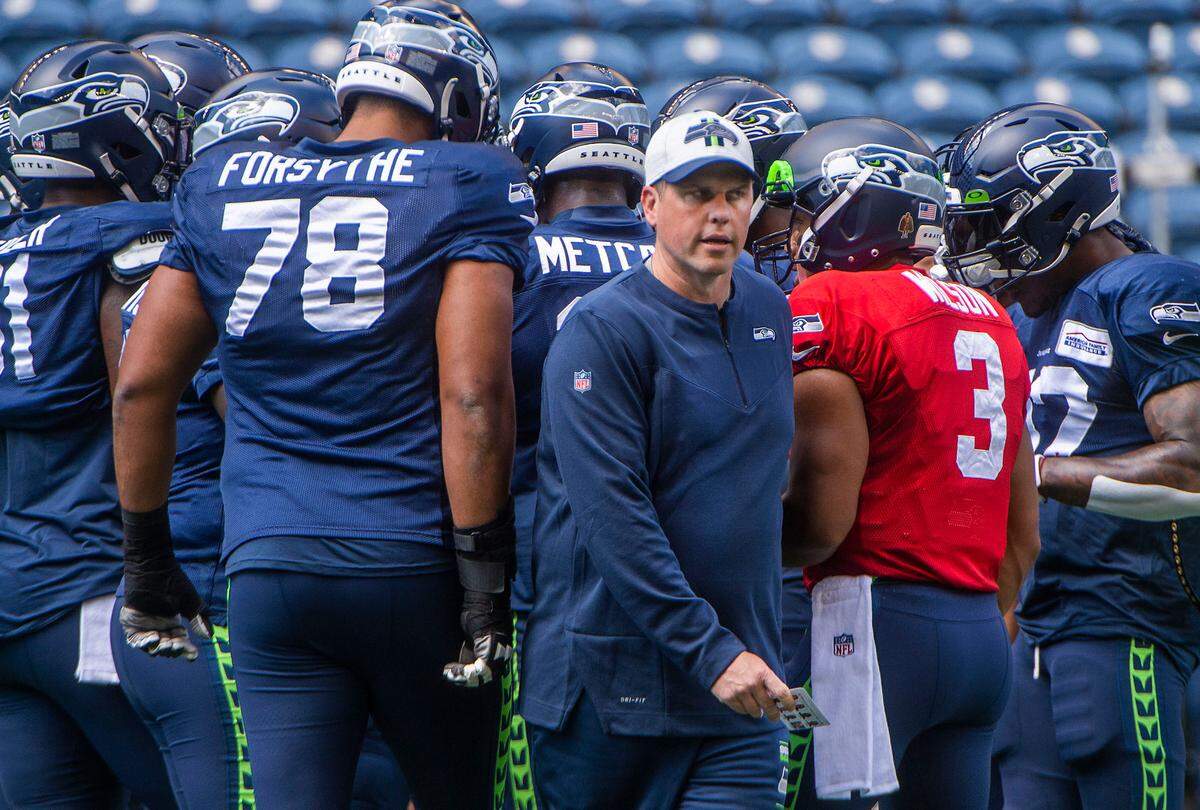
Waldron’s Seahawks are going to be in Formation-palooza this season.
In its preseason finale against the Los Angeles Chargers, Seattle marched on a 14-play drive to a field goal by Jason Myers in the second quarter. For the first time this summer, the public got to see some of what Seattle’s variation in formations will look like this season.
Waldron used two tight ends for most of that drive, as he is likely to all season with ultra-versatile newcomer Gerald Everett in with his play caller from the Rams, plus trusted Will Dissly. After a timeout before a third and 1 near midfield, Waldron actually used with those two tight ends a real, live I formation, a Holmgren relic in today’s NFL Fullback Nick Bellore, the special-teams captain who also plays backup linebacker, lined up in front of tailback Alex Collins. There were no wide receivers.
Last year, with Schottenheimer calling the plays, Seattle usually went to spread, shotgun formation with multiple wide receivers on third and short. The results weren’t great. The Seahawks were 7 for 11 converting on third and 1 running the ball in 2020. That was the 31st-best conversion rate in the 32-team league. Seattle was so bad running on third and short the offense threw it instead more than 31% of the time.
Against the Chargers late last month, Collins followed Bellore off rookie left tackle Stone Forsythe, cut once and gained the first down — with 5 yards to spare.
Also in that drive, Waldron twice sent reserve tight end Cam Sutton out into the left slot in a tight, bunch formation with two wide receivers. He also flexed tight end Tyler Mabry behind Sutton as a wing, inside Sutton tight on the left end of the line. Waldron ran and passed out of his two tight-end looks, part of the Rams’ style of having much of their offense look the same, run or pass, to the on-its-heels defense before the snap.
That’s another signature of Walsh’s West Coast: so many formations, with run and pass plays out of them that look the same to defenses pre-snap.
In motion
Walsh was a tight end, at San Jose State. So he had a particular interest in and affinity for using them.
In Cincinnati as Brown’s top assistant, Walsh became one of the first in football to send the tight end in motion before the snap. That had been what only wide receivers and maybe an occasional running back out of the backfield did, to confuse and shift defenses at the snap.
In his autobiography “Building a Champion” written with Bay Area writer Glenn Dickey and published in 1992, Walsh described the origins of his tight-end motion.
It doesn’t jibe with Walsh’s “genius” reputation.
“We used the tight end in motion first by mistake,” Walsh wrote in his book. “Cincinnati was playing the Raiders in Oakland. In the third quarter, Bob Trumpy lined up on the wrong side by mistake. He had to shift over quickly to the other side, and all hell broke loose.
“At that time, the Raiders had very specialized (defensive players). They had a weak-side linebacker. They had a strong-side linebacker. They had a defensive end who only played on the tight-end side, and they would shift their two inside linebackers. They all ran into each other in the middle of the field, trying to adjust.”
Training camp hinted Waldron’s Seahawks may be using the tight end more than any previous Carroll team in Seattle. Everett is poised to be moved around and in motion so much he may log a game’s worth of steps before snaps.
The tight end, the motion, the vast array of formations, the use of quick, short passes like running plays in a quarterback-friendly system are ways Waldon’s Seahawks are like Walsh’s West Coast offenses. Seattle’s zone-running system with Carson are like Shanahan’s and Gibbs’ Broncos offenses with Terrell Davis and others.
But there are obvious differences.
Walsh’s split backs have all but disappeared from the NFL. Waldron’s Seahawks will mostly remain in one-back formations.
Seattle will be using plenty of “11“ personnel, as typical in today’s league, with one running back, one tight end and three wide receivers. Waldron’s system uses “12” personnel, one tailback and two tight ends, a lot. And judging by the Rams’ recent offenses, Waldron will have Wilson throw out of “12” personnel more than the NFL norm.
For all his various formations, Walsh usually stayed with the same personnel: the same single tight end, the same two backs, the same two wide receivers. Waldron is going to have personnel groupings galore: “11,” “12” and “10” personnel, five, four and three wide receivers, tight ends and running backs split out wide as “X” receivers on the line and in the slot, all over — and all over the depth chart.
Screen passes weren’t big in Walsh’s West Coast offense. They took too long and were imprecise. Waldron showed more screens to running backs and wide receivers in preseason games than Seattle has used in many of the Carroll seasons.
Waldron also showed in that final preseason game a glimpse of the fly sweep he is poised to use with speedy rookie wide receiver Dee Eskridge. That’s a wide receiver going in motion that is timed to get him to the quarterback at the snap for a hand-off and rushing attempt around the opposite end.
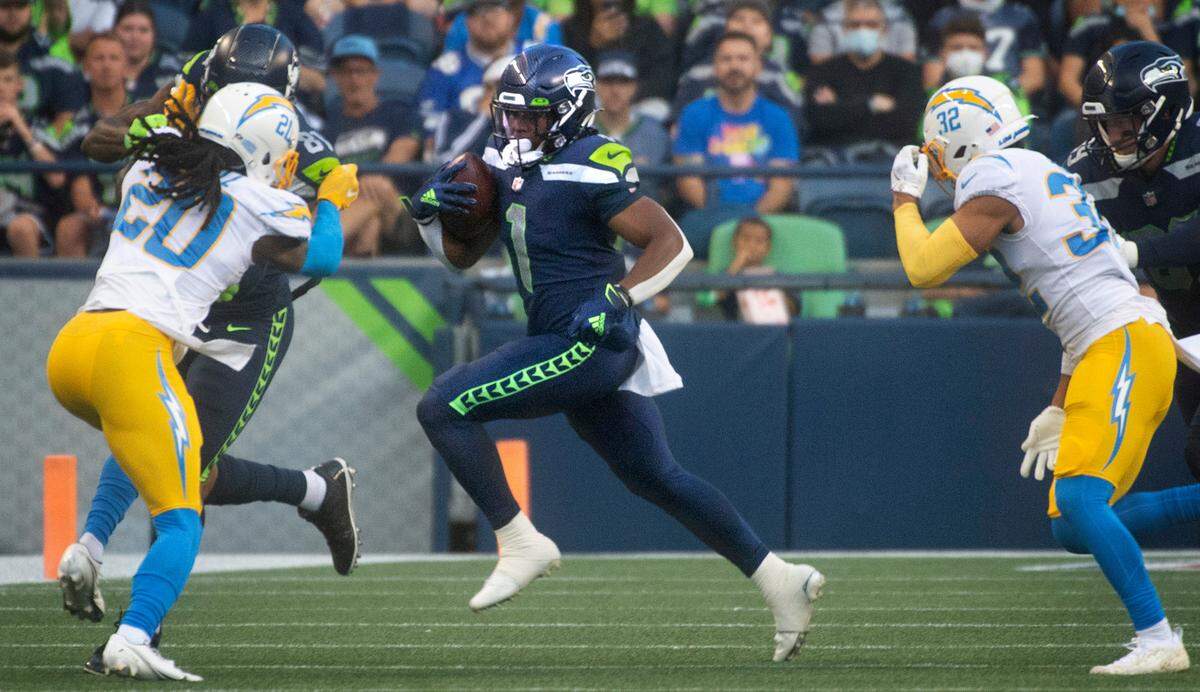
Walsh had a wide receiver with Eskridge-like speed on his 49ers of the early 1980s: world hurdles record holder Renaldo Nehemiah. But he didn’t send Nehemiah on fly sweeps.
Then again, the entire game has of course evolved. Walsh’s original West Coast offense has, in turn, evolved with it.
“As time has gone on, our offense, like a lot of offenses, has a little bit of a mix and match of several aspects of different systems,” Waldron said. “There is some origin in the West Coast, but there’s a pretty good mix of different things throughout the different places I’ve been, or different places other coaches have been, that have morphed a lot of these offenses into what they are today.”
Things tend to change over 50 years. But the West Coast offense had to.
Holmgren, Shanahan, Raiders coach Jon Gruden, Chiefs coach Andy Reid and others in the West Coast, 49ers coaching tree had to answer defenses’ blitzing and 3-4 systems designed in the late ‘80s into the ‘90s to combat Walsh’s original West Coast schemes. Holmgren and his disciples used more three and four wide receivers, more motion, more one-back — more of what Waldron is incorporating into Seattle’s new-old offense.
“The roots are there,” Carroll said of the 2021 Seahawks and Walsh’s original West Coast scheme, “and that’s about timing, being quarterback-friendly, the mix of the running game, and the rhythm of the passing game.
“All of those things are very similar.”
This story was originally published September 10, 2021 at 5:00 AM.