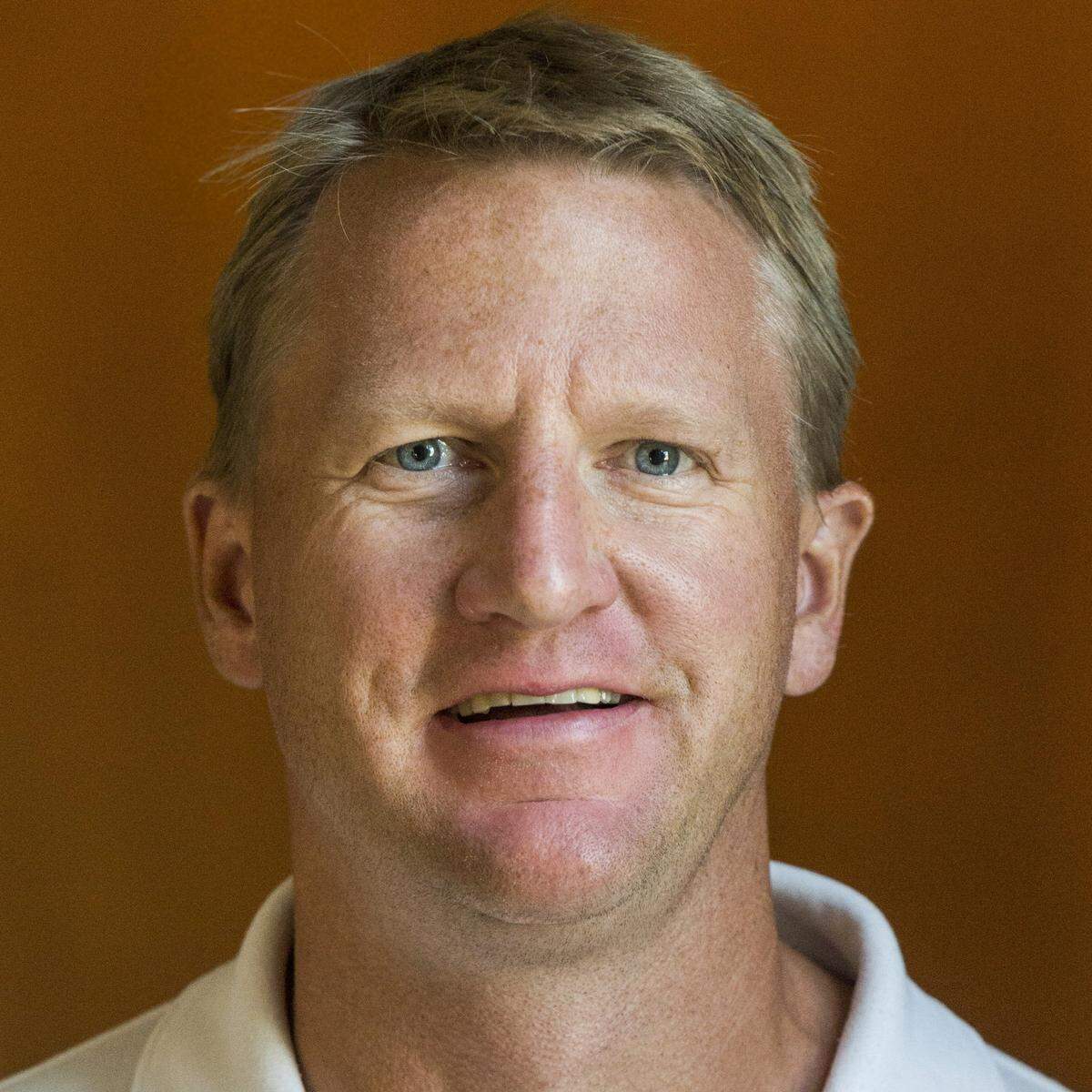
Emotional Russell Wilson says goodbye to ‘my best friend’: mental coach Trevor Moawad dies
When Russell Wilson had just led Wisconsin to the Rose Bowl and was preparing for the NFL draft almost a full decade ago, his agent aligned him with a draft-preparation academy.
Mark Rodgers got Wilson aligned with the IMG Performance Institute to prepare for the 2012 draft.
Upon the quarterback’s arrival on the IMG campus in Bradenton, Florida, one of the first people he met with was Trevor Moawad.
Moawad grew up in Lakewood. He graduated from Charles Wright Academy in University Place, then Occidental College in California. He founded his own consultant firm for mental conditioning, then his own company, Limitless Minds. In early 2012, he was a director at the IMG Performance Institute Wilson was visiting.
When Wilson walked in to see him, Moawad said he knew Wilson was going to succeed. Wilson said he knew that, and he knew why.
Wilson asked this man he just met in the IMG offices: “Do you know why?”
“Yeah, I know why,” Moawad told Wilson. “Your mind.
“Your mind, that’s what’s going to separate Russell Wilson. That’s what we’re going to work on.”
“And so,” Wilson said Thursday, “from that moment ever since, he’s been my best friend. We’ve spent so much time together. The highest of the highest, highest moments to some of the lowest moments. To the moments of winning the Super Bowl, to the moment of not winning it, unfortunately, he’s always been there for me. He’s a guy who always gave me perspective, gave me knowledge and insight.”
Wilson’s best friend died Wednesday night.
Trevor Moawad passed away at age 48 in California, following his years-long fight with cancer. The company he and Wilson co-founded, that Wilson’s brother Harry is president of, confirmed Moawad’s death just after midnight Thursday.
Hours later, Wilson talked about his best friend’s cancer.
“He hid it,” Wilson said, “in a sense that he just didn’t want to affect other people. He didn’t want people to feel bad for him, or sorry for him.
“I told Trevor, ‘Man, people love you, man.’”
Wilson does.
He said Moawad constantly told him: “I believe in Russell Wilson. I believe in 3.”
And: “The best is ahead.”
“So when I think about what I want to do, and my life mission,” Wilson said, “last night as I was praying as he passed away, I was talking to C (Ciara, Wilson’s wife) and my brother — my brother was down there; I couldn’t be there, obviously — it was that, man, people need us to help their mindset.”
“He was a winner,” Wilson said of Moawad.
“He was a mental giant — in a cool, cool way.”
Moawad was there for Wilson 6 1/2 years ago, right after Wilson threw the most infamous pass in Super Bowl history. Wilson’s attempt to throw to extra wide receiver Ricardo Lockette on a slant route from the 1-yard line in the final seconds of Super Bowl 49 became Malcolm Butler’s immortal interception. The Seahawks lost, instead of beating the New England Patriots for a second consecutive NFL championship to Seattle.
It will always be, from the Seahawks’ perspective, the worst play in Super Bowl history. The morning after it, Moawad called Wilson. The quarterback was packing with his stunned teammates at their Arizona hotel, readying to fly out of Phoenix, home and to an offseason that was beginning of the end to that Legion of Boom era of Seahawks football.
“How ya’ doin’?” Moawad asked Wilson.
“You know, the sun still comes up in the morning, Trev,” Wilson told his best friend, the man who reinforced that thinking each day.
“You are a winner,” Moawad told Wilson, as the quarterback recalled Thursday. “I believe in Russell Wilson. I believe in number 3.
“What are we going to do about it?”
Wilson told his mental guru he was ready that February 2015 day, ready to work “right now” on his mind. Ready to not let Butler’s interception define Wilson, his career or his life.
How close were Wilson and Moawad?
Two days after that Super Bowl-ending interception, Moawad moved in with Wilson, for about a month. They were in Wilson’s offseason home in San Diego.
“Just to keep everybody away, just to have everything move efficiently,” Wilson said. “And (we) got to work, the next morning.”
Wilson and Moawad sat at Wilson’s circular table in his home in San Diego. They talked how the QB had a choice to make.
“I told him, ‘I’ve already made it. I’m not going to let this moment affect me for the rest of my career,” Wilson said. “’Not me. They got the wrong one.’’”
Moawad’s response 6 1/2 years ago?: “Good. That’s what I thought you were going to say.”
Wilson has gone on to take the Seahawks to eight playoffs in nine years overall. He holds 26 Seattle franchise records. Sunday, in the 2021 home opener against the Tennessee Titans, Wilson will attempt to win his 100th game in his 146th consecutive start to begin his career. Only Tom Brady (131) and Joe Montana (139) have won 100 in fewer starts. Wilson would top Terry Bradshaw (147), Ben Roethlisberger (150), Brett Favre (153) and Johnny Unitas (153).
With a win Sunday, Wilson would trail only Peyton Manning (105) in most regular season wins in a NFL quarterback’s first 10 seasons.
Visualize success
Early in the 2019 season, the Seahawks played the Steelers in Pittsburgh. It was the first game Wilson had played in Heinz Field; the NFL’s scheduling system says NFC teams play AFC teams on a yearly rotation through each of the other conference’s four divisions. The Steelers had played in Seattle in 2015, so 2019’s game was Seattle’s first in Pittsburgh since 2011. That was the year Wilson moved from North Carolina State as a graduate transfer to Wisconsin, and led the Badgers to the Rose Bowl.
To prepare for that game in Pittsburgh two years ago, Wilson did two things Moawad taught him. They weren’t exactly conventional, Xs and Os prep work of what the Steelers defense was likely to present to him.
Wilson used Google Maps online for satellite images zoomed into Heinz field for an overhead look at where the play clocks are in that stadium. He explained that was to visualize where he would be looking immediately before the snap of plays in Pittsburgh.
“You know me,” Wilson said during that Steelers game week in September 2019. “I look up what the field looks like. I figure out where the clocks are. I kind of get a feel for it.
“I get used to it in my mind — now. I’m practicing there already, you know, right now.”
The other thing he did to prepare that week: he watched the video Moawad made of Wilson’s best plays in that 2015 meeting with the Steelers, a 39-30 shootout. Wilson had a career high-tying five touchdown passes and no interceptions to ultimately outgun Roethlisberger that day in Seattle.
It was, Moawad told ESPN.com in a story from that 2019 season, a “way to take him back to the emotion of that experience so that he can connect that emotion with that behavior with playing Pittsburgh.”
Wilson and the Seahawks won that game, too. Wilson completed 14 of 16 passes for 140 yards and two touchdowns in the second half to rally Seattle past Pittsburgh.
“He was a winner,” Wilson said of Moawad.
“He was a guy who always gave back, knew how to win championships and knew how to help people win — not just on the field, but in their personal lives, too.”
Three truths
Moawad drilled three truths into Wilson during their almost daily talks, sometimes in person but more often on the phone.
1. “Simple wins.”
“We don’t have to make our lives more chaotic than they have to be.”
2. “You don’t have to be sick to get better.”
“Everybody waits to get sick to get better. Why don’t we always improve our minds? Why don’t we think about it? Why don’t we try to help others, and always constantly get better?”
3. “Too many people, it’s not that they aim too high. They aim too low, and hit.”
That third one, Wilson says, is why he articulates mammoth goals. Be the best who’s ever played in the NFL. Win more Super Bowls than Brady. Play until I’m 45, or older.
And: Why not me?
Moawad’s core principle to support those three truths that he reinforced with Wilson: keep a neutral mind.
Never get too high or too low. Stay even mentally, to accept success and failure and be ready for what is coming immediately after.
“To be able to remain consistent through it all, and know what you are saying and controlling your language and how you go about life,” Wilson said Thursday.
“And, attitude is everything.”
Moawad instilled in Wilson the belief he, a football player, can transcend sport. That he can use his platform as a famous athlete to change lives.
The young patients, families and staff members at Seattle Children’s hospital are believers. They see the lives Wilson changes in the QB’s weekly visits to Seattle Children’s, to the youngest and the sickest of the sick. He’s been doing that since the first weeks he was a Seahawks rookie, trying to win a job from richly signed veteran Matt Flynn, in the spring of 2012.
“It’s important to me that I can help kids all over the country and all over the world on how they think, and what their mindset is like,” Wilson said.
That is Moawad’s legacy to his best friend. That is more than touchdown passes, wins, even Super Bowls ever will be.
“That,” Wilson said, “is my mission.”
Wilson wanted to say a final word about Moawad.
It was, in fact, not about but to his best friend.
“You know, Trev, I thank you,” Wilson said, his voice shaking. “I wish I could talk to you again.
“But, I’ll see you again. I’ll see you again.
“The best is ahead. Go Hawks.”
This story was originally published September 16, 2021 at 6:10 PM.