Seahawks’ defensive woes are limiting Russell Wilson and Shane Waldron’s new offense
The attention -- and criticism -- are on the defense.
That’s what happens when a team blows two-score leads in consecutive losses, allows 985 yards and 63 points the last two games, 63 points and 23 unanswered points in its latest loss. The focus stays on the defense when that unit holds a players meeting after the latest shredding, and when the starting cornerbacks say they have questions with coaches’ schemes.
Other than that, all’s swell with the Seahawks’ defense.
Yet there’s a corollary reason Seattle is 1-2 — with the only victory against the winless, woeful Indianapolis Colts. Now comes a key stretch of two games in four days against the NFC West-rival 49ers and Rams beginning this Sunday at San Francisco.
Russell Wilson’s and play caller Shane Waldron’s new offense need to improve — if not be darn near perfect right now.
Instead, the Seahawks scored zero points from 11:12 left in the second quarter through the end of their 30-17 loss at the Minnesota Vikings Sunday. That was no points over the final 41:12 of the game. The offense has scored six points total in the second half and overtime periods of the last two games, the five quarters those last two games were on the line.
The simplest way to put it is also the most damning for the Seahawks: Kirk Cousins outgunned Wilson. Decisively.
“We’ve got a challenge ahead of us,” Wilson said. “That’s where our heads (are) at.”
Their heads need to get back on running the ball and sustaining drives. Or sustaining drives to get back to running the ball, as coach Pete Carroll said it may be.
At this very low point, who knows?
The Seahawks have had one drive in the third quarter in each of the last two games while blowing double-digit leads in losses Tennessee and Minnesota. Seattle had the ball for just over 6 minutes and only three full possessions of the 30 minutes of the second half against the Vikings.
The Seahawks are last in the NFL in time of possession, having the ball a total of 71:07 through three games. Seattle’s opponents have had the ball 114:13 this season. That’s a whopping edge of 43:06.
Time of possession often is not a decisive indicator in games. But this disparity is so great it’s decisive in Seahawks games right now. Opponents have had 43 more minutes to control field position, 43 more minutes to score. Wilson and Waldron have had 43 fewer minutes of opportunities to score, to keep pace with what the defenses are allowing.
“Offensively in the second half, we had two shots on the first two drives that we didn’t convert, and it made a big difference,” Carroll said Monday.
“They held the football and did a nice job of keeping it away. If you had told me that we would give up nine points in the second half then I would have felt pretty good about that — but not with the way it happened because our offense wasn’t able to get on the field. They had three long drives...those were long possessions and we are sitting there and waiting.
“I think the offense had the ball twice and then got the ball back with 4:30 in the game. That’s third-down conversions on both sides of the ball, and we have to work together much better than that.
“It tells the story, unfortunately.”
Not running
This Sunday, the Seahawks will have Wilson throwing at San Francisco’s patched-together secondary. The 49ers lost starting cornerback Jason Verrett to a season-ending knee injury. Then Josh Norman got a bruised lung and K’Waun Williams strained his calf in the first half of their loss last weekend at home to Green Bay, when Aaron Rodgers threw all over the Niners to rally the Packers.
But for Waldron’s new offense to function at its full capacity and design, and for their iffy offensive line to have a chance to protect Wilson consistently, the Seahawks need to get Chris Carson running more.
Carroll hired Waldron in January to get Seattle’s offense back to being based on Carson and the run this season, to make those third downs more convertible than the 37.5% rate the Seahawks had in Minnesota.
“We need to run more with focus and direction and count on it a little bit differently than we did,” Carroll said Jan. 11, after the offense face-planted to end the 2020 season.
The next day, Carroll fired offense coordinator Brian Schottenheimer. Later in January, he hired Waldron from the Los Angeles Rams to be a first-time play caller.
The running game is what Waldron’s Rams system is based upon. Run to set up quick, play-action passes. Run to improve the Seahawks’ perennial issues in pass protection, by scheme. Run to get into manageable third downs.
And in this case, run to keep the ball and thus keep opposing offenses from getting to shred Seattle’s defense anymore than they already are.
When they scored 17 points in their first three drives of their roaring start at Minnesota, the Seahawks had just three third downs, with an average distance to gain of 5 yards. On their third scoring drive they didn’t even have a third down before Carson’s 30-yard touchdown run. That play was on an audible. Wilson changed Waldron’s call at the line of scrimmage just before the snap, from a pass to run off left tackle behind Duane Brown. Brown plowed his man. Wide receiver DK Metcalf blocked his guy outside. Carson sprinted past them both to increase Seattle’s lead to 17-7.
“The offense functioned well. ...We ran the ball efficiently, particularly in the first half of this game,” Carroll said in Minneapolis late Sunday.
“Then, we just didn’t get enough run opportunities because we didn’t make the first downs.”
While the Seahawks weren’t scoring a point over the final 41 minutes their average yards to go on third downs was 10.3. Waldron’s new offense is not designed to extend drives on third and 19 — which is what they faced after incomplete, sack and short pass in the flat on their only drive of the third quarter. It’s not designed to convert consistently on third and 7 and third in 12, which is what it had in the fourth quarter.
Few offenses convert those more than 30% of the time. The Seahawks were 0% (0 for 3) on those long third downs in the second half.
Faded Carson
No sustained drives made the run game that romped over the Vikings early disappear.
Carson had 74 yards rushing by the middle of the second quarter. He appeared on his way to a career day.
Then Seattle’s defense began allowing Minnesota to sustain its long, repeated scoring drives. Alexander Mattison, playing for the Vikings’ injured star running back Dalvin Cook, kept running wild on run plays inside and screen passes outside. Cousins kept all day to throw for easy completions to wide receivers and tight ends against Seattle’s soft, confused zone coverages and beaten man-to-man. And the Seahawks’ offense stayed on the sideline.
Carson finished with 80 yards rushing, including a 30-yard touchdown run on which Wilson changed the play at the line from a pass to a run. Carson’s 202 yards rushing are the most through three games of his five-year career.
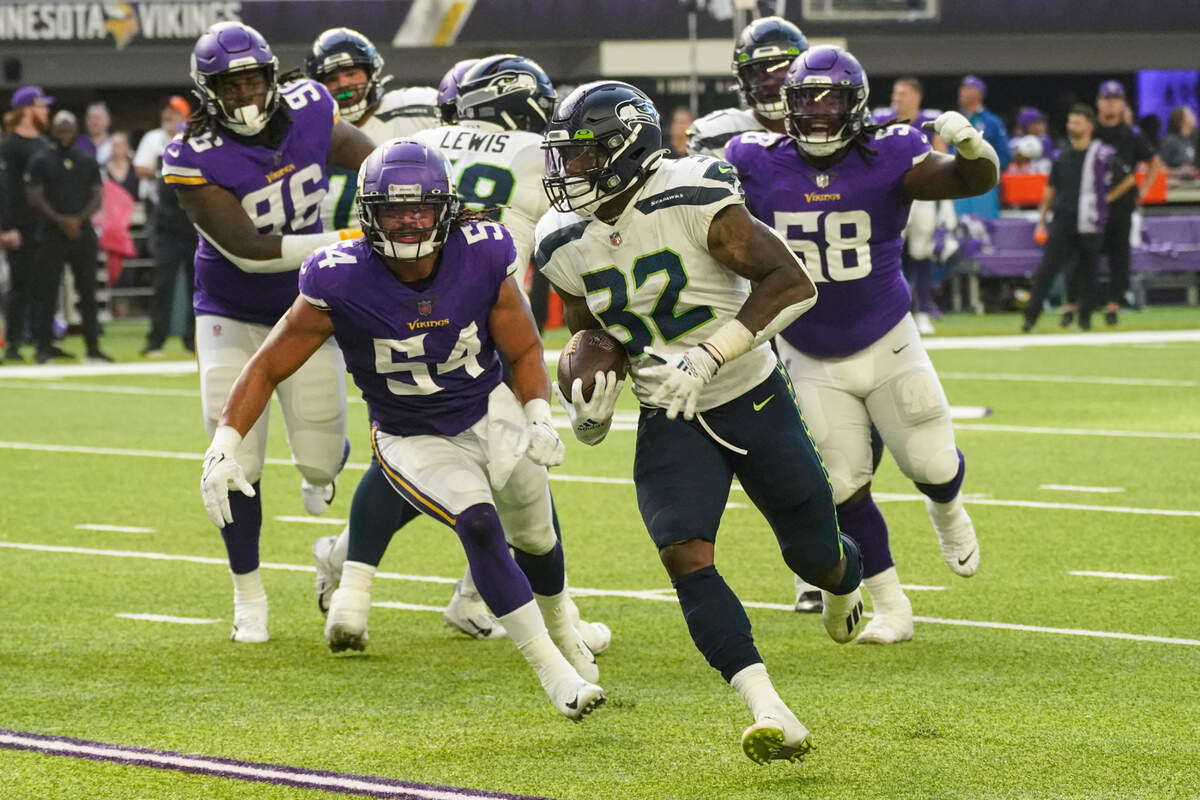
But Carson appeared banged up in Minnesota. He was getting his lower leg looked at by the team’s medical staff on the sideline while he was gaining six yards over the final 2 1/2 quarters. Carson ended up playing just 23 of the 53 snaps (43%) Sunday -- also not how Waldron’s offense is designed.
Meanwhile, Seattle’s defense was allowing Cousins and the Vikings to convert nine of 14 third downs (64%). The best team in the NFL at converting third downs last season did it just 50% of the time, Green Bay.
And, of course, Cousins is no Aaron Rodgers.
Put another way: the Seahawks didn’t have the ball for more than an hour of the three-hour game Sunday afternoon in Minneapolis.
Wilson, Carson, Metcalf and Tyler Lockett didn’t get on the field for a full possession from 3:14 remaining in the second quarter, when Jason Myers’ missed a field goal to keep Seattle’s lead at 17-14, to 6 minutes left in the third quarter. The Seahawks went from up by three points to down by seven, 24-17, without the offense getting a true chance to score, other than a throwaway drive after the Vikings’ offense left Wilson with only the final 16 seconds in the first half.
“We felt like we can run the ball on them, and we did. Chris was having a really nice day,” Carroll said. “But we needed to get back to it. We’ve got to get off the field defensively so the offense can have their shot.
“So, it all works together.”
Or, in the Seahawks’ current situation, it all malfunctions together.
While opponents are running 70 and 80 plays in games, Seattle’s offense has yet to run more than 53 plays in any game this season. Minnesota had the ball for 22:40 of Sunday’s second half. The Seahawks had it for just 7:20.
“I do know that we haven’t played well enough on the other side of the ball to get off the field and give (the offense) more chances,” Carroll said.
The effect of the defense being unable to stop anybody or anything are obvious on Wilson and Seattle’s offense. They often get so few chances to score, they almost have to score every time they touch the ball.
Their margin to not score on any drive and still win the game is almost zero right now.
“I wouldn’t say it puts extra pressure,” Wilson said. “I just think we have to be that much cleaner, we got to execute every drive. We believe that we can score on every possession, every drive. That’s just our mentality.
“So we got to make sure we do that.”
But, no pressure, or anything.
Speaking of: Wilson has never lost three games in a row in his 10 years leading the Seahawks. He and his 1-2 team need win at San Francisco (2-1) Sunday to keep that going -- and to steady a season that is already wobbling.
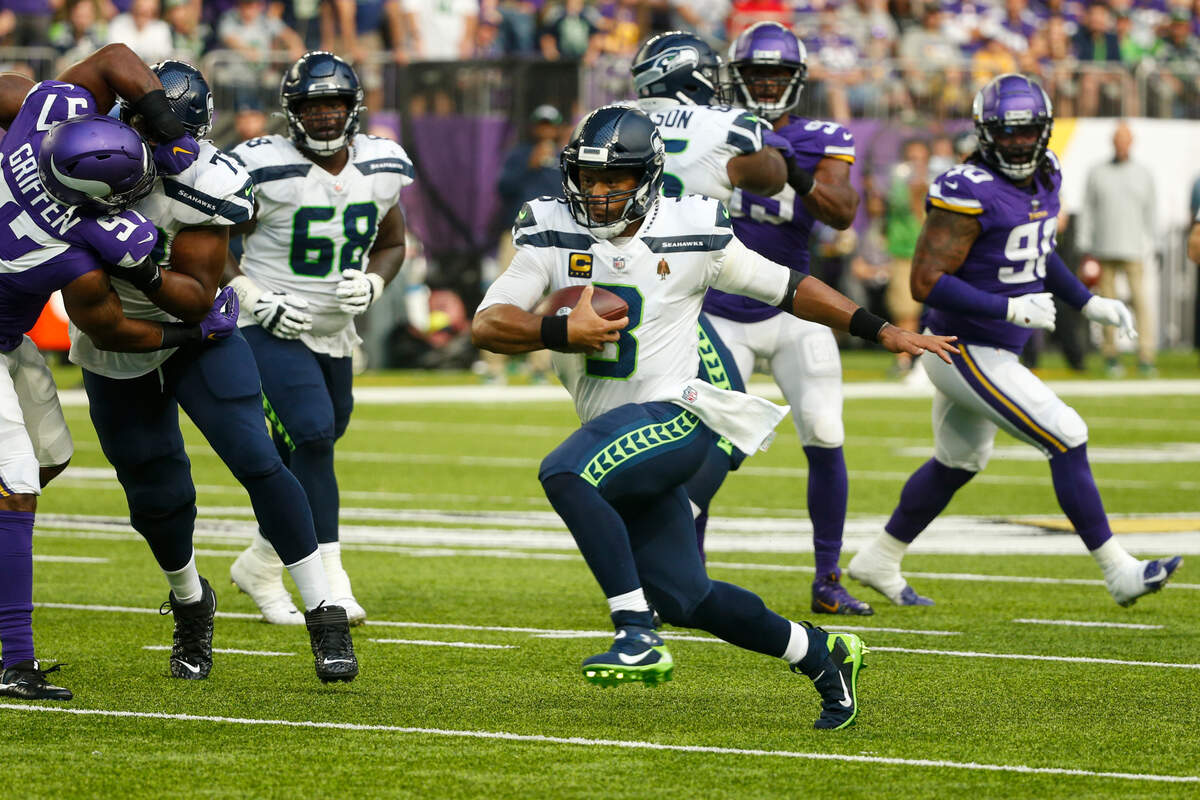
“We just have to stay the course,” Wilson said. We’re a good offense and we can do a lot of the great things. It’s going to be challenging sometimes. It’s not going to be -- you’re not going to be able to score every single time, necessarily. But...I just think that we got to stay the course.
“I’m super confident. I think that we are confident that we can respond in the right way. ...As we go through the season there will be challenges. It’s going to be a journey. We’re not stopping here.
“We can always be cleaner and we can always be better.
“But I believe in this football team. I believe in what we can do and what we will do.”