Is it scheme? Is it the players? Pete Carroll on soft Seahawks coverage in loss to Vikings
Is it “schematic,” as Tre Flowers said when asked in Minnesota to assess his play.
Or is the players’ performance?
Which of those has the Seahawks 1-2 heading into Sunday’s game at NFC West-rival San Francisco (2-1)? Which is allowing opposing offenses to convert so many third downs? Roll up so many yards? Control so much field position and time of possession? Keep Russell Wilson and Seattle’s new offense off the field for so long, while foes score 30-plus points per game, as they have in Seattle’s losses the last two weeks?
The previous week, in the team’s 33-30 overtime loss to Tennessee, Seahawks cornerbacks Tre Flowers and D.J. Reed broke the number-one rule of coach Pete Carroll’s pass defense: they got beat deep. Repeatedly, for game-changing plays.
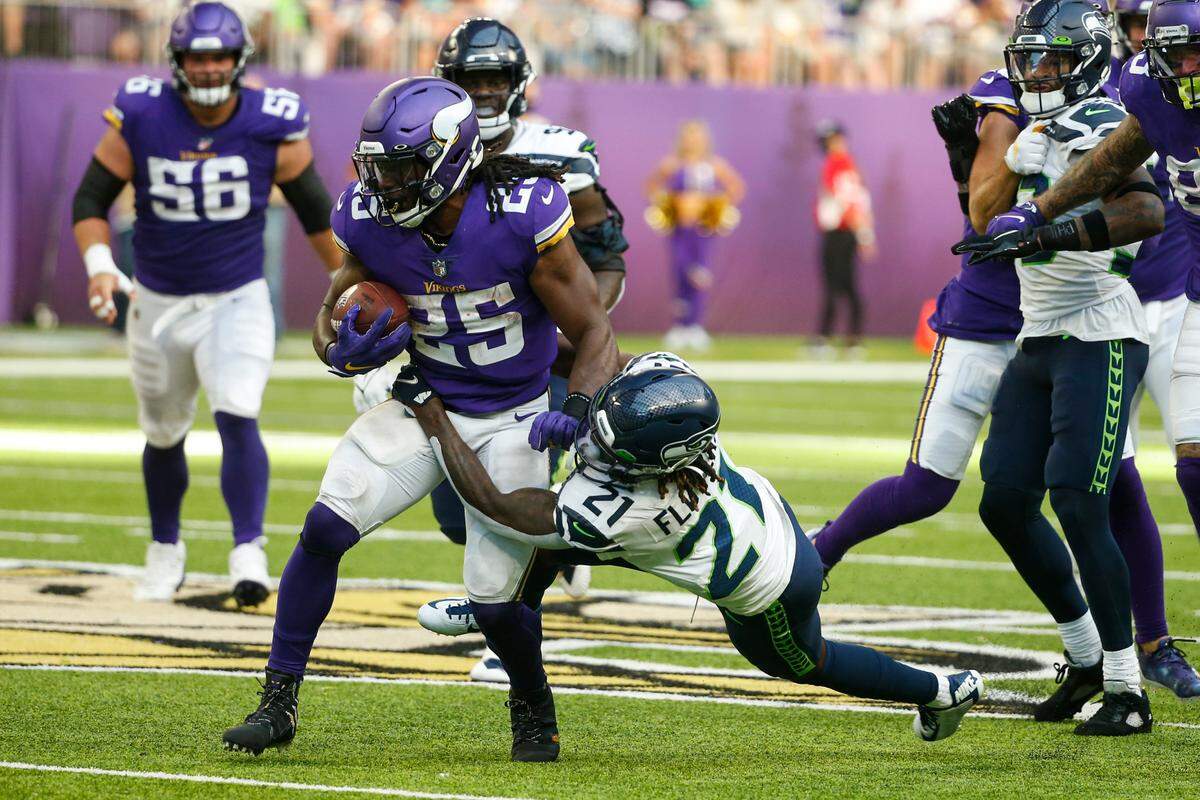
Sunday in Seattle’s 30-17 loss at Minnesota, the Vikings scored 23 unanswered points. They converted on 9 of 13 third downs. In Minneapolis, Flowers and Reed often played way off Vikings receivers at the snap, at times double the amount of yards Minnesota needed for the first down.
“The game turned out (where) we kept them in front of us, is really what we did,” Carroll said. “We had a lot respect for their receivers and all. They threw the ball underneath us quite a bit. We couldn’t do much to disrupt that.
“I thought they played a pretty solid, conservative game, but didn’t make any plays that could change it for us. We could have used a couple here and there. Unfortunately, we didn’t get anything from any of the guys on that side of the ball.”
A deeper study of 10 times the Vikings threw on third down Sunday showed eight of those 10 plays a Seahawks cornerback was lined up so far off his receiver he was behind the line to gain at the snap. Often, that cornerback was then back-pedaling at the snap, to get even further off the receiver in front of him.
“I don’t know that mathematics there that you are talking about,” Carroll said Monday, “where there is a distance off the ball depending on what the down and distance is.”
OK, let’s explain.
Soft cushions
Minnesota had third and 3 in the second quarter, with Seattle leading 17-7. Flowers was 7 yards off a bunch formation of receivers in slot left, then immediately backpedaled deeper at the snap. Kirk Cousins got sacked by Rasheem Green, but nickel defensive back Ugo Amadi inexcusably held slot receiver K.J. Osborn away from where Cousins was looking to throw. Defensive holding is an automatic-first down penalty.
Instead of getting the ball back on a rare defensive stop up by 10, Seattle allowed Minnesota to keep marching for a 15-yard touchdown pass to make it a 17-14 game. Cousins found Adam Thielen, who easily got inside and up the field into the end zone on Reed. Reed was 8 yards off the receiver at the snap.
Reed said his Seahawks got out-schemed — which, of course, means out-coached.
“They schemed our ass up,” the starting cornerback said of the Vikings. “I mean, it just felt similar to the Bills game last year (in November when Buffalo rolled to 44 points, the most allowed in the Carroll era). Whatever we were doing, just getting schemed up.”
With Minnesota leading 21-17 early in the third quarter and Wilson’s offense in the middle of an hour of real time not touching the ball, the Vikings had a third and 4 at the Seattle 34. Flowers was 9 yards off wide receiver Justin Jefferson in the left slot at the snap. Jefferson ran a simple, 6-yard out route in front of the back-peddling Flowers. Cousins had a grade-school-easy conversion on a quick, unchallenged throw to the left sideline. The Vikings finished that drive with a field goal instead of a touchdown because Darrell Taylor sacked Cousins and forced a fumble on third down at the Seattle 15.
Late in that third quarter with the Vikings leading 24-17, Minnesota had third and 5 at its 40-yard line. Reed was 7 yards off Thielen as the right outside receiver. Thielen ran the retreating Reed seemingly into the parking lot, while Minnesota’s K.J. Osborn ran a simple out route underneath them. Safety Quandre Diggs was late getting to Osborn on another simple pass and 11-yard gain, for another Vikings first down. That set up another Vikings field goal. The Seahawks were down two scores.
Is playing so far off when the opponent needs so much less to extend the drive part of Carroll’s scheme, or players not playing the defense correctly?
“That would be a good assumption if you know what coverage they are playing,” Carroll said. “You can play off the ball and sit in cloud-cover (hedging against deep passes) techniques where you have the chance to jump those routes.”
Cloud coverage, usually in Seattle’s common, cover-three zone with safeties deep, typically has one cornerback closer to the line of scrimmage and the opposite corner farther off. The strength of the defense usually rolls to the side of the cornerback who is closer to the line without the deeper, zone-coverage responsibilities.
“So that distance isn’t always telling you what the story is,” Carroll said.
“But, I think you are trying to get me to talk about the corner play, and trying to get me to tell you that there’s an issue, or something there,” the coach said, chuckling. “We’ve got to get better. We’ve got to work harder on our stuff. We’ve got to make sure we are putting our guys in the best positions, and they’ve got to take advantage of it. That’s the way it is.”
Flowers said outside the locker room in Minneapolis on the way to the team bus and flight out of Minnesota Sunday evening, “I’ve got a couple questions,” about Carroll’s and defensive coordinator Ken Norton Jr.’s schemes.
“I’ve got to find a way to (attack) digs (dig routes),” Flowers said of the many inside routes receivers are easily catching in front of him. “Those in routes, I’ve got to find a way to drive them (attack the pass in the air) or whatever it is.”
Flowers suggested confusion and uncertainty on what the scheme is calling for in coverages.
“There’s a little gray area right now amongst a couple people,” he said. “And I’ll fix it or someone else will fix it. We don’t know yet.
“I’ve got a couple questions myself.”
“I’ve just got to play better overall,” Flowers said.
Relayed that on Monday, Carroll said: “I don’t know about what they said. I didn’t hear that. I didn’t read that, so I don’t know what they have said.
“But what I would tell you is it was a frustrating game. That’s why we have Monday, and we get back to business. Everybody looks at the film.”
Carroll was asked if his cornerbacks have the latitude in the Seahawks’ scheme to be more aggressive than they were in Minnesota, or were their defensive plays being called that prevented that aggressiveness?
“No, we can always challenge,” Carroll said.
“There is freedom in our scheme. There always been for them, when they are playing up and back, and on the line of scrimmage and that. They have to make choices, depending on the situation, and the call, and the (wide receiver’s) split and all of that. So, you know, we’ll work with them. We coach them up during the course of a game. We’ll coach ‘em up in prep for a week how we want to do it. But they have some freedom there.
“And we wound up off quite a bit in this game, and probably more than we would like to, if we could go back and do it again.”
No help
Also not helping Seattle’s shredded defense: It’s not forcing turnovers, as it did to help U-turn a bad start to the 2020 season.
The Seahawks have zero interceptions in opponents’ 123 drops back to pass this season. They’ve have forced two fumbles Seattle has recovered. The Seahawks are plus-1 in turnover margin, 17th-best in the NFL through three games.
Last season, Seattle had 22 takeaways in 16 games.
Seattle’s pass rush hasn’t been doing the cornerbacks any favors, either.
Losing both starters since last season, Shaquill Griffin and Quinton Dunbar, to free agency, trading preseason starting left cornerback Ahkello Witherspoon to Pittsburgh just before the opener, moving Reed from right side to left at the same time — cornerback was always going to be a problem position for the Seahawks this season. The cover men need the help of the defensive front getting the ball out of quarterbacks’ hands before they want to throw it, and before receivers can beat the iffy coverage downfield.
Seattle got three sacks and eight hits on the Titans’ Ryan Tannehill when he threw for 347 yards. Tennessee gained 532 yards in all rallying from being down 24-9 and 30-16 to win in week two.
In week three, the Seahawks got just Taylor’s strip sack and four hits on Cousins. He decisively out-gunned Wilson, completing 30 of 38 mostly easy passes for 323 yards and three touchdowns without a turnover.
Carroll and Norton have tried a five-man defensive line, their usual 4-3 scheme, blitzing out of base defense, out of nickel defense, sending three blitzers, rushing only three and covering with eight — as they did dropping ends Carlos Dunlap and Alton Robinson into the flat in coverage on Cousins’ first touchdown pass to tight end Tyler Conklin past linebacker Jordyn Brooks in the first quarter Sunday.
“We threw everything at them,” Carroll said.
None of it worked.
“We need more. We need to be more effective. We have not disrupted the quarterback,” Carroll said. “That shows you in terms of (the lack of forcing) turnovers and us being able to get after that football. It starts there.
“Our guys are working it. They are busting their tails to get it. We just need to work together.
“I just think the whole thing needs to work together tighter. It would cause some holding the football longer on the quarterback’s point, and sometimes we disrupt. It just needs to work together more effectively.
“And we are working for that.”
This story was originally published September 27, 2021 at 4:53 PM.