Seahawks’ 80-20 pass-run skew in Green Bay? Russell Wilson didn’t change Waldron’s calls
A pass-run imbalance of more than 80-20?
Who was calling the Seahawks’ plays, Mike Leach in his college, Air Raid offense?
Was it Pete Carroll?
No, not according to what the Seahawks’ head man said after his team’s first shutout loss in 22 years, 17-0 last weekend at Green Bay.
“I didn’t like that we didn’t get to run the ball more. In a close game like that, I would have expected that we would have run the ball more than we did,” Carroll said. “The running backs carried the ball 11 times, that’s not enough. It’s not enough to get into a rhythm and it’s not enough to get a feel for the game.”
Was it Russell Wilson? The franchise quarterback has remarked how he has more latitude to change plays at the line to a wider array of the entire playbook this season with a first-time offensive coordinator than he’s had in previous years with Brian Schottenheimer.
But asked this week if he changed many of the plays that resulted in 48 of Seattle’s 59 plays being pass calls in the Packers game that was 3-0 into the fourth quarter, Wilson said no.
“Earlier this year, we changed them quite a bit. This past game, we didn’t change quite as much,” Wilson said, “just because of how full the game was.”
Full of passes, by a quarterback returning from a month off whose long throws fluttered and floated off his repaired finger into the cold Wisconsin air Sunday night. Wilson’s longer throws in Green Bay were noticeably different than the renowned deep-ball passer’s usually exquisite, accurate darts and rainbows.
That means the man who called all the passes and so few runs for an offense that must run the ball to give an iffy line fair chances to protect Wilson passing was that new, first-time play caller.
“I need to do a great job of sticking in the run game in those early game situations where we can come out with that balance,” offensive coordinator Shane Waldron said this week, “especially in the first half of the game.”
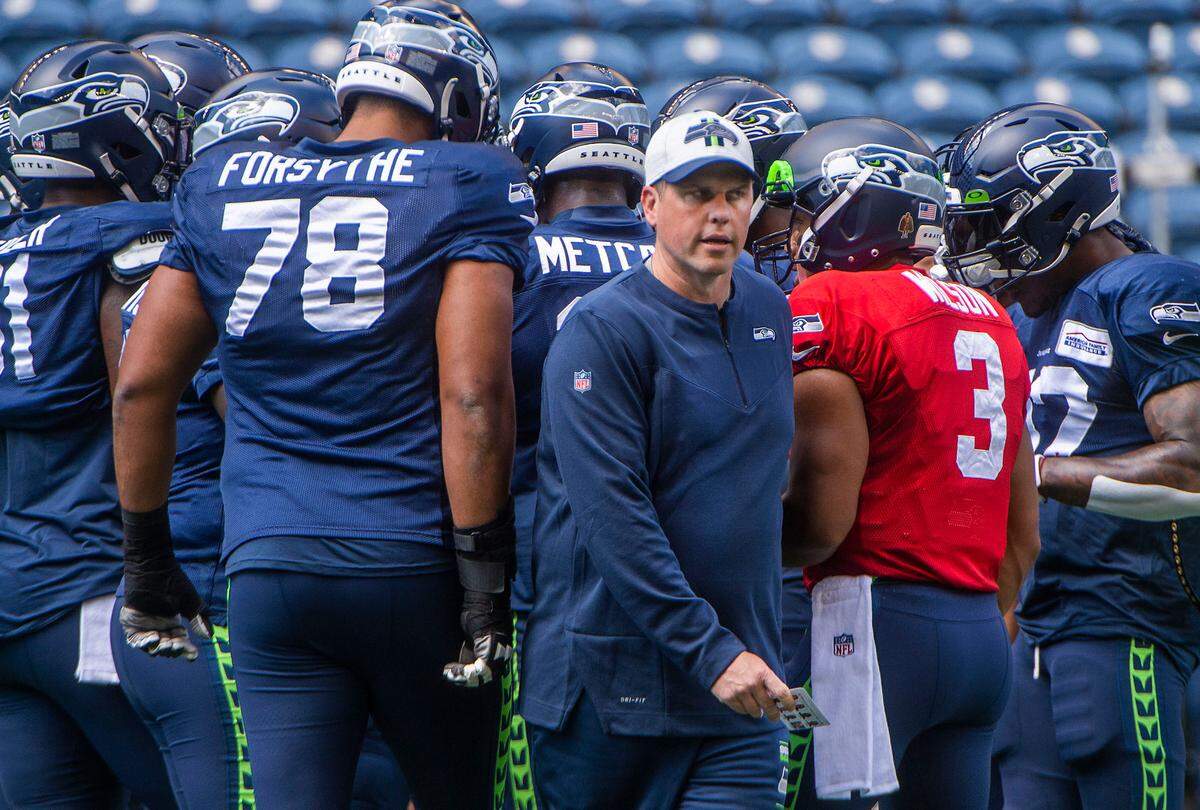
What they planned
Carroll hired Waldron from the run-based Rams in January to get opposing defenses out of the two-deep safety coverages Seattle saw shut down Wilson, DK Metcalf, Tyler Lockett and the Seahawks’ deep-passing game the latter half of the 2020 season. Carroll said 10 months ago the idea was for Seattle to re-dedicate itself to running first with lead back Chris Carson, to force defenses to bring a safety back “into the box,” nearer the line of scrimmage, and leave more single-high pass coverage for Wilson, Metcalf and Lockett to exploit.
That’s the defense the Seahawks saw most during their back-to-back Super Bowl seasons of 2013 and ‘14 based upon Marshawn Lynch’s powerful running and Wilson’s deep throws that put a single, deep safety in constant quandary.
A ton has happened to the offense since Carroll added Waldron, Waldron installed it in August and now.
Little of it has been good.
Seattle lost Carson, the designed bedrock, for the season after just four games. Carroll announced Friday the 27-year-old running back is having cervical surgery to repair a vertebrae issue impacting a nerve in his neck. The Seahawks believe he will be able to play the 2022 season, but with neck surgeries no one is certain.
Then, what no Seahawk considered: Wilson got hurt enough to miss games, three of them, for the first time in his 10-year career. It ended his streak of 165 consecutive games played, the sixth-longest streak in NFL history.
Seattle is 30th in the league in rushing through nine games. The offense is 30th in converting third downs (33.7%). Only winless Detroit and two-win Jacksonville, which the Seahawks beat by 24 points late last month, are worse making the line to gain on third down.
And the Seahawks are 3-6 for the first time since 2011, Carroll’s second season and the last one before he drafted Wilson to be his quarterback.
Seattle needs to go 6-2 the rest of the regular season to finish 9-8 and have any realistic chance at making the playoffs for the ninth time in 10 years.
To do that, they need to run more, to make defenses play them more honestly, to keep pass rushers from teeing off on Wilson.
They need to start doing it pronto. As in, on Sunday, when last-place Seattle faces elite pass rushers Chandler Jones (four sacks against Wilson in a 2019 game), Markus Golden (second in the NFL with nine sacks in 10 games this season) and the first-place Arizona Cardinals (8-2).
Carroll, Wilson and Waldron think the Seahawks’ problems running the ball come from lack of opportunity.
The Seahawks have run the fewest plays in the league (501, an average of 55.7 snaps per game). They are averaging 25:18 of possession time in each 60-minute game, more than 4 minutes lower than they averaged in 2020.
Both of those bottom-of-the-NFL numbers are related to not converting on third downs. Too many third downs have been long yardage because of so many negative plays.
Of their 108 plays on third down this season, the Seahawks have had 10 or more yards to go 31 times. Nearly 30 percent of the time Seattle has been in third and way too long.
That’s deadly for an offensive line that’s had problems protecting Wilson for years — and Sunday will have its best lineman, left tackle Duane Brown, playing with a strained groin from last weekend.
“I’m always going to keep coming back to avoiding those negative plays,” Waldron said, “doing a better job on third down so that we can get those runs going.”
He used as an example the fly sweep he called late in the third quarter last weekend at Green Bay.
Anatomy of a negative play
On second and 9 following Jamal Adams’ end-zone interception of Aaron Rodgers to keep the Packers’ lead at only 3-0, Waldron sent Dee Eskridge in motion from outside right toward Wilson at the snap. The Seahawks’ speedy rookie top draft choice this spring had not played a down the first 2 1/2 quarters in his return from two months out following a concussion in the opening game. The only two NFL touches he’d had to that point were fly sweeps — “my specialty,” Eskridge called them this summer.
Guess what the Packers were waiting for on Eskridge’s first involvement in their game?
Cornerback Rasul Douglas charged across the line of scrimmage up field and just waited for Eskridge to get the ball at the snap from Wilson and run to him. He did. Running back Alex Collins couldn’t get back to the charging Douglas to block him. Three other Packers were waiting to tackle Eskridge if Douglas hadn’t chopped him down.
Loss of 4. Third and 13. End of Seattle’s momentum and drive.
That’s on Waldron’s play call as much as the execution of it.
“Coming out in the run and then we have the jet sweep that we gave up a negative play on and kind of get out of whack,” Waldron said. “That’s going to keep being the main focus is eliminating those negative plays so that we don’t get stuck in those second-and-longs, third-down situations, and we can keep on track and have those play actions and runs and keepers in the marriage that we know we want to have them at.”
Eight games remain for the Seahawks to find the run. At least find more of it, more often, with Collins and forgotten Rashaad Penny (zero snaps last week) instead of Carson.
Their offensive line, offense and season depend on it.
“We’ve got to catch our groove,” Wilson said. “As we catch that groove, I think the running game, passing game, all that as to click together as one.
“If we can do that, which I know we can, and we have this year so far, a few times, let’s catch fire. That’s just kind of our mentality.”
This story was originally published November 20, 2021 at 9:02 AM.