Seahawks’ Bobby Wagner talks mental health: ‘Real strength is knowing when you need help’
Bobby Wagner did not begin playing football until his junior year of high school.
When Wagner was a senior, then-Stanford coach Jim Harbaugh came to Ontario, California, on a recruiting trip. So did a member of Utah State’s coaching staff. Harbaugh and the Utah State coach happened to be in the same bar-restaurant in the Ontario area east of Los Angeles.
Wagner’s coach at Colony High School saw them there. The coach had a lot at stake, personally. Two years earlier, he had promised Phenia Wagner, Bobby’s mother, he would get her son a college scholarship if Wagner ditched basketball and played for his Colony High football team.
With no offers coming and with Harbaugh and the Utah State staffer inside the same establishment near his school, Colony High coach Anthony Rice got tricky.
“He walked over to Jim Harbaugh and said, ‘We’ve got this linebacker. You should look at him,’” Wagner said. “Jim said, ‘No.’
“Then he went from Jim Harbaugh to Utah State and said, ‘Hey, that guy over there is going to offer him if you don’t.’
“So, they offered me.”
Yes, Wagner got his only college scholarship offer because of a bar trick by his high school coach.
After his freshman year into Utah State, his mom suffered a stroke. Wagner wanted to leave Logan, Utah, and go to school closer to Mom.
“She told me to stay,” he said. “So I stayed.”
Phenia Wagner died months later, of a heart attack. She was 47.
So, yes, the Seahawks’ perennial All-Pro linebacker who leads the NFL with a franchise-record 170 tackles with two games left in this season has had his challenges to get to the top of professional football. Many players in the league do.
That’s one of the reasons Wagner wanted to talk about mental health awareness and well-being Wednesday.
“There’s a lot of misconceptions when it comes to the way you take care of your mentals that I feel like we should start slowly trying to break down,” a reflective Wagner said four days before his 5-10 Seahawks host the Detroit Lions (2-12-1) in the home season finale at Lumen Field.
“We could talk about football. But it can be no matter what sport profession you’re in, there’s a mental aspect of it. And if you don’t take care of it, it can catch up to you. I think I see that in a lot of people that walk away from the game that I play. ...
“I think it should be something that we talk about a little bit more. I think a lot of times we hide the stuff that we go through on a personal level and we think that is strength.
“The real strength is knowing when you need help.”
Wagner is 31 now. He’s made it. He’s an elite, likely future Hall of Fame middle linebacker 10 years into an NFL and Seahawks career he hoped could last three.
“It’s really unique. It’s special. It’s hard to do, and it’s hard to play the game for that long at that level day in and day out, week in and week out, year in and year out,” said Seahawks defensive coordinator Ken Norton Jr., Wagner’s position coach when he entered the league.
“The NFL average has been 3 1/2 to four years and this young man has done it going on 10. There isn’t a word for it. I think he is setting a new standard for what a high-level middle linebacker, Hall of Fame, sustained excellence over a long period of time. He has really set a new bar for guys.
“There is more out there. He is not done yet, there are a few things left to do. And I can’t wait to see what happens.”
When Norton and the Seahawks drafted Wagner in the second round in 2012, one round before they took Russell Wilson to be their quarterback, Wagner said he didn’t understand the importance of getting help mentally.
“Like I said, there’s a lot of misconceptions. Even myself when I heard of the word therapist, I just thought crazy,” Wagner said.
He said he now sees a mental-health counselor like a training coach in sports.
“I didn’t really think of it from a standpoint of when we workout we really want to get a really good workout we find a good workout coach,” he said. “When you want to take care of your mind and you’re having trouble figuring that out, you find somebody who is similar to a coach that can help you process that.”

More than football
Wagner has evolved in his career and life from just trying to win a job and stay in the league to realizing he has a platform as a famous athlete. Wagner is increasingly using that his platform to talk about everything but football.
This season, the Seahawks’ captain has started each of his weekly press conferences talking about a different subject. One week he spoke on all women have accomplished in our society, and that it needs to be appreciated more, by men. He spoke of why The Alchemist by Paulo Coelho is one of his favorite books.
This month the Seahawks nominee for NFL Walter Payton Man of the Year in 2019 talked this month about teaming with Delta Air Lines to send a U.S. Army family of four home for the holidays.
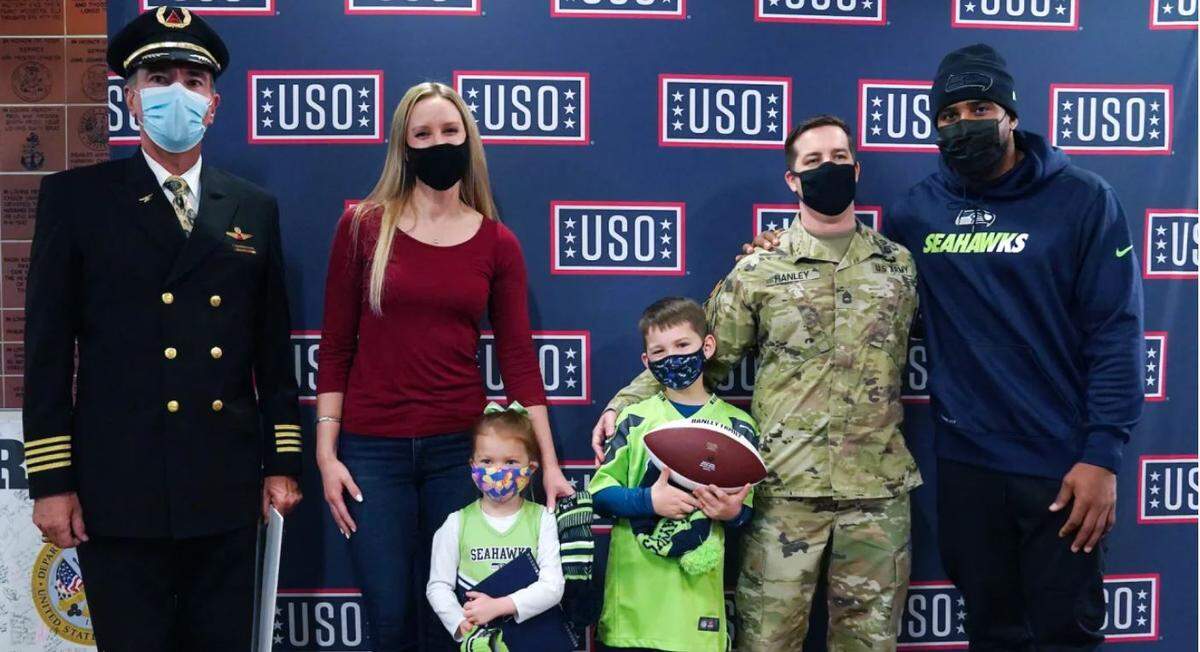
The budding entrepreneur — he’s a co-founder of Seattle tech startup Fuse Venture Partners VC — negotiated his $54 million contract with the Seahawks without an agent. This month at one of his press conferences Wagner announced he would take nine students who submitted writing samples on Twitter to Silicon Valley with him to tour venture-capitalist companies, as he and Seahawks teammate Duane Brown did a few years ago.
The importance we as a society give professional athletes may be larger than it should be. That’s a product of how popular professional sports is in our country.
Staying grounded
Wagner has a daughter, Quinncy. He rarely talks about her publicly.
“I don’t really like to talk about myself. I don’t really like to talk about my family and just kind of the things that I do,” he said. “I feel like the world that we live, it creates this façade almost that you’re bigger than what you are. You go out to the stores or go out to restaurants and people know who you are.
“You can get kind of stuck in that world, and when they take that world away from you, I think that’s where some of the mental problems come. You get so used to being treated a certain way because people love what you do for them and how you make them feel. The moment you take that away, they don’t realize what they’re taking away.
“I try to keep myself grounded, keep myself connected to my loved ones and the people around me, and protect them. I chose this world, I chose this life. The people around me didn’t choose this life, so what comes with this life and the eyes that come with this life, I try to do my best as a leader in my family to protect them as much as I can.”
Wagner knows because he is a Super Bowl-winning, star linebacker people look up to him. People listen to him.
He mentioned this month he didn’t like mayonnaise, and national controversy erupted.
So he’s saying things that matter far beyond the field.
“There’s a lot of highs and lows and a lot of times where things don’t go your way or things are hard in your life,” Wagner said. “It doesn’t matter what color you are, doesn’t matter what profession you’re in, doesn’t matter how much money you have or how little money you have, everybody has something that’s going on in their life that sometimes it’s overwhelming.
“If you always just keep it compressed, at some point it’s going to come out and come out in ways that you may not want it to come out.”
Wagner’s latest message is a crucial one.
“I just want to stress it’s OK to not be OK, and it’s OK to look for somebody to help you out through that process,” he said.
“I support anybody that needs that help, and I think it should be a conversation moving forward and just let us all figure out a way to get mentally stronger.”
This story was originally published December 30, 2021 at 12:07 PM.