Russell Wilson’s Seahawks legacy? More than wins, Super Bowls, TDs. Ask Seattle Children’s
When Russell Wilson first flew to Seattle soon after the Seahawks drafted him 10 years ago, he had a vision.
Not just of how his NFL career would begin, then flourish.
Wilson’s vision was how this football player born in Cincinnati to a lawyer father and a nurse mother — who grew up in Richmond, Virginia, then played baseball and football for North Carolina State and led Wisconsin to the Rose Bowl — would change lives in the Pacific Northwest.
He was 22 years old.
“It gives me chills thinking about it, really,” Wilson said. “Flying into Seattle, it was May 11, 2012, it may have been May 10, 2012, but I flew in and first of all, I had never been out here. ...I had heard great things, but I also heard that it rained a lot.
“They got me. I came in May where it was 82 degrees.
“I remember landing and flying over Seattle, and I love nature, water, mountains, trees, and stuff like that. I landed and thought, ‘This is a beautiful place, and this is the place for me.’”
As he looked out of his jet and saw Mount Rainier for the first time 10 years ago, Wilson wrote out his goals for his NFL career.
“I wrote out my right-now, present goals. And then my future, legacy goals,” he said.
The football legacy goals, Wilson has made those clear over his decade as Seattle’s franchise quarterback: To be the best who’s ever done it; to win the most.
In his second season, he won Seattle’s first and still-only Super Bowl championship. Last season he became the winningest quarterback in NFL history over the first 10 years of a career. He signed two league-record contract extensions with the team, in 2015 and ‘19. He earned $181 million in football contracts with Seattle, plus tens of millions more in endorsements.
In the last year, he’s refined his football goals. He wants to win three more Super Bowls. He wants play until he is at least 45, past Tom Brady. Brady retired this winter at 44.
Yes, he self-promoted. He had his “performance team” and brand. He often sounded and seemed programmed.
Yet Wilson’s personal legacy in Seattle is far beyond all that.
“The thing that I have always relied on and believed in was, my parents taught me this: whenever you go somewhere, leave that place a better place,” he said.
“That doesn’t mean through wins and losses. But what it means is through people and the community as much as possible.”
He has absolutely done that.
The deal
Wilson has decided his football legacy in Seattle stops here.
He’s chosen to continue his pursuit of more Super Bowl wins in Denver.
He waived his no-trade clause and Tuesday decided to approve a trade from the Seahawks to the Broncos. The deal that shakes Seattle’s franchise and region brings the Seahawks five draft choices plus three players, including quarterback Drew Lock.
The trade is pending Wilson officially signing the waiver on his clause prohibiting him from getting traded, and on him passing a physical examination with the Broncos. Expect both teams to first state they have “agreed to terms on a deal,” perhaps in the next day or two.
The trade won’t be announced as officially complete until the start of the league year March 16.
Wilson leaves behind a legacy in Seattle more important than victories and touchdown passes.
The 2020 NFL Walter Payton Man of the Year did more than win for the Seahawks.
He changed lives here.
He is the 2022 Bart Starr Award winner. The award honors the NFL player who best exemplifies outstanding character and leadership in the home, on the field, and in the community. He and his wife Ciara founded the “Why Not You” Academy. Their tuition-free, public charter high school in south King County opened in 2021 with a freshman class of 100.
The kids and staff at Seattle Children’s hospital have “Blue Tuesdays” instead of the city’s Blue Friday. That’s because Wilson visited the sickest of the sick there every week for a decade.
Meet Frida, Hunter, Ailynn
On yet another Tuesday visit to Seattle Children’s during the Seahawks’ 2018 season, two days after his team’s win at Arizona, Wilson flipped a pink football he’d just autographed to little Frida. Her agape mouth and her wide eyes showed Frida was about two solar systems over the moon.
On the same Tuesday Wilson also changed the solemn lives of Hunter, of other kid patients. Their families. The hospital’s staff. Everyone there.
Hunter was a cancer patient at Seattle Children’s during the fall of 2018. That made him a genuine authority on courage. He talked with Wilson about courage while they sat on his hospital bed.
“You inspire me, Hunter,” the Seahawks’ quarterback replied to the boy.
Wilson was wearing yellow, protective outerwear required for visiting the kids at most risk. Their conversation was on a video Wilson posted to his Twitter account.
Wilson had his left arm around Hunter as they talked into a smart phone.
“But the cool thing about you, Hunter, is you are inspiring some other kid that is going through what you are going through,” Wilson told him. “And just how your family loves and cares, it’s really inspirational.”
Hunter nodded.
“I really hope that I can be an inspiration for people,” the boy said. “I want to be positive for people. And hopefully I can do that.”
“You are doing that, buddy,” Wilson said.
“You helped me do that,” Hunter told Wilson. “And I am really thankful for that.”
Wilson then told Hunter: “Why not you, brother?
“You are going to make it. We are praying for you. Continue the positive talk, just your self-talk. Your encouraging words. Your inspiration. You inspire me, that’s for sure.”
“Thank you, very much,” Hunter said.
Seattle Children’s Hospital is the pediatric referral center for the Pacific Northwest. It has some of the West Coast’s most serious and complex medical situations involving kids. Families from as far away as China seek Seattle Children’s specialists for their unique care.
The hospital is located in the Laurelhurst section of northeast Seattle. Wilson used to rent a house in the neighborhood. In 2015 he bought a mansion on Lake Washington in west Bellevue for his wife Ciara, their three kids and himself.
My wife has been a speech-language pathologist at Seattle Children’s for the last 16 years. She says the staff there eagerly awaits Tuesdays. For a decade, minus only the two years the pandemic strictly limited hospital visitors, she’s seen the effects Wilson’s visits have on the patients and their families there. That’s both in the anticipation before he arrives and the appreciation after he leaves. Seahawks gear has become normal duty attire for many who work there, because of Wilson.
And during the pandemic, when he couldn’t go into the hospital, he visited the kids on Zoom.
He didn’t hang out in the hospital lobby, cafeteria or first-floor play room fronting with the masses for mere photo ops, either. He went onto the floors, into the hospital’s most critical situations, into the intensive-care and cancer units. He mocked up in protective outerwear and gloves to be at the bedside of the most contagious and at-risk kids. He played a ukulele for a sick boy at his bedside there, then autographed it for him.
Some criticized Wilson for promoting these visits on social media, for being self-serving. Fact is, the posts of Wilson’s visits served others. They remain enormous sources of pride and appreciation for the kids he highlighted, and their families. Those of us not in those heart-breaking situations can’t even imagine.
The families of the kids he stopped in to see absolutely loved and cherished his visits.
They cherished Wilson.
Months after he led the Seahawks into their second consecutive Super Bowl in 2015, Wilson mentioned at the end of one of his weekly Thursday press conferences another patient he had met that week at Seattle Children’s. Her name was Ailynn Arredondo.
He had posted an Instagram photo and entry the previous week about her.
“This beautiful angel was asked by me to be her godfather! I said yes!” Wilson posted, in Spanish. “@seattlechildren She asked...”
Ailynn died the day after Wilson’s post.
“I want to say another thing,” Wilson said, unprompted, to end that presser in 2015. “I’m sure people have paid attention, but just Ailynn — such a sweet girl, first of all. I’m fortunate enough to go to the Children’s Hospital every Tuesday and I get to see a lot of kids, and unfortunately sometimes you see a kid and they pass away. Sometimes you get to see them on their last few days. Sometimes you may not see them for another couple months and then they pass.
“But just a special girl. I pray that everybody keeps their family in their prayers and all that, and just anything that you can do to help people. That’s the best thing we can do as people, especially with kids, like the Children’s Hospital...
“Thank you guys. Go Hawks!”
Wilson reflects on Seattle
In December, before what proved to be one of Wilson’s final games as Seahawks quarterback, The News Tribune asked him to reflect on what those weekly visits did for him in Seattle.
“Children’s hospital has meant a lot to me,” Wilson said.
“That’s one of the things I wanted to do. When I got to Seattle, whatever city I went to, I wanted to make a difference in that city in a way that meant something.
“My mom (Tammy), when I was growing up she was an ER nurse, was always in hospitals. My dad was a diabetic who passed away from diabetes. They were always in a hospital, for whatever reason.”
Harrison Wilson III was a one-time San Diego Chargers wide receiver. He graduated from Dartmouth. He became a lawyer, married Russell’s mother and had two sons and a daughter with her. He died in 2010 from complications with diabetes. He was 55.
“I think what I found in my life is that...what’s really important is the ability to serve, the ability to love, and the ability to give as much you can give,” Russell Wilson said.
“I think that throughout all of the things that I have and have been fortunate to experience, it doesn’t mean anything without the ability to love and serve. For me, when I came here to Seattle, it meant the world to me to be like, ‘Hey, how am I about to establish my feet here, what would that look like?’
“I had my football goals, obviously win multiple Super Bowls, be a starting quarterback, and all of those things.
“On this side of it, it was about how I would be able to impact my city. The first thing that really meant something to me was the Seattle Children’s Hospital. I’ve always loved the youth, being able to impact there, so for me, I wanted to dedicate my time here, no matter how long it is.”
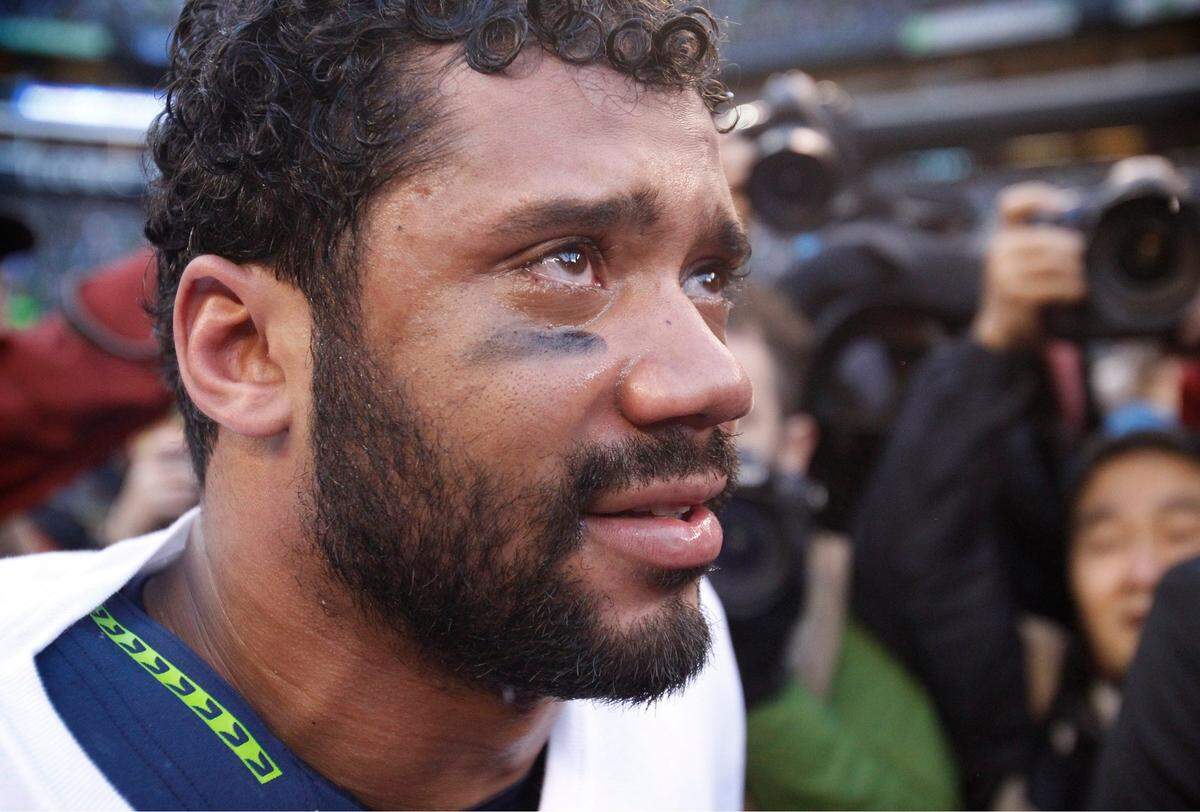
Looking back now, Wilson’s words in December became his farewell to Seattle Children’s, and indirectly, to Seattle.
“When I came here — if I’m going to be here, I hope for 20 years, 10 years, two years, I didn’t know — but I would make sure that every time, every week, I would try to do something that is connected to the Children’s Hospital,” he said Dec. 8. “I wanted to have some type of meaning there and try to impact someone’s life.
“Every time I go into a room I’m praying for a miracle. I’ve experienced it with my own life. I’ve experienced it with my dad who passed away, but him also being told that he had 12-18 hours to live. And he lived another 3 1/2 years. He got to see me get drafted in baseball. He got to see my brother get married, and he got to see a lot of special things that a lot of people said wasn’t going to happen. He couldn’t breathe again. He will never live again.
“What I pray for every time I go into the Seattle Children’s Hospital room is that hopefully, I can give a little glimpse of hope, a glimpse of love, and a desire that life is worth living. Hopefully that inspires someone else.”
This coming regular season, Wilson will return to Seattle — with his Broncos, to play the Seahawks.
“Seattle means the world to me,” he said. “And always will be.”
This story was originally published March 9, 2022 at 7:39 AM.