DK Metcalf’s penalties: What Seahawks are doing, and one obvious way to reduce them
His latest performance was truly the full DK Metcalf Experience.
Four catches on 10 targets for 69 yards doesn’t even begin to explain Metcalf’s Sunday in Cincinnati.
- The Seahawks’ 25-year-old star wide receiver had a big play. He had a 30-yard catch down the sideline, soundly beating his defender Cam Taylor-Britt. He should have had a bigger one in the second quarter, for a touchdown Seattle ultimately needed to win the game. But quarterback Geno Smith didn’t throw to his wide-open receiver after he got inside Taylor-Britt and alone at the Bengals 20-yard line.
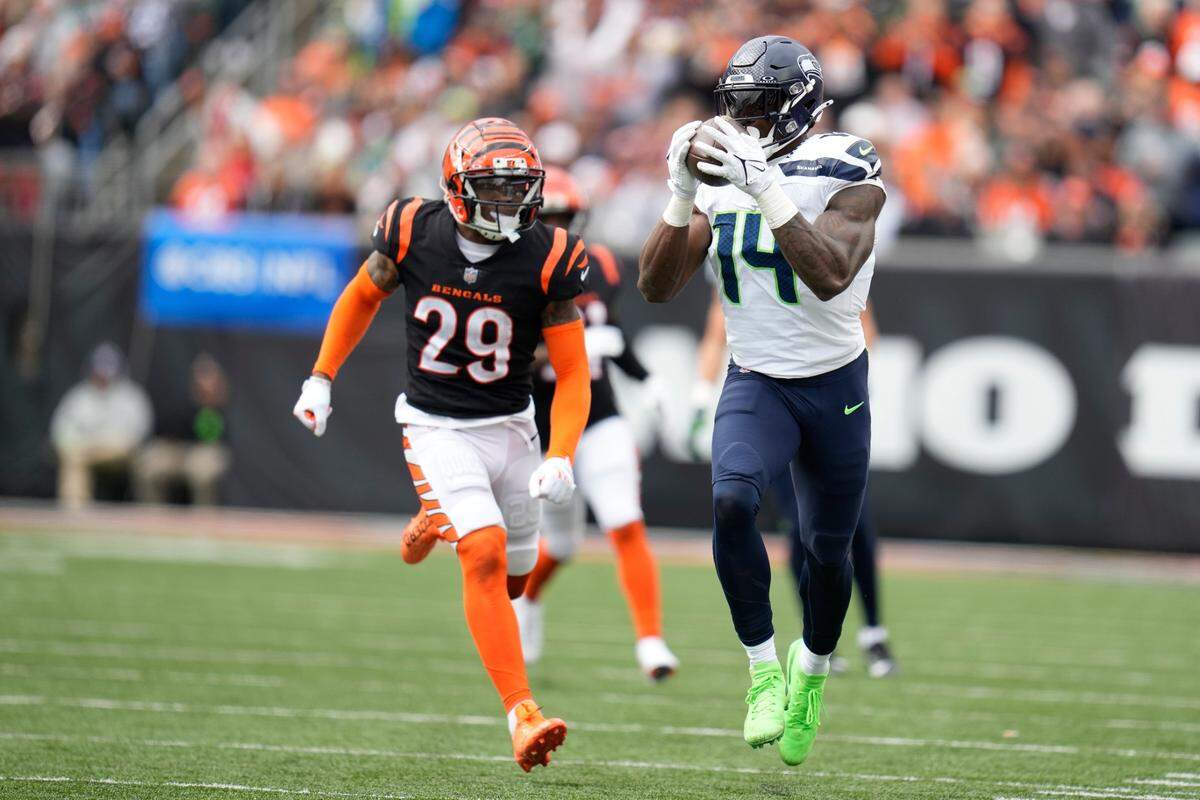
- Metcalf lost another big play. That was down the opposite sideline, when he allowed smaller defender Taylor-Britt to rip from his hands the ball Smith accurately threw onto them.
- Metcalf got hurt. In the third quarter he left the game and jogged behind team physician Dr. Ed Khalfayan into the Seahawks’ locker room at Paycor Stadium. The team said he was questionable to return because of a hip injury.
Yet a few minutes later he jogged out of the locker room back to the sidelines and back into the game.
- Metcalf took blame. That was after the game, for creating Smith’s second interception. Metcalf stopped his in-breaking route when he saw Taylor-Britt far inside anticipating his cut. Smith threw the ball inside expecting Metcalf to keep running and challenge Taylor-Britt for the ball. Cincinnati turned the interception into its only three points of the game’s final 42 minutes. That field goal made the Seahawks have to go for touchdowns on their two fourth downs inside the Bengals 10-yard line in the game’s final 2-1/2 minutes. They failed on both, and lost the game.
- To make Metcalf’s day complete — and characteristic: He had another needless penalty.
It’s getting to the point where it’s now: Of course he did.
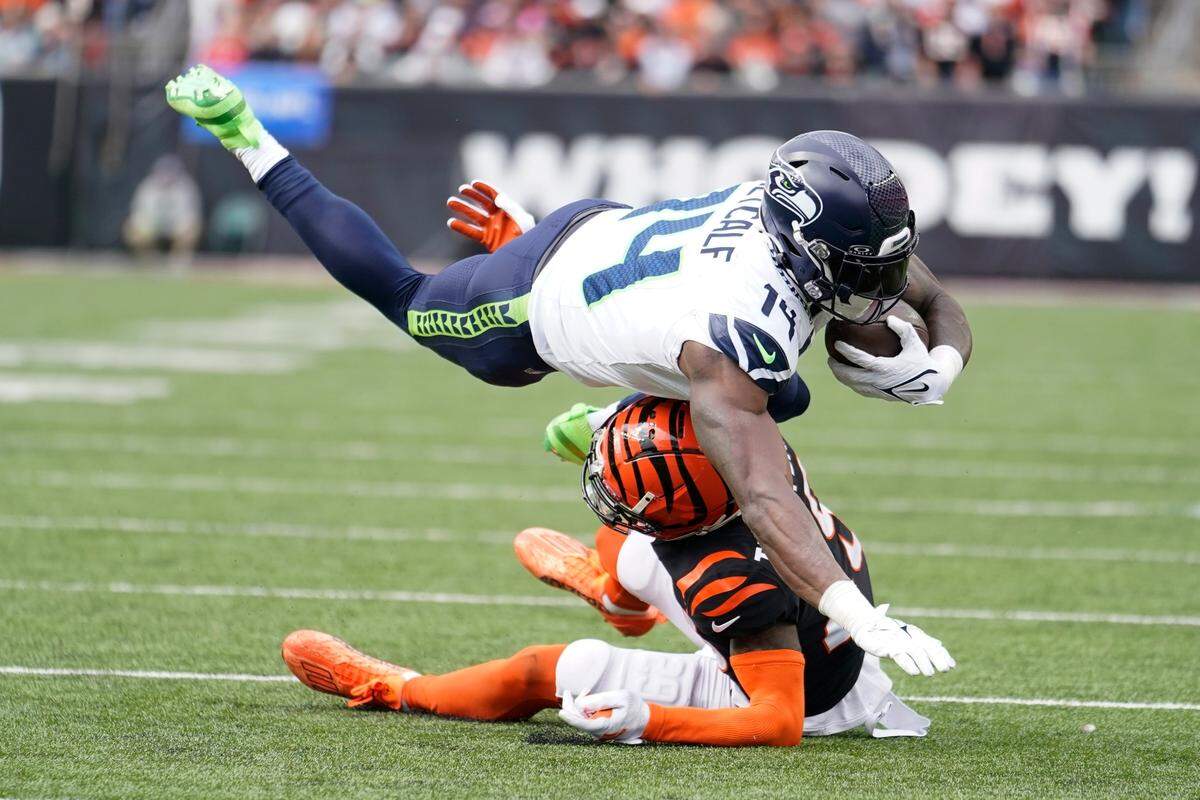
Late in the first half, at the end of one of the few times Seattle successfully got the ball into the hands of decisive rookie running back Zach Charbonnet, officials flagged Metcalf for pushing Taylor-Britt to the ground. Metcalf shoved the cornerback, five inches and 30 pounds smaller than the 6-foot-4, 230-pound wide receiver, in the chest after the play.
He did it about 40 yards down the field from where Charbonnet had completed a catch and run for 6 yards.
The penalty was for unnecessary roughness. It was far more unnecessary than rough.
Instead of second and 6 at their 40-yard line, the Seahawks had second and 16 at their own 25. Though Smith’s completion to Tyler Lockett for 32 yards erased the yards Metcalf cost them, the drive ended like all but one of them did for Seattle in its 17-13 loss at Cincinnati: without a touchdown. It ended with a Michael Dickson punt near midfield.
A DK Metcalf trend
No wide receiver in the NFL has more penalties than Metcalf’s four, in five games.
He is well on his way to surpassing the eight penalties, seven accepted, he had in 17 games last season. That was also the most of any wide receiver in the league.
In 2021 it was again seven penalties, most for any NFL wide receiver. They including for taunting, pushing, jawing with opposing player after plays. His seventh flag that season came with an ejection, for fighting late in Seattle’s 17-0 loss at Green Bay.
A few days after that ejection, Metcalf said, “I’ve gotta grow up.”
Only one of the four penalties on Metcalf this season has been a foul for an in-play, football act. That was holding while trying to block Oct. 2 in Seattle’s win at the New York Giants. His other three penalties have been familiar: for unsportsmanlike conduct, taunting, unnecessary roughness — officials subjectively assessing Metcalf’s actions, usually at the end of or after plays.
Upon the Seahawks (3-2) return home to prepare for a game against the Arizona Cardinals (1-5) at Lumen Field on Sunday, coach Pete Carroll said what he’s said many times the last few seasons: He and Metcalf have talked about these penalties.
Specifically, Carroll says Metcalf understands officials have a bug on him, that his reputation for extra-curricular activities that spans several seasons precedes him.
“Yeah, we’re on it. Yeah,” Carroll said Monday. “We’re well aware of that.
“The word ‘unnecessary,’ in terms of a penalty ‘unnecessary roughness,’ sometimes it looks like that,” Carroll said. “That’s what he has to ... we are still adjusting to. When the opportunity arises he might have to take a little something off it, you know? Because he has been seen, and they definitely call some stuff on him.”
Carroll said Metcalf in the moment of contact with an opposing player, he “has got to make to decisions that work in your favor to stay out of trouble with the officials.”
Hearing whistles
After Sunday’s game, Metcalf explained the roughness penalty stemmed for an issue he also had in the Giants game. He is playing through a whistle he can’t hear.
He says he takes pride in his physical play, through the end of plays. When he’s doing it 30, 40, 50 yards down the field he doesn’t realize the play is over.
The solution here, of course, is: Don’t do it 30, 40, 50 yards down the field away from the play.
Carroll and Metcalf talked at length and animatedly to side judge Jim Quirk and field judge Mearl Robinson at the sideline during the media timeout following the change of possession. Carroll said they were trying to explain to the officials that Metcalf didn’t hear the whistle, and could the officials perhaps help him out by blowing it when they see the play is over way up the field.
“On the penalty, he was way downfield and he was still getting after the guy and didn’t hear the whistle,” Carroll said. “The official saw the play end and saw the hit come after that. He just figured it was way too late.
“I said, ‘Maybe you could help us. You could realize if somebody is behind you, blow the whistle again to help just knowing that could happen.’ That was basically what we really talked through it clearly.”
Thing is, the taught mechanics for officials in high school football through the NFL is for covering officials at or near the end of a play to blow their whistles to signal that. Officials 40 yards from that spot do not blow their whistles. If they did, there would be eight whistles at the end of every one of 150-some snaps a game, one whistle for each official on the field, all across NFL stadiums in each game.
Talk about unnecessary.
What’s more necessary: Metcalf changing.
“He’s playing really hard. He’s giving great effort. He’s playing tough. He cares. He’s working, all that,” Carroll said.
“He just have to make sure that he keeps it in. He can’t quite go to the level that is going to draw that attraction, because it’s hurting us.
“And he knows it.”
This story was originally published October 16, 2023 at 4:36 PM.