Breaking down Seahawks’ often broken-down run game. Walker or Charbonnet?
The Seahawks players are long gone, spread to wherever during this bye week.
Seattle’s coaches?
They are on an expedition — to find a consistent running game.
“Searching for answers,” coach Mike Macdonald says.
Now on their weekend off, the Seahawks have won five of their first seven games. They’ve done it despite their rushing attack upon which the entire offense got remodeled for this year being nowhere near what they redesigned it to be.
The Seahawks have the run game more central to their offense than any other NFL team does. They run 49.6% of the time, the highest run rate in a pass-heavy league. Last season Seattle ran 37.2% of all offensive plays.
On the surface, Seattle is 19th in the league in rushing offense at 106.1 yards per game. That’s an improvement from 28th last season, when they gained 95.7 yards per game. Those were the numbers that led to Macdonald firing ex-Washington Huskies offensive coordinator Ryan Grubb after one, failed season. Seattle’s head coach replaced Grubb, now back in college football calling plays for Kalen DeBoer again at Alabama, with veteran NFL play caller and run-first mind Klint Kubiak.
But the Seahawks are 30th in the league in yards per rush (3.7). That’s actually worse than last season (4.2). That’s because the league knows Seattle is going to run; the Seahawks face more “stacked boxes,” eight or more defenders crowding near the line of scrimmage, than any other NFL team.
“Like you said, I think that’s going to be something that we continue to see and continue to work through,” Kubiak said. “I’ve seen a lot of strides, especially with our running backs, our offensive line, with the young group, I’ve seen those guys get better together.
“The results aren’t what we want them to be right now, but we’re just going to keep striving.”
The Seahawks have had a 100-yard running back just once in seven games, and really just one half of one game. Kenneth Walker ran for 79 of 105 yards at Pittsburgh in week two in the second half. Seattle beat the AFC North-leading Steelers 31-17 on Walker’s eighth career 100-yard rushing day.
More games have been like at Jacksonville two weeks ago. The Seahawks rushed for just 60 yards yet still won, thanks to the brilliant passing of Sam Darnold and catching of Jaxon Smith-Njigba, the NFL’s leading receiver by yards (by a ton).
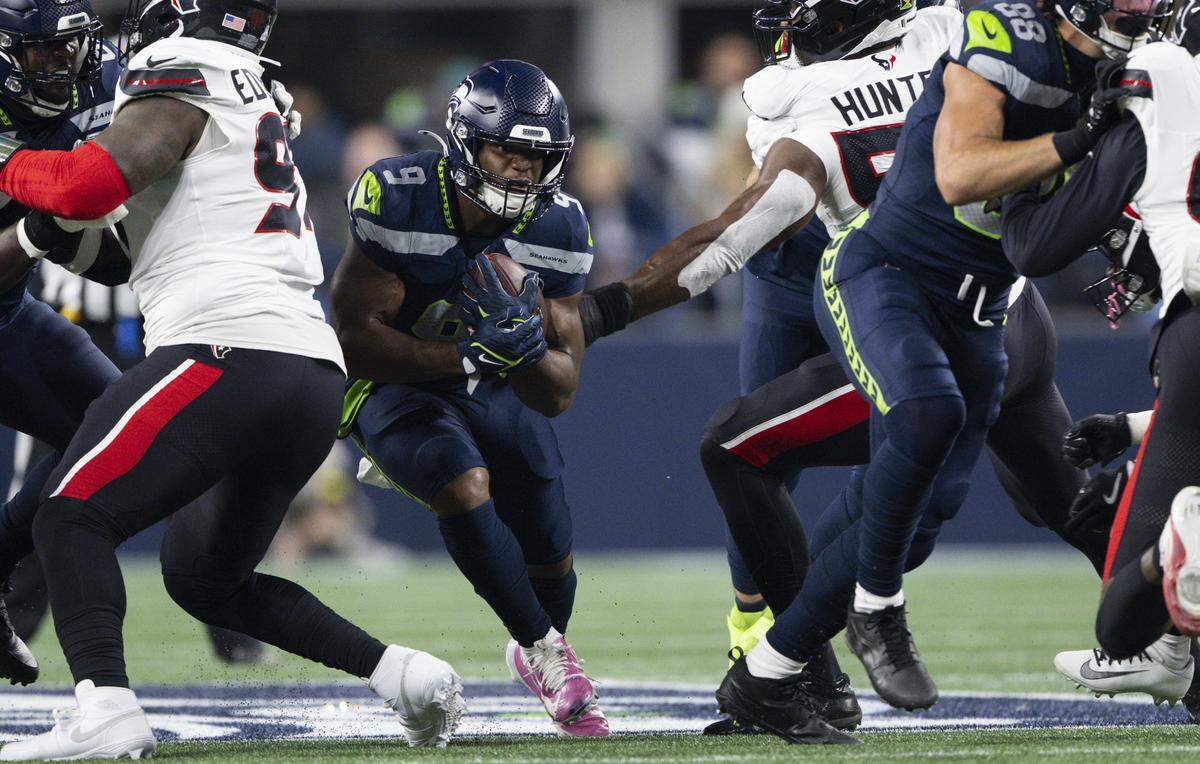
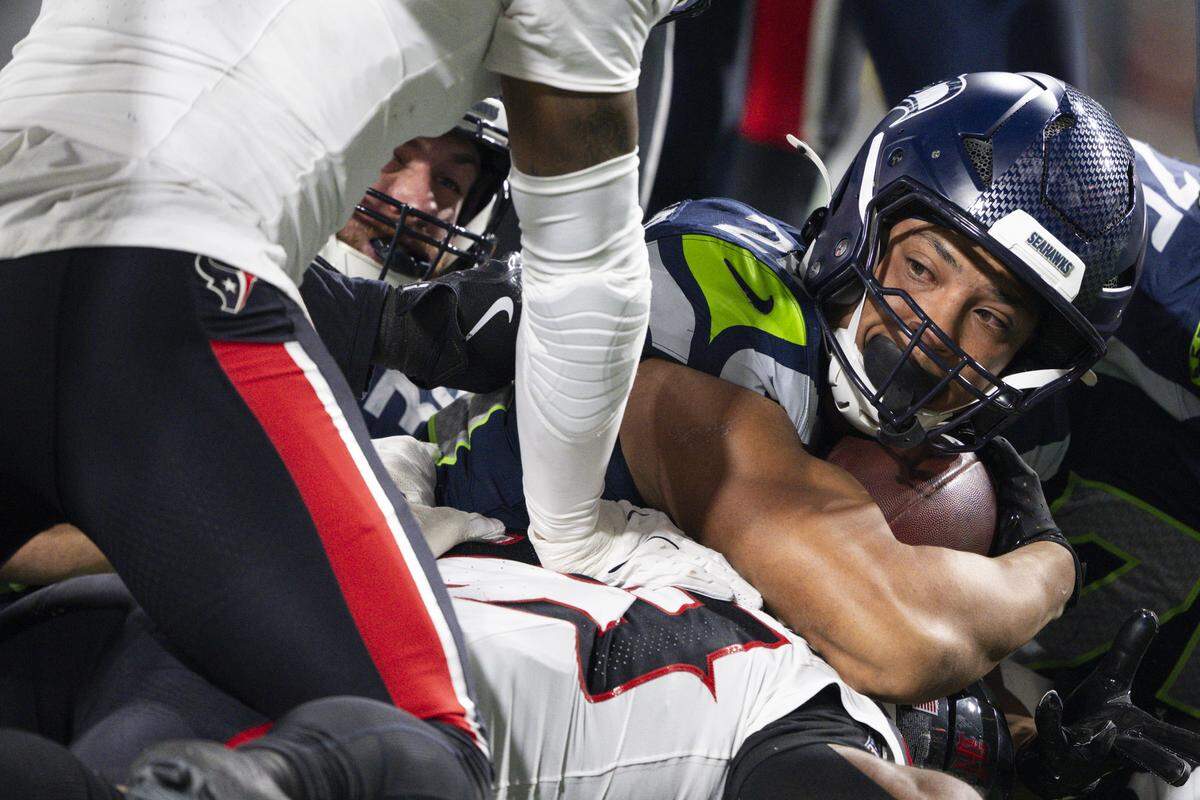
This past Monday night against Houston, Seattle scraped together 118 yards rushing. Walker got 66 on 17 runs. Number-two back Zach Charbonnet had 39 of his season-high 49 yards after halftime. Charbonnet, the team’s back for most short-yardage situations so far this season, had two short touchdown runs in the Seahawks’ 27-19 win over the Texans. It took 33 rushes to get to those 118 yards.
The Seahawks are running it more often this season, but less effectively than in 2024 — after which Macdonald decided to junk the entire system and start anew.
So what’s he deciding to do this bye week to change that?
Keep running the ball. Even with poor results.
“You’ve got to keep attacking. Eventually that’s your chance to go get the run game alive,” Macdonald said. “That was the mentality. I think we’ll look at it and realize there’s things we want to get better at.” There’s also the expectation that if Darnold and Smith-Njigba continue throwing and catching the ball at league-best levels, many off play-action stemming from the run game, some of those stacked boxes will become lighter near the line.
That would unclog running lanes. Eventually. In theory.
Seattle’s offensive line
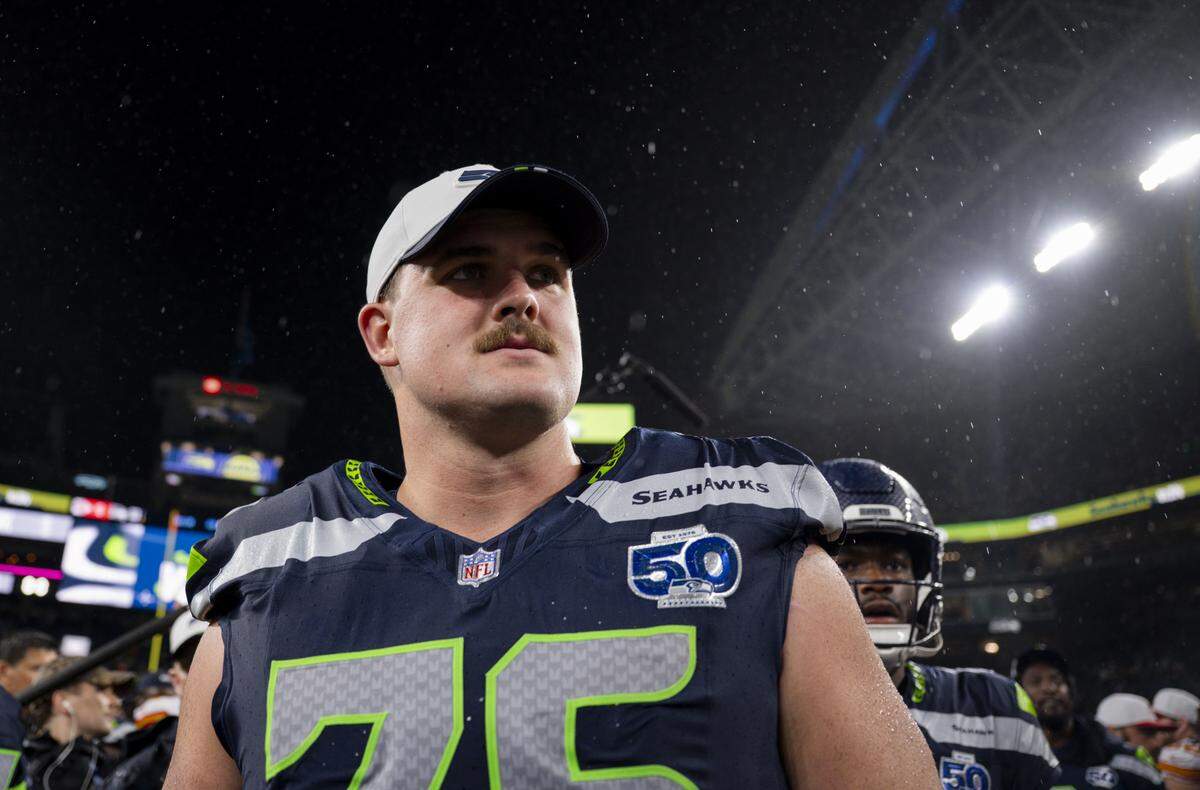
The left side of the much-scrutinized offensive line has been stellar. Tackle Charles Cross and rookie guard Grey Zabel are the line’s clear strength.
Macdonald loves pretty much everything Zabel is doing — including going after Azeez Al-Shaair after the Texans’ veteran linebacker drilled Darnold into the turf on Houston’s sideline at the end of a scramble run Monday night.
Center Jalen Sundell is quick and athletic, yet often has problems moving massive, stronger interior defensive linemen. Right guard Anthony Bradford has struggled, particularly in pass protection. Macdonald acknowledged last week he and Abe Lucas know the right tackle can block better.
Asked this week about his offensive line, Macdonald said: “I think we’re improving.”
“I’ll tell you what, the guys are working really hard. We’re not there yet, just like our football team,” the head coach said. “They play hard. They finish plays. And there are some details that we’ve got to attack here, then we get cleaned up.
“But that’s always going to be the case.”
Kenneth Walker and Zach Charbonnet
The running-back rotation is nuanced. Not in results, in application. Walker has been the Seahawks’ lead back for all four seasons since the team drafted him in the second round out of Michigan State. He has been definitively more productive, particularly in outside-zone running plays that were supposed to be Kubiak’s staple for the 2025 season.
Walker is averaging a standout 5.5 yards per rush on outside-zone plays. That’s the fourth-best in the league, among running backs with at least 20 attempts on outside-zone runs.
Charbonnet is averaging 1.9 yards per outside-zone runs. That’s the NFL’s lowest such average (with a minimum of 20 outside-zone rushes).
On all rushes, Walker is averaging 4.5 yards per carry.
Charbonnet is at 2.8. That is the fewest yards in the league for any back in the league who has carried the ball more than 35 times through seven weeks this season.
Yet Charbonnet has played 54% of Seattle’s offensive snaps, to Walker’s 43%. Most of that is because Charbonnet has become Kubiak’s short-yardage choice (with a team-leading five rushing touchdowns) and third-down back, plus his guy for 2-minute, hurry-up drives.
Before the game Monday night against the Texans, Kubiak said of Walker and his playing time: “He’s certainly earned more. We want to keep getting him more opportunities. He’s doing a heck of a job, but I don’t want to discount Zach...”
Walker had runs of 6, 8, 13, 16 then 17 yards in the second half against Houston. Yet he then left the game in the middle of those drives.
Why? Coaches and the team’s medical/training staff are pacing Walker to get him through the entire, 17-game season. Since August they’ve been managing a foot issue Walker has had related to the high-ankle sprain that put him on injured reserve in December 2024.
Walker is as motivated as the Seahawks to play every game. This is the final year of his rookie contract. He needs to be on the field to showcase himself for a next contract in 2026 and beyond, be it in Seattle or elsewhere. So he’s been on board with the managing of his playing time.
Macdonald is mostly vague when discussing his two backs and how the team is using them.
He said after the Houston game: “Actually going back and looking at it, I thought we took strides yesterday. I thought the guys played really hard. I think both ‘K9’ and ‘Charbs’ had good performances. They run it decisively. And there’ll be more.
“There are opportunities there for even more explosive yards, and it’s just going to come with more detail.
“I think we’re figuring out what we do well, which is positive. Coaches are working well together, and we’re not there yet. But it’s positive.
“I think we’re going in the right direction.”
Robbie Ouzts
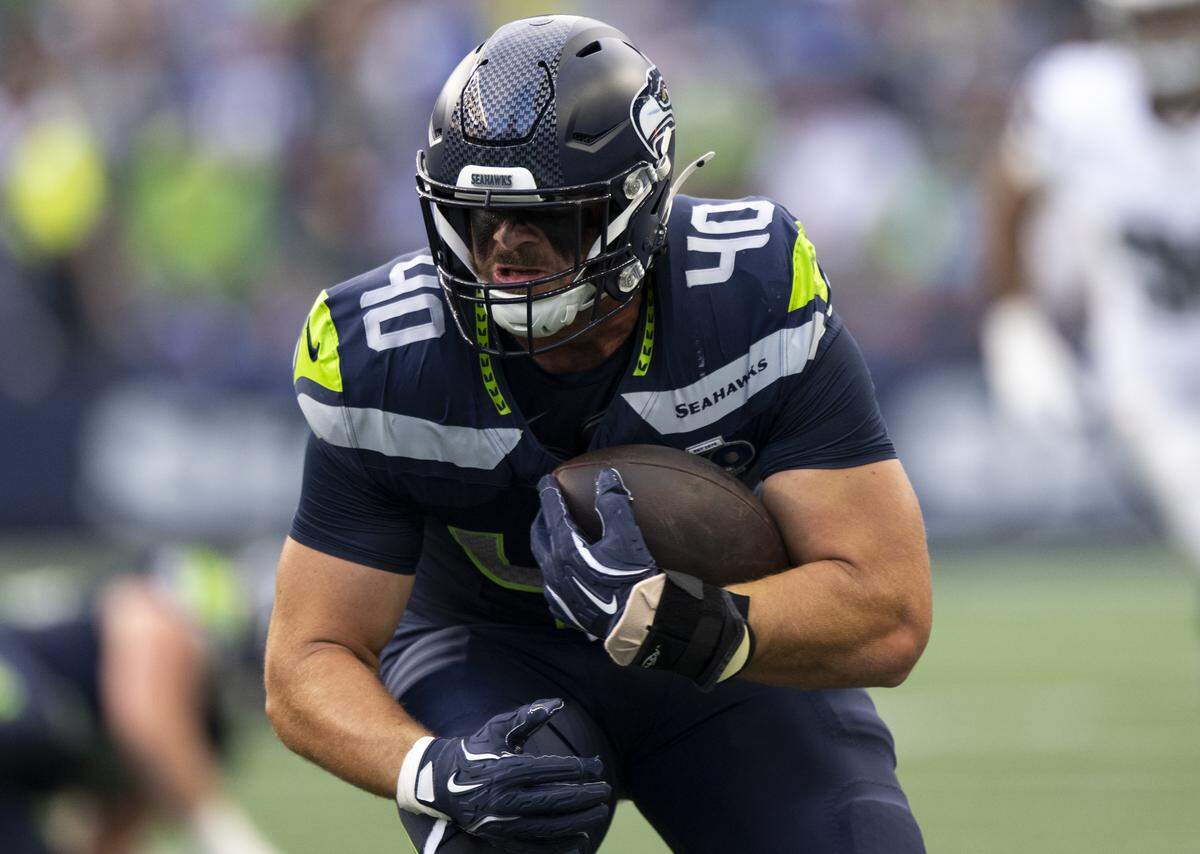
A big factor in Kubiak’s system is the fullback. He uses one more than any play caller in the league.
Seattle’s hasn’t played in a month.
Robbie Ouzts has been on injured reserve with an ankle injury. He last played in week three against New Orleans, Sept. 21. The 275-pound rookie who was a tight end at Alabama through last season was to be leading Walker and Charbonnet through the lanes that are currently clogged without him playing.
Brady Russell, previously a Seahawks tight end and still a special-teams stalwart, has filled in for Ouzts. He lost out to Ouzts competing to be the starting fullback this summer; that competition was over very early in the preseason.
“He’s a great fullback,” Macdonald said of Ouzts, “and it’ll definitely help what we’re trying to do.”
This story was originally published October 24, 2025 at 2:43 PM.