
Ethics probe targets free legal work for Lindquist
According to Pierce County’s ethics code, Prosecutor Mark Lindquist, like every other county employee, can’t accept free stuff. That means anything worth more than $25.
For the last four years, Lindquist, by his own admission, has accepted free legal services from Stewart Estes, a Seattle attorney. Estes represents Lindquist’s interests in a long-running case tied to the prosecutor’s personal phone records.
In the same time frame, Estes and his law firm — Keating, Bucklin and McCormack — received $587,263 from Pierce County taxpayers for other legal work.
The firm hadn’t done any business with the prosecutor’s office before Estes agreed to represent Lindquist on a pro bono (free) basis.
Those facts, among others cited in recent findings from an independent whistleblower investigation of Lindquist’s office, could become the focus of a new investigation by the county’s ethics commission, announced Thursday.
Potential outcomes range from nothing to sanctions and fines against Lindquist, the county’s most powerful law enforcement officer.
Lindquist did not respond directly to requests for comment Friday.
Deputy prosecutor Dan Hamilton, the county’s chief litigator in the phone-records case, responded with an emailed statement, saying, in part, “It is my understanding that prior to Mr. Estes appearing pro bono … our civil division advised Prosecutor Lindquist that County Ethics Code also did not apply to this situation.”
Hamilton added that it is standard practice for private attorneys who do government work to provide occasional free service regarding public policy, and called it, “a good thing.”
Reached Friday, Estes said he frequently represents government agencies and often provides free legal service and analysis to those agencies on issues that affect public policy.
He said he agreed to represent Lindquist without any expectation for other work, and added that the county subsequently hired him for paid work due to staffing issues.
The ethics probe into Lindquist’s administration adds a new layer of controversy to troubles that seem to grow by the day.
Apart from the whistleblower findings, Lindquist faces a recall campaign, multiple pending lawsuits and an active investigation by the state bar association into allegations of official misconduct.
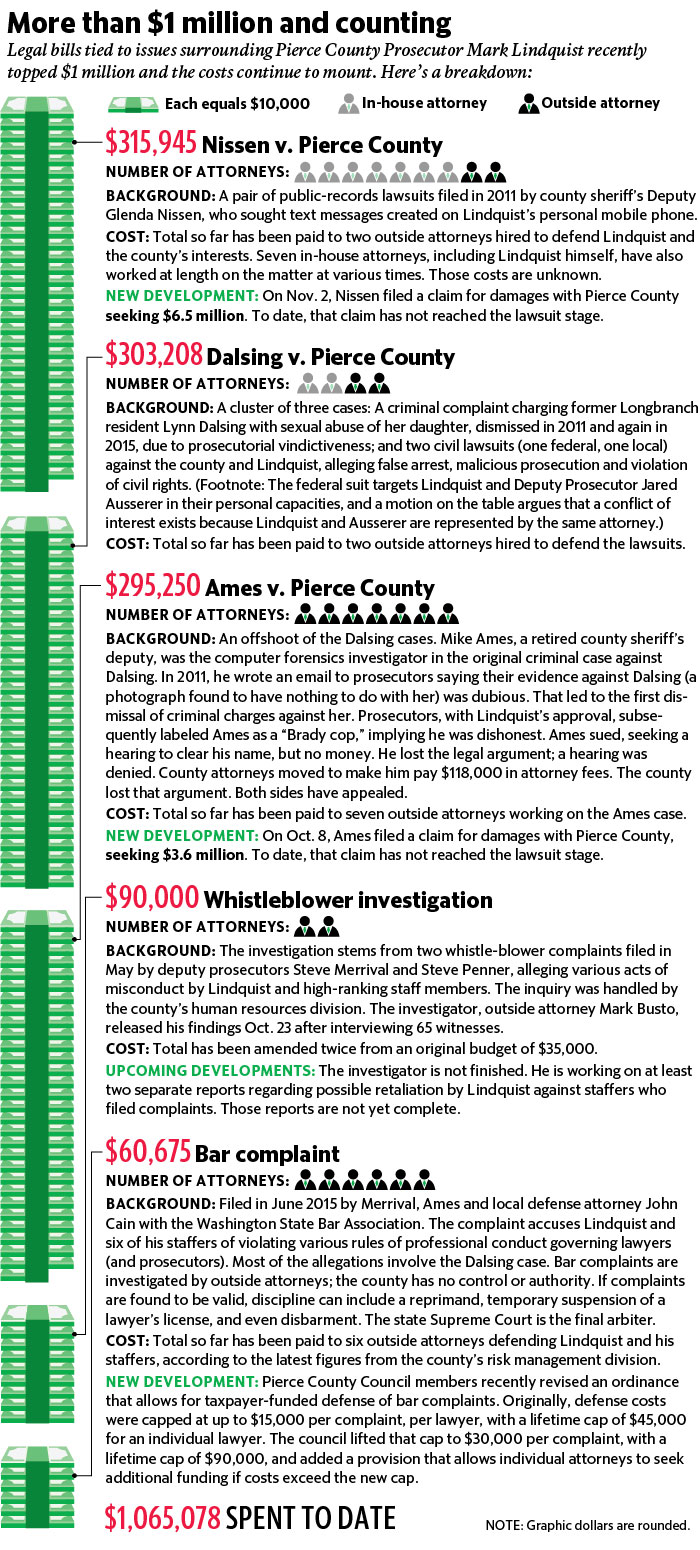
Fees and costs for outside attorneys involved in those matters recently topped $1 million. Damage claims, preludes to lawsuits filed against the prosecutor’s office in the last month, seek a combined $10 million.
The ethics commission, a five-member body appointed by the county executive and confirmed by the County Council, meets once a month. Aided by a hearing officer, it reviews complaints of possible ethics violations by county employees; the commission has no authority over Estes or other outside parties.
Members convened for a special meeting Thursday. Commission Chairwoman Mari Kruger Leavitt announced the new investigation after a unanimous vote.
The decision answered a formal request from Ginny Dale, the county’s human resources director, who recently forwarded the whistleblower findings to the commission for review.
In a letter notifying Lindquist, Dale said the investigation included “findings that potentially implicate the Pierce County Code of Ethics.”
The letter didn’t say which findings, but free lawyering for Lindquist suggests one possibility: The ethics code prohibits county employees from accepting gifts worth more than $25.
To define “gift,” the code relies on state law. The legalese boils down to three words: “anything of value.”
Lindquist freely admits accepting Estes’ services. When asked by whistleblower investigator Mark Busto, he underlined the savings to the county.
“Lindquist insisted that the county ‘has not paid a dime’ to Estes and his firm because Estes has worked for him on a pro bono basis,” Busto’s report states.
COUNTY LEADERS UNAWARE OF FREE SERVICE TO LINDQUIST
Though Estes has represented Lindquist personally since 2011, the whistleblower findings indicate that county leaders didn’t realize it until June 11, when the Washington State Supreme Court heard arguments in the phone-records case.
Estes sat on one side of the courtroom, next to Hamilton and outside attorney Phil Talmadge, who did all the talking.
As Talmadge argued that Lindquist had the right to keep his phone records private, Justice Debra Stephens stopped him with a question.
“Here’s what’s troubling me a little bit,” Stephens said. “You represent the county. You don’t represent Prosecutor Lindquist. Isn’t that correct?”
“Correct,” Talmadge replied.
Estes said nothing at the hearing, but he had drafted legal briefs to support Lindquist’s position — as had Talmadge and at least seven deputy prosecutors, according to public records.
Click to enlarge:
Another player sat in the gallery: Mark Maenhout, the county’s risk manager. He later told Busto that was the moment when he understood Estes was representing Lindquist personally.
“Maenhout said that he first became aware of Estes’ involvement at the oral argument before the Washington Supreme Court,” the report states.
Maenhout also said the civil division of the prosecutor’s office had “kept him at an arm’s length” regarding the phone records case.
As risk manager, Maenhout holds authority over payments resulting from legal settlements and fees to outside attorneys, though he has no voice in legal strategy.
The phone records case was far from typical — a lawsuit tied to the emerging issue of public records on private devices. The defendants were the county, the prosecutor’s office and Lindquist.
If the case ever reached a settlement stage, Lindquist, as the elected head of the prosecutor’s office, would have to sign off on it — but he also was intervening personally, with a separate attorney acting on his behalf.
Lindquist was the county’s chief legal officer, with final authority over the county’s interests, as well as a defendant with authority over his personal interests — at the same time.
In theory, Talmadge was representing the county and Estes was representing Lindquist — but Estes and his firm also were representing the county in other matters that had generated almost $600,000 in legal fees.
Who decided to hire Estes for that work? In theory, the prosecutor’s civil division, headed by Doug Vanscoy, makes decisions regarding litigation and the hiring of outside attorneys.
LINDQUIST ENDORSED PAID WORK FOR ESTES
Estes has worked on multiple cases for the prosecutor’s office: one involved former Tacoma middle school teacher Harold Wright, who sued after rape charges against him were dismissed. The county has repeatedly prevailed in that lawsuit.
Estes said he was hired in the Wright case due to “a staffing issue” at the prosecutor’s office. He said he accepted the work more than a year after he agreed to represent Lindquist in the phone records case.
Estes represents the prosecutor’s office in a pair of active lawsuits tied to a long-running sex-abuse case dismissed earlier this year due to prosecutorial vindictiveness. He said the county hired him after its in-house attorney on the suits developed health issues.
Estes has also represented Pierce County in litigation involving the agency’s marijuana ordinance.
That hiring came with a direct and public endorsement from Lindquist. In January 2014, Lindquist told The News Tribune that Estes and his firm were “particularly well qualified to defend the county on this issue.”
Is the relationship between Lindquist, Estes and the prosecutor’s office too cozy? The whistleblower complaints against Lindquist contend that it is. The prosecutor’s office, through Hamilton, says it isn’t.
Busto, the whistleblower investigator, said it wasn’t his job to decide such questions.
“Estes’ alleged conflict of interest is a question of law, which I do not address in this report,” he wrote.
Hamilton, the prosecutor’s chief civil litigator, said the ethics code doesn’t prohibit Lindquist from accepting free legal service that aids the county’s position in a matter of broad public interest.
“A prosecutor could not accept a personal gift worth more than $25 for prosecuting a case or for representing a client. That did not happen here,” Hamilton said. “In this case, the pro bono work was a not a personal gift to Prosecutor Lindquist for performing his job, but was instead pro bono work to benefit the county’s legal position and to benefit public employees throughout the state.”
Others familiar with the circumstances see the issue differently.
“It’s obviously a quid pro quo, that (Estes’) firm gets this big fat contract from the county. That’s just greasy,” said attorney William Crittenden, who represents the nonprofit Washington Coalition for Open Government.
Crittenden also appeared at the Supreme Court hearing in the phone-records case, arguing on behalf of open-government advocates that the records should be disclosed.
Separately, Crittenden filed a whistleblower complaint in May against the prosecutor’s office, alleging the legal nexus between Lindquist, Estes and the county presented a clear conflict of interest.
He continues to seek public records related to the issue, but he’s making little headway. A Oct. 23 letter he received from the prosecutor’s office states, “There was no conflict of interest between the County and Mr. Lindquist.”
Since then, Crittenden has read the whistleblower report, and the finding that Estes has represented Lindquist for free for the last four years.
“The gift to a public official — that’s unethical,” Crittenden said. “That is certainly unethical in the pedestrian sense of what’s ethical. It’s ethics 101.”
FREE LEGAL SERVICE IDEA CAME FROM PROSECUTOR’S OFFICE
The idea of accepting free legal service came from Hamilton, according to the whistleblower findings. Hamilton suggested it, and Estes confirmed his account. The two attorneys have known each other for 20 years.
“(Hamilton) pitched the idea to Lindquist of him intervening with Estes as his counsel, so long as Estes was willing to do it on a pro bono basis,” the report states. “Hamilton thought it would be a difficult sell if Lindquist had to pay Estes personally.”
Estes said he agreed to take on the phone-records case because of its broader implications for public agencies throughout the state.
“The issue was whether the Public Records Act applied to data on personal smartphones,” Estes said. “This was a cutting edge issue that could affect literally thousands of my current public agency clients and was of importance statewide.
“I agreed to accept this very interesting assignment. I had no expectation that I would receive any future case assignments.”
Originally, Lindquist did not want to intervene personally in the phone records case, according to the whistleblower report; Hamilton “worked him over” to convince him, then spoke to Estes.
“(Hamilton) asked (Estes) to represent Lindquist and told him the County could not pay him,” the report states. “Estes indicated that he was interested and agreed.”
There was no quid pro quo, Hamilton told the investigator, because the county had “no cases in the pipeline” to offer.
“Since that time, the County has paid Estes’ firm $587,268.63 for legal work on behalf of the County,” the report states.
Did the subsequent funneling of legal work and taxpayer money to Estes’ firm create a conflict of interest? If the answer is yes, what consequences might follow?
The ethics commission has the power to issue subpoenas, hold hearings, levy fines and in rare cases, refer potential criminal violations to law enforcement. Fines can range from $500 to an amount that triples the value of a wrongly accepted gift.
The unique circumstances of the ethics investigation have another inevitable byproduct: money, in the form of more outside attorney fees.
Typically, deputy prosecutor Denise Greer advises the commission on legal issues. That can’t happen in the Lindquist inquiry due to conflicts of interest. The actions of Lindquist and Greer, among others, are discussed at length in the whistleblower investigation.
The consequence: an outside hire.
“We will be identifying a legal counsel to work with us,” Kruger Leavitt, the ethics chairwoman, said Thursday.
Sean Robinson: 253-597-8486, @seanrobinsonTNT
This story was originally published November 14, 2015 at 11:00 AM with the headline "Ethics probe targets free legal work for Lindquist."