
Germany canceled Oktoberfest. Why hasn’t Pierce County?
Though the annual Oktoberfest festival was canceled in its home country, the show will go on in Pierce County this year. There are better ways to celebrate the season that still involve delicious Märzen and crispy schnitzel — and that support local breweries and restaurants.
In a region saturated with IPAs, and during fresh hop season no less, drinking this crisp yet toasty lager is as welcome as the recent rainfall and cool autumn air.
Find examples of the style, sometimes called Festbier, both imported and made in America, on tap and in the coolers of bars and bottle shops like Peaks & Pints, Pint Defiance, Edison City Alehouse, The Red Hot and Caskcades; at breweries such as Odd Otter, Dystopian State, E9 and Camp Colvos.
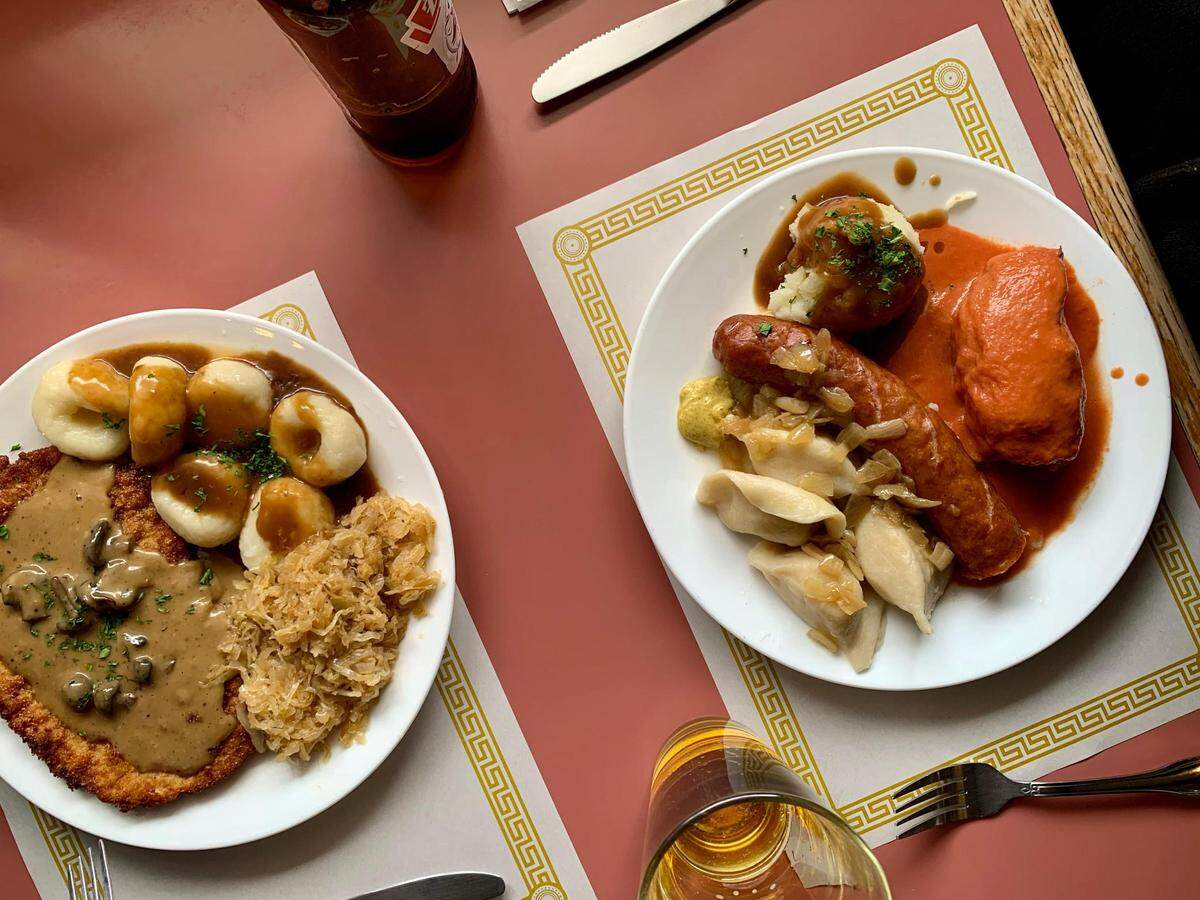
For a taste of Germany any time of year, visit Bruno’s European Restaurant for hearty plates and sweet service, and Hess Bakery & Deli, where you can stock up on Black Forest ham, butterkäse, Riesling and rye.
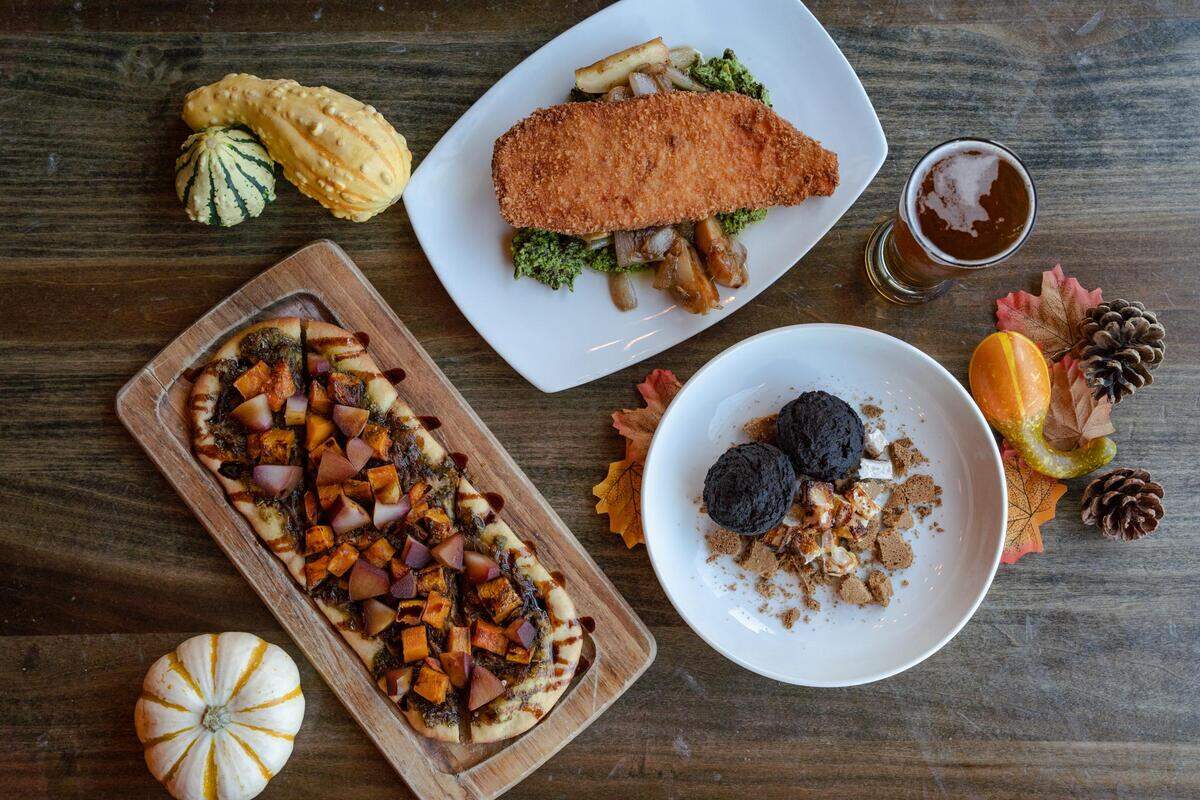
At Rhein Haus, relish a contemporary spin on Bavarian fare, now with more vegan options, and this month a few Oktoberfest specials, including a glazed pork shank and butternut squash flammkuchen with walnut-sage pesto. Or take home a party pack with house sausages and pretzels, mustard, kraut and a mini bier boot!
Then there’s Oktoberfest Northwest.
The event will return from a 2020 hiatus to the Washington State Fairgrounds in Puyallup Oct. 8-10, with a bigger outdoor beer garden and fewer vendors, more open air and redesigned traffic patterns to limit gathering. These steps “go above and beyond any mandate and are a very proactive approach in the safety of our guests,” said Stacy Van Horne, public relations manager for the venue.
Minors have always been admitted before 6 p.m. to certain areas, notably the root bier garden, with activities like a scavenger hunt and pumpkin painting. The event has never reached capacity, said Van Horne, adding this year’s roomier layout should help the current health and safety situation.
That’s easier said than done even at a family-focused event not dripping with alcohol. According to the Tacoma-Pierce County Health Department, more than 20 people who later tested positive for COVID-19 attended or worked at the Washington State Fair in its first two weeks, in early September.
Meanwhile, in Bavaria, home to world-renowned breweries including Paulaner, Augstiner, Spaten and Hofbrau, more than 6 million people — most of them Americans, according to the state’s business promotion agency — descend upon Munich at this time of year to partake in a tradition that dates to the early 1800s. But there, unlike here, the festival was canceled in June, with the state’s leaders citing uncertainty, worse financial loss if they had to later call it off, and pragmatism. Perhaps most importantly, pandemic precautions would almost certainly stumble into “chaotic conditions,” said Bavaria’s prime minister Markus Söder, adding that the risk of tarnishing the Oktoberfest brand — which rakes in upwards of $87 million in beer sales alone, and more than $1.5 billion in tourist revenue — was too great.
I visited Germany in August for a family wedding. Planning was admittedly stressful. The German-American couple had scheduled the 2021 date pre-pandemic and decided to go forth only in June when the European Union approved U.S. citizens to visit — with proof of vaccination or a negative COVID-19 test. Three days before our departure, Germany, where the death count is about 30 percent lower than its neighbors France and Italy, upgraded the U.S. to a high-risk area, rendering travel for unvaccinated travelers untenable due to quarantine expectations.
The penalty for breaking the 10-day quarantine, by the way, is up to a €25,000 fine.
Living in Washington state, the rules for vaccinated travelers didn’t feel unusual, but two things stood out:
First, masks are required in almost all indoor spaces nationwide, and they must be medical-grade — no cloth masks. Bavaria requires N95-type masks (there called KN95). At the Sea-Tac Airport, the Lufthansa check-in agent reminded us to swap our homemade masks for surgical ones before boarding the plane.
Second, the German government requires businesses where guests stay for more than just a few minutes — restaurants, museums, hotels, the Cologne Cathedral — to check for proof of vaccination or a recent negative test to enter. We were in four cities, including one smaller town, and the pattern held true in almost every case, including the wedding venue which was mostly outdoors. No one seemed to bat an eye.
Do disagreeing Germans exist? Of course: I found a flyer on the street in Munich that questioned compulsory vaccination for schoolchildren.
On the flight home, I felt a sense of relief.
To even get my boarding pass, I had to show a series of documents beyond my passport, including my vaccination card and an attestation form for the CDC. Once seated, I realized that aside from the great outdoors, this scenario was perhaps one of the safest: a self-contained environment with excellent air filters presumably full of vaccinated people who had all tested negative for COVID-19 within the past 72 hours, a requirement to enter the country.
Is it so terrible? I wondered.
Three days later, I drove to the county testing site in Lakewood for a full lab test, recommended after international travel, and received my negative result by text message 24 hours later.
At home, I felt a sense of distress.
My heart ached as I scrolled through post after post of a local restaurant closing for several days because of COVID-19 in their midst. No one was forcing them to make this decision, but in the absence of broader regulation (as will be the case in King County as of Oct. 25) or sensible camaraderie in our society, they were doing what they, as an individual entity, felt was right.
Oktoberfest thus got to me.
We’re not the only ones stateside hosting large gatherings that involve heavy drinking and don’t require anything to enter except an ID proving you’re of age. With upwards of half a million visitors, the apparent leader of Oktoberfest celebrations in the United States is Cincinnati, Ohio, whose annual three-day festival became four this September. (Organizers told local news outlets that vaccination was the best way to safely enjoy the festivities.)
For their bravery, “Oktoberfest Zinzinnati” likely will go down in history as the world’s largest such celebration in 2021.
At least we’re not that.
This autumnal occasion deserves the love it gets. What Germany recognized, though, we apparently have not.
Pierce County is nearing a 60 percent fully vaccinated rate, but it’s not enough for “yolo” attitudes. As the state’s health leaders warn of hospital overload — as has already happened in neighboring Idaho — now feels not like a time to gather in a giant crowd, even semi-outdoors, without extra precautions in place.
You can’t go to a Seahawks game without, eh, taking one for the team. You shouldn’t be able to go to Oktoberfest either.
This story was originally published September 30, 2021 at 5:00 AM.