Indigo clinic staff launch two-day strike over COVID safety issues
The battle between Tacoma-based MultiCare health system and health care providers at its Indigo Urgent Care sites in the region intensified Monday with the start of a two-day strike.
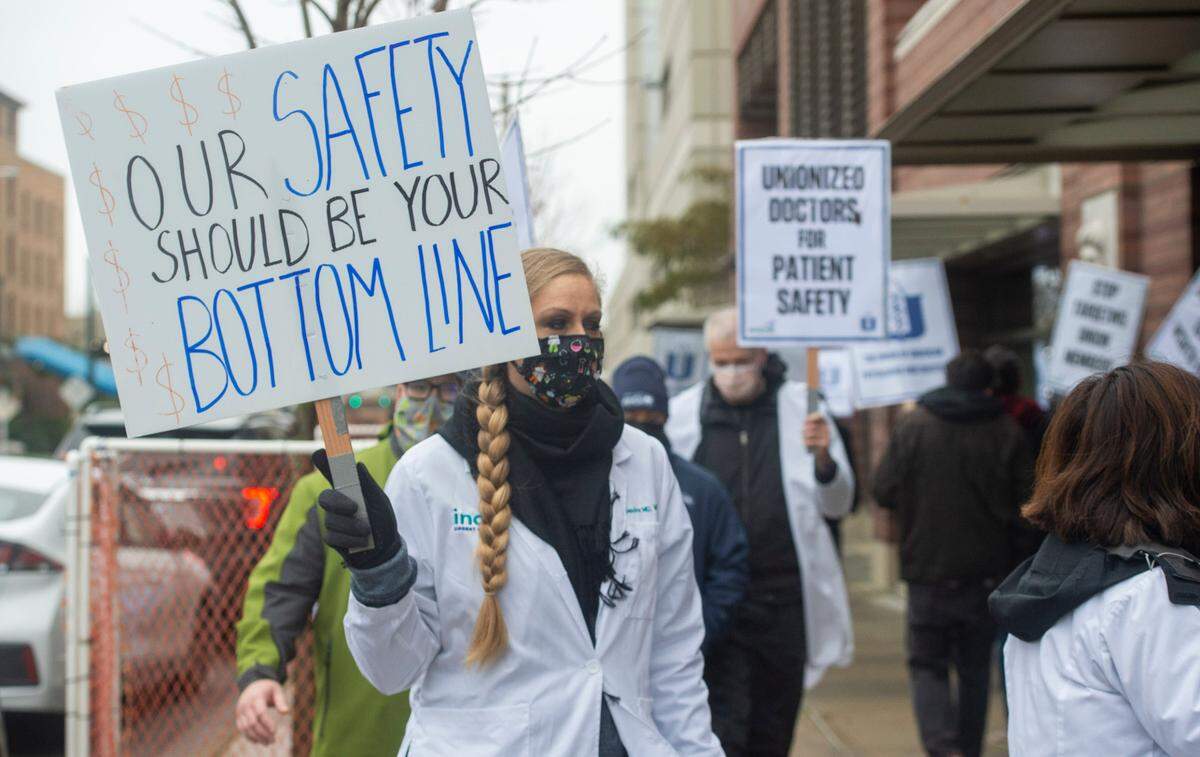
Providers who work at 20 Indigo clinics in the Puget Sound area, represented by the Union of American Physicians and Dentists, planned to take to the sidewalks at different MultiCare sites on Monday and Tuesday, including Multicare’s Tacoma General Hospital, as part of its action against the health system over working conditions and personal protective equipment supplies.
The strike comes as Pierce County is seeing some of its highest days yet in new reported cases of COVID-19. Striking workers contend MultiCare is forcing them to work extended shifts without breaks and failing to provide N95 face masks as they test a steady stream of COVID-19 patients each day.
MultiCare has repeatedly pushed back against the allegations and, in a statement issued early Monday, defended its efforts to reach agreement at the bargaining table with the UAPD members, saying it had worked throughout the year “to bring a labor agreement to closure, so together we can focus on patient care.”
UAPD first announced the intent to strike Nov. 12.
“UAPD has made every day available to MultiCare to negotiate to avoid a strike, but MultiCare has not agreed to any additional days,” the union said in a statement Monday.
MultiCare representatives disagreed with that portrayal of events, noting that federal mediation had just started.
MultiCare said in a statement issued Monday morning: “Friday and Saturday, we worked with a federal mediator and representatives from UAPD to re-affirm our priority for a fair contract that supports staff and patient safety and the communities we serve.
“Saturday morning, based on some guidance from the mediator, we made a formal written proposal that would have allowed the parties to keep talking and avert the strike. UAPD again rejected our proposal. It appears to us that UAPD thinks it is more important to ‘send a message’ by striking than do the hard work to finalize the collective bargaining agreement we have been working on for more than a year. UAPD has continued its months-long pattern of appearing to meet us in the middle, then bringing up new or old issues we understood to be resolved,” the health system said.
Mark Mariani, chief medical officer for MultiCare’s Retail Health, said Monday that “When you go in to the federal mediator, to be able to expect that all of a sudden you can take off right there and make progress is unrealistic.”
“It takes time for them to understand the cases and talk to both sides. In fact, that’s what happened. And so we saw some opportunity to make some collaboration despite all that, and we even presented a road for them to be able to do that through the weekend, which they chose not to follow.”
The issues on Monday amplified by strike attendees were focused on COVID-19 workplace safety.
Erin Naidu, an Indigo Urgent Care physician assistant, told The News Tribune on Monday during the picket, “We’re here because we’re advocating for our right not to die at work.
“We work 12-hour shifts in a pandemic front line, diagnosing, treating testing COVID patients, all day long, up to 70 patients a day, with little to no breaks, and we aren’t even provided the basics of an N95 mask.”
She said the paper masks used at the clinic are not enough protection for workers.
Naidu said, “We’re wearing these loose-fitting surgical masks that provide no protection from aerosolized virus. It’s aerosolized, because those patients who are being tested are coughing and sneezing and breathing in our faces.”
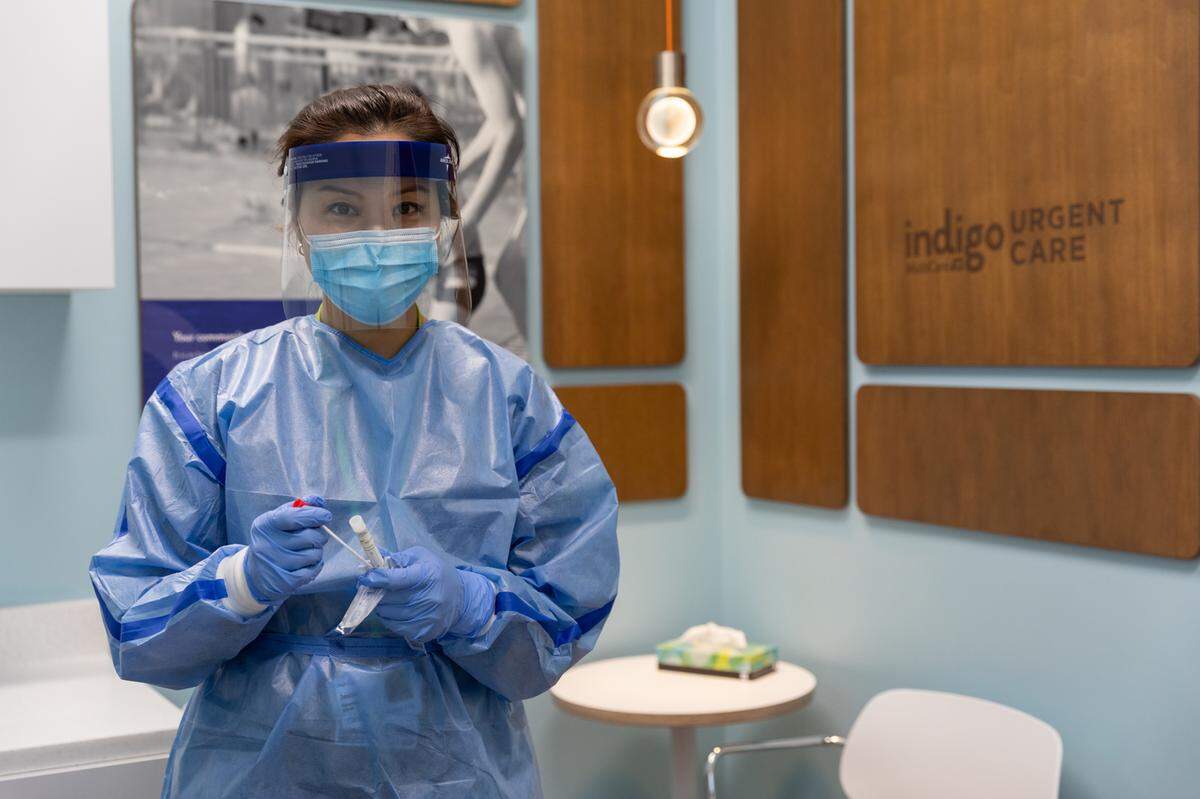
MultiCare has repeatedly defended the current PPE supplied to the workers and provided The News Tribune with a photo of sample PPE used at Indigo clinics, showing not only a paper mask but eyeshield worn over it, along with gown and gloves.
Mariani told The News Tribune the health system is comfortable with the level of protection provided.
“We’re confident we have the right personal protective equipment for the right care in the right setting. ... But we’re open, we’re going to constantly evaluate what our practices are and figure out what’s right. But what I can tell you is is we’re going to follow what the science says we’re going to follow with CDC guidances. And we’re going to do what our infectious disease prevention experts really helped guide us toward.”
Naidu countered that frontline healthcare workers do, in fact, need N95s.
“We are not being protected, and we’re asking for that basic protection here,” she said Monday.
Mariani also pointed to a still-struggling national supply chain that has meant preserving N95s for more intense hospital work with COVID patients, such as intubation.
“It is no secret right now, as a community, we’re in a pretty significant surge. And so we have to take this very seriously and be thoughtful in how we do that,” Mariani said.
MultiCare on Monday said it renewed its proposal to start the Joint Safety Committee to work on COVID-19 safety issues.
“As we’ve consistently stated, we believe a collaborative, thoughtful discussion involving providers and subject matter experts is the best way to develop appropriate protocols and PPE programs for the unique settings in our urgent care clinics,” the health system said. “We were disappointed UAPD rejected our Safety Committee proposal and provided no alternate proposal.”
Sen. Karen Keiser, D-33rd District, which encompasses several King County cities south of Seattle, spoke to The News Tribune on Monday. Keiser will be sponsoring a Health Emergency Labor Standards Act in the next legislative session that, among other things, would allow for employees’ voluntary use of PPE, and/or for employers to provide required masks and gloves.
“We have to make sure that we protect workers on the job,” she said. “And that includes for them, if the employer provides PPE, great. But if they don’t provide adequate PPE, then the employees have the right, I believe, to bring their own.”
Workers in the past and again on Monday have described “assembly-line” working conditions with little to no breaks..
Matthew Carey, an Indigo physician assistant, noted that while he considered himself “fortunate to work with some really excellent providers,” he’d seen a fair share of workload problems on site.
“I’ve not seen a provider take a break. Lunch breaks are usually one bite, in between patients while you’re typing your note,” Carey said. “Oftentimes you’ll save a bathroom break to the end of the day, because of the patient volumes, and no control on the amount of patient volumes and under-staffing, chronic under-staffing of all the clinics.”
Mariani said he knew the clinics were facing unprecedented times, but that on-site staff needed to manage to take their breaks.
Other sites announced for UAPD picket activity either Monday or Tuesday at various times include MultiCare Indigo Tumwater; MultiCare Indigo Puyallup; MultiCare Indigo James Center, Tacoma; and MultiCare Indigo Burien.
MultiCare said it anticipated “only minor interruptions to some Indigo Urgent Care clinics.”
Mariani said as for the next round of meetings for both sides: “Most likely it’s going to be after Thanksgiving, based on schedules.”
News Tribune’s Drew Perine contributed to this report.