
Pierce County should court aerospace industry despite Boeing’s boom-bust cycles
Way back in ancient times — say, the 1970s and 1980s — the economic rule of life in the Puget Sound region was that if Boeing sneezed, the region caught a cold, and if the aircraft manufacturer got aches and chills, lost its appetite and energy, and developed a persistent, hacking cough, the region was in for a prolonged and severe bout of economic flu.
Whether the cause was a prolonged strike, governmental budget cuts for defense programs or one of the commercial-aviation industry’s regular busts, whatever was happening with Boeing at the moment didn’t just ripple through the rest of the economy, it was amplified and accelerated.
From housing prices to freeway traffic to retail sales, Boeing’s influence could be seen and felt everywhere.
That outsized influence was a product of Boeing’s outsized presence in the economy. Employment Security Department data show an annual average of 113,000 jobs in the aerospace product and parts category in 1990. That was a third of all the state’s manufacturing jobs and 5 percent of total employment in Washington.
Given the paychecks involved, the number of households supported by them, the quantity of subcontractors, suppliers and vendors doing business with Boeing and the civic and philanthropic activity of the company and its executives and employees, that little 5 percent had tremendous power to get the economy rolling — or drag it into recession.
Every time one of those Boeing recessions hit, the region would renew its worries about having its economy so dependent upon one industry and wonder aloud about diversifying the economic base. Which it did, if not exactly by design.
Boeing is still a big deal around here, but in proportional terms not as much as it used to be. The annual average for the aerospace product and parts category so far this year is 82,700, or 29 percent of manufacturing employment.
Meanwhile, the tech sector in 1990 was so new and relatively small (there was a Microsoft, but believe it or not, kids, no widespread internet) that it hardly figured in calculations; the category of software publishing, for example, was credited with just 7,000 jobs. In 2018, the category of software publishing alone is up to 64,200.
As a consequence, aerospace employment represents just 2.4 percent of statewide employment.
Pierce County wasn’t a full participant in the Boeing cycles the way King and Snohomish were, but it was hardly a bystander either. The booms and busts at Boeing reverberated in Pierce County directly through the residents working at plants to the north and indirectly through the impact on regional housing markets.
Pierce County had other things to rely on — the port, Russell, manufacturing including boatbuilding and aluminum — but even as the region as a whole was discussing how to become less dependent on aerospace, this subregion was looking at ways to get more of the action.
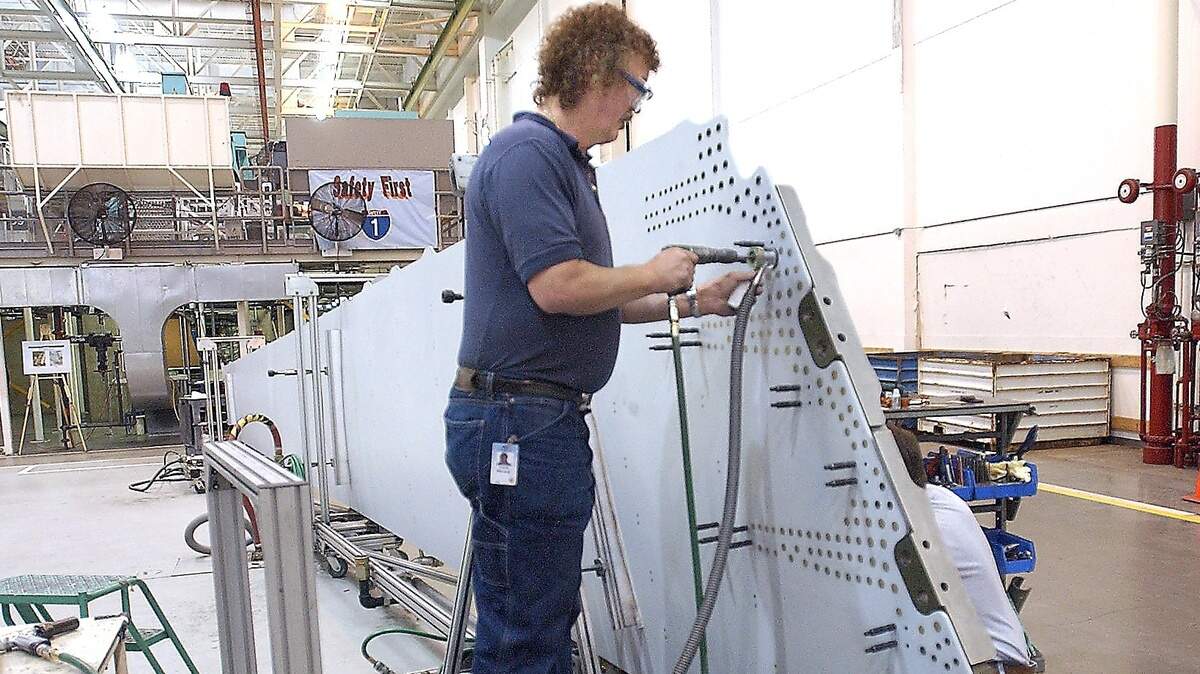
Which it did. Boeing opened its Frederickson facility in 1992, and it has grown to be not only a major employer but an important center for composites. That in turn has drawn other companies to the area, including the next-door Toray Composites plant (also opened in 1992).
Other local companies are emerging as significant contributors to the Boeing supply chain. Tacoma-based Tool Gauge was the Pacific Northwest Aerospace Alliance’s aerospace company of the year.
Aerospace’s importance to Pierce County, and the county’s growing reliance upon it, got further reinforcement this past week with the announcement from AIM Aerospace that it plans to expand its Sumner operation, adding hundreds of jobs in the process. Heady stuff and times for the sector in the county.
But is it healthy for the county’s long-term economic health? With the standard caveats that nothing is certain or guaranteed and with the list of concerns (Boeing moving, foreign competition, the end of the airline order cycle) firmly in mind, the answer is yes, for several reasons.
First, there’s Boeing itself, which at present has an order backlog of about 5,900 aircraft, including about 4,700 for the Renton-built 737. Another production-rate increase is under consideration. Boeing also is looking at the launch of another aircraft, one that would fit between the 737 and the wide-body planes like the 777 and the 787 (the county is among the entities organizing to lobby Boeing to put assembly of that plane here).
To counter Airbus’ alliance with Canada’s Bombardier, Boeing has a deal with Brazilian planemaker Embraer. Boeing has its defense and space side, is already a player in unmanned aerial vehicles (thanks to Bingen-based Insitu) and is investing in new technologies like electric-powered planes. All of those are going to be opportunities for local aerospace companies.
Second, Boeing isn’t the only show in town. Airbus had a delegation in Seattle recently doing meet-and-greets with companies interested in becoming part of its supply chain. Japan’s Mitsubishi is testing its regional passenger jet at Moses Lake. And to take the latter half of that term “aerospace” for a moment, just up the road in Kent is Jeff Bezos’ space venture Blue Origin. Those two are opportunities for the locals.
Three decades ago, Pierce County wasn’t considered a part of the region’s aerospace sector, nor was the sector seen as more than an indirect influence on the local economy. Both those conditions have changed dramatically. Should the county continue to count on aerospace as a contributor to its economy? Why not — it’s worked so far, knock on wood or a composite-fiber panel.
This story was originally published September 29, 2018 at 8:00 AM.