Vaccination rates are falling. COVID cases are rising. Will Pierce County ever reopen?
Pierce County, you have a COVID vaccine problem: Not enough people are showing up to get it.
The “why” to the story is complicated. There is an abundance of places to get vaccinated, but appointment slots are going unfilled.
Amid steadily rising cases, the county seems to have hit what one health department representative described as the “tipping point” of supply and demand.
Kayla Scrivner, immunization branch director for the Tacoma-Pierce County Health Department, told the Board of Health on Wednesday that mass vaccine sites started to see a noticeable drop-off in recent weeks.
“Just about 10 days ago, the demand really dropped off in the registration for those ... this is what they’re seeing in other counties as well,” Scrivner told the board.
One stark example is in Tacoma.
At the Tacoma Dome, a mass vaccine event run by the county’s Department of Emergency Management is set to go for six weeks (three weeks offering first doses and three weeks offering the second dose). The clinic started April 27.
The goal, according to the announcement of its opening, was to vaccinate at least 1,170 people each day and administer an estimated 34,000 doses of the Pfizer COVID-19 vaccine, available to anyone age 16 and older.
So far, 6,097 have been vaccinated, according to figures provided Friday to The News Tribune by Mike Halliday, public information specialist for DEM, with 5,190 showing up the first week (April 27-May 3) and 907 so far in the second week (May 4-7).
That puts the average number of unfilled appointments each day at the Dome at more than 600.
“Unused doses are moved to the next event and the vaccination team closely monitors inventory to make sure doses are not thawed too early,” he wrote. “DEM also managed vaccination sites at other locations during this time and administered 5,595 doses. Some were first doses and others second doses.”
Scrivner noted at Wednesday’s board meeting that last week in the state “providers ordered less than half of what was available for state allocation, and I’m sure you are seeing in the news that this is happening in many places in the country.”
“We have a lot of supply right now, and people continue to seek vaccine, but I’m certain the ones that were the most eager have already gotten theirs, and we’re seeing a surplus of vaccine available,” she said.
If demand continues to fall off, it puts the county and the state further away from ever reaching herd immunity, which at this point health officials are choosing not to emphasize anymore.
The reason: More contagious variants and a significant slowing rate of those seeking vaccines have combined to keep COVID-19 not just alive but also thriving in areas such as Pierce County. That could be the situation for some time.
When it comes to herd immunity, “I oftentimes don’t use that terminology, I use adequate vaccine coverage,” Washington Secretary of Health Dr. Umair Shah said at Wednesday’s state Department of Health briefing. “What we’re really trying to achieve is to make sure that we have enough vaccine coverage so that you lessen the risk to individuals who are most likely to have a negative consequence but also that you have a situation where you are able to limit the amount of outbreaks, or the significance of those outbreaks.”
Shah said that in the next week or two, his department might have a better sense of what percentages it takes for those fully vaccinated and those infected by the virus to offer the first real signs of widespread slowdown of viral spread.
“What we’re doing is behind the scenes trying to look at our data and trying to do some projections and seeing what a good number is,” Shah said. “We know that it’s at least half of our population, but how far it goes above that — that’s what we’re really working on.
“But I’m shying away from the use of the words ‘herd immunity,’ and really talking more about adequate vaccine coverage.”
The state DOH in its latest situation report said that on April 16, “the best model-based estimate of overall population immunity was (at) 31.9 percent. Estimated immunity from vaccination (about 19.3 percent of the population) is clearly higher than immunity from previous infection (about 12.6 percent). These estimates include the time it takes to develop immunity after completing vaccination.”
Pierce County by the numbers
Pierce County’s vaccine rate, based on available data, still is behind its neighbors.
As of May 3, Pierce County was at 34.88 percent of the total population initiating vaccines, and 25.34 percent fully vaccinated according to the Department of Health’s dashboard.
Among those 16 and older, which is the population actually qualified to receive the vaccine, better rates emerge, with 44.58 percent of that group initiating vaccination, and 32.38 percent fully vaccinated in the county.
No matter which percentages you choose, the county trails the state’s overall percentages, with more than half of the state’s population of those 16 and older having received their first dose, and 39.38 percent of that same age group now fully vaccinated.
Pierce County’s percentages also remain lower than other counties. King County, for its population of those 16 and older, 65.45 percent have initiated vaccination, with 43.9 percent fully vaccinated. In Kitsap County, its 46.88 percent and 36.98 percent, respectively for its 16 and older population. In Thurston County, its 50.86 percent and 38.52 percent.
Complicating factors in measuring Pierce County are that JBLM and VA vaccine data still are not made available to count.
“For Department of Defense security reasons, the data dashboard does not include the number of COVID-19 vaccinations the military administers,” Karen Irwin, TPCHD’s COVID-19 media representative, told The News Tribune via text on Friday.
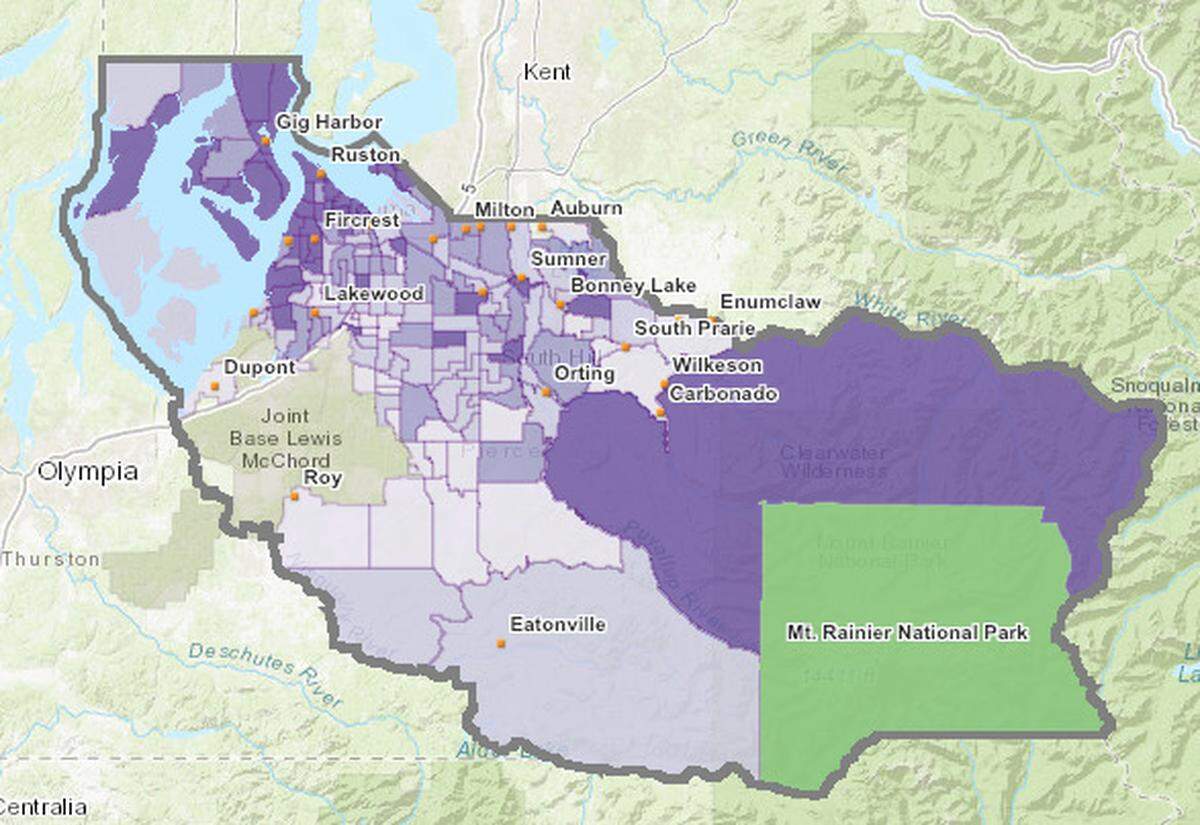
One only needs to look at TPCHD’s vaccine map to see lagging uptake across the county. There are more census tracts in the lighter shade of purple on the low end of having received at least one dose, in the 20 to 25 percent range, than on the high end, those shown in dark purple representing more than 40 percent to 50 percent and beyond.
A tract representing the Buckley area shows less than 24 percent of the population vaccinated. Contrast that with tracts from University Place to Point Ruston, running anywhere from 45 to 54 percent vaccinated with at least one dose.
Key Peninsula is practically divided in half with its numbers of those vaccinated with at least one dose, with a sizable portion to the north running at more than 46 percent and the southern, Lakebay/Longbranch area at 34.8 percent.
A large, dark purple swath seen in the map, which according to the color chart should represent a great success, actually is a sparsely populated area around Mount Rainier, it was noted at Wednesday’s Board of Health meeting, and isn’t an actual representation of a large population vaccinated.
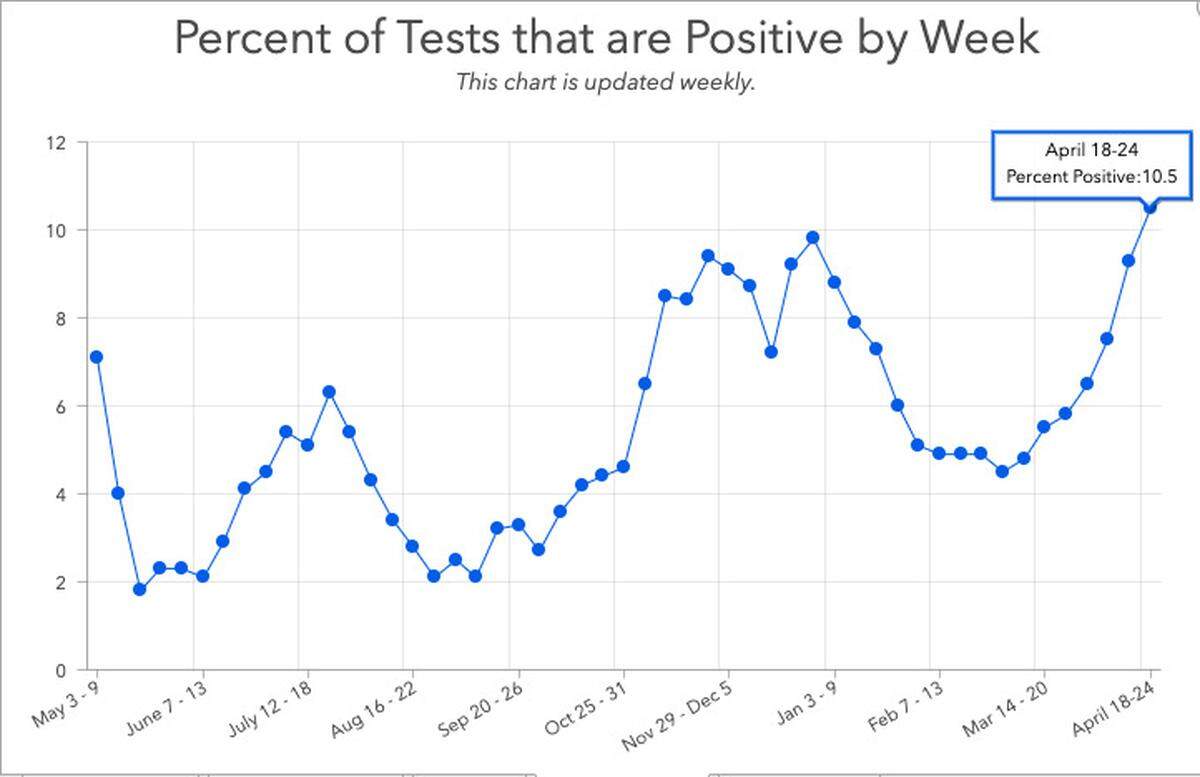
The virus’ spread is in sharper focus.
COVID-19 test positivity rates as of April 24, the most recent data available, showed the county at 10.5 percent positive with an average of 1,900 tests run daily, the highest rate since a January peak of 9.8, when the county was running about 3,000 tests a day.
As for COVID-19 variants, state DOH’s report on May 5 showed that eight variants are circulating in the state, with B.1.1.7 (UK) variant the leading one among cases sequenced statewide.
In Pierce County, all eight variants have been detected, according to the report, with the B.1.429 (first emerging in southern California in January) the most detected with 207 cases, followed by the B.1.1.7 variant with 147 cases.
Among the notable attributes of the B.1.429 variant, according to the report, is it is thought to be about 20 percent more infectious than earlier versions of COVID.
In a news release accompanying its state situation report released May 5, the state DOH said that it’s “too early” to tell whether the plateauing of cases would hold in other counties, and that as of April 22, “case trends varied more from county to county than in previous weeks.”
“The vast majority of cases in the state are now associated with variants of concern. As of May 6, the report estimates over 80 percent of all cases in the state were likely due to the B.1.1.7 variant ....”
The reproduction rate — how many new people each COVID-19 case will infect with the variants now in play — puts the state at between 1.46 and 2.08.
The rate needs to be well below one “for a substantial amount of time,” according to DOH, to reduce cases and hospitalizations.
Roadmap metrics
This week, Pierce County drifted into Phase 1 territory, failing at both Phase 2 metrics in the state’s Roadmap to Recovery reopening process.
Phase 2 allows for 200-350 cases per 100,000, and new hospitalizations per 100,000 over seven days need to stay between 5-10.
As of May 5, the county was at 372 newly diagnosed probable and confirmed cases per 100,000 during the past 14 days, and at 11.1 new COVID-19 hospitalizations per 100,000 during the past week.
To remain in Phase 2, the county needs to meet at least one of the two metrics. Local health districts have the authority to roll back a county on its own, though Pierce’s trajectory still could improve before that call becomes necessary.
At Wednesday’s Board of Health meeting, Nigel Turner, director of the communicable disease division for the department, weighed in on where the county stood.
“The numbers tend to change day to day quite dramatically even with a seven-day average,” Turner said. “And so with that we’ve seen that number bouncing around quite a bit. I anticipate they will drop back down again in the next couple of days but still at the high level.
“The good news is that we are seeing the hospitals have good capacity to handle this surge, and ... resources to put in place if the surge is beyond what they are currently seeing. They are certainly managing the current demand.”
Turner said he anticipated a plateauing of new cases soon, based on preliminary data, which the state also noted in its situation report the same day. Both offered a more optimistic assessment than the Governor’s Office did Thursday evening in a message responding to a group of legislators’ complaints about the pause in phases based on Roadmap metrics, which left Pierce County in Phase 2.
In outlining his reasons for the pause, Gov. Jay Inslee wrote: “There have been stark differences between the acceleration of the infection rate experienced in Pierce County and the plateauing of infections statewide. Any rational assessment of appropriate response to this pandemic has to take into consideration the intensity of the infection rate in the relevant counties and this we have done. Hospitalizations in Pierce County rose rapidly in the last two weeks of April as well. It would be entirely irrational to ignore the conditions in Pierce County.”
Turner on Wednesday said vaccines were critical in getting the county back on track.
“Overall, we’re very much in a race with this virus. It is vital we all do our part to stop the spread and improve the vaccination coverage, which is our long-term solution to controlling the pandemic overall,” he said.
Declining turnouts and new outreach attempts
Local health officials are now grappling over of what to do about declining rates of COVID-19 vaccine participation among residents, and not just at the Dome clinic.
Christa Moor is a public health nurse with the Tacoma-Pierce County Health Department who is serving as one of its branch directors in TPCHD’s immunizations response.
She recently spoke to The News Tribune in a phone interview about the department’s vaccine efforts.
“Last week we saw about 4,400 residents per day get vaccinated, and when you compare that to the previous week, it was about 5,300 per day,” Moor said.
Last week’s average was the lowest 7-day average since February.
Moor said lower turnout is also being seen at the department’s vaccine clinics at Hilltop, Lakewood and Puyallup, so much so that the department this seek declared that walk-ins were welcome with no appointments at the sites and for most all of the events offered on its tpchd.org/vaxtothefuture website.
Hours have been expanded for the Lakewood and Puyallup sites to accommodate those seeking appointments in the early evening hours, and hours are set to expand soon for Hilltop, Moor said.
“The Hilltop site is the one that we’ve had open for the longest, and we’re definitely seeing lower uptake of appointments there,” Moor said. “Puyallup just opened this week and Lakewood has been open for a few weeks — we are still seeing a good amount of patients each day at the locations but definitely less than we have capacity to see.”
Some of the softening demand also could be the rise in appointments available at other places, including retail pharmacies. This week, Safeway, Albertsons, Walmart and CVS all announced they also could take walk-ins at their Washington pharmacies.
Scrivner said that among other outreach efforts, the health department was reaching out to “our shelters and then are following up with adult family homes, just in case they have any staff turnover, or new residents that need vaccine.”
She noted that a mailer is going out the week of May 10 in hopes of reaching those without internet access, with tips on how to get vaccinated.
To keep distribution going, the health department is moving away from the mass clinic model that proved popular earlier in the year and now is focused on walk-in clinics, pop-up sites in neighborhoods or special events, such as offering a choice of the Johnson & Johnson or Moderna vaccine to Tacoma Rainiers attendees.
“This Saturday we’re going to be at the Rainiers game, and we’re going to give vaccines to anybody who wants one. We’re really excited about that, to see how it goes,” Moor told The News Tribune.
“We also do a lot of pop up clinics and community mobile events. We work with a lot of community organizations to host events at their locations, places like churches. ... and then thinking about other opportunities ... looking at some employer-based clinics.”
She added: “Now’s the time to get creative, think about how we can make it easier for people to get vaccine in different locations we can go to, to reach people.”
While the health department has been working to make it easier to access vaccines, the reasons behind people not following through have remained hard to pin down.
Reasons such as vaccine hesitancy, or COVID denial, or people wanting to avoid vaccine side effects, or people claiming not to find appointments that fit their schedule have all been mentioned in health department briefings, both locally and at the state level.
No one solution has yet addressed all factors, but suggestions at Wednesday’s Board of Health meeting included reaching out to trade unions.
“In my other life, I’m a commercial contractor,” Board of Health member and Pierce County Council member Dave Morell said at Wednesday’s meeting. “And one of the things that I really noticed among the males, 24- to 40-year-olds — and I’m on construction sites on a regular basis — there is really vaccine hesitancy among that group.
“Within the building trades, I really think we need to get the message out to them, because ... individuals that I’ve talked to, they’re just saying, ‘No way.’ And with no real rational reason.”
Board member and Pierce County Council member Marty Campbell also expressed frustration over the decline.
“It’s really a shame that we’re at a point where we’re trying to figure out how to reach all these people to get vaccinated,” Campbell said.
“Sitting here a year ago ... all these people who were saying, ‘Give me that vaccine now,’ and now that we have it, they just don’t seem to be taking it. It’s baffling.”
Health Department Director Dr. Anthony Chen told the board this about vaccine hesitancy:
“We know that there’s a gender disparity, that men are less likely to want to get the vaccine. We know that there’s some racial, ethnic differences and you know, you’ve heard the work that our equity action network has been working with the Black community, the Latino community, so on. There’s also some age issues with some of the younger people, I mean, I think we’ve seen that over time, a lot of the cases have been led by the 20-year-olds 30-year-olds, and now, increasingly, you know, a quarter of our cases are under 20.”
Chen noted the department’s vaccine map showing census tract trends also tied in with current COVID hot spots; low vaccine rates were seen in places that have shown higher case numbers.
“We have seen a significant shift in the number of cases to Eastern Pierce County,” Chen noted. “So we have this kind of double whammy; people not getting vaccinated, but also significant number of cases in our community.”
Tacoma-Pierce County Chamber president and CEO Tom Pierson, who’s been outspoken over the handling of the Roadmap phases and the current pause, told The News Tribune this week that his group also was seeking ways to increase the number of vaccines received and in finding ways to convince others who don’t want the vaccine.
One talking point resonated with him:
“If you don’t want to have these regulations, and you don’t want to be told what to do, then getting more people vaccinated is going to open up our freedoms,” he said.
Youth vaccinations
Moor said the department is working with school districts to get vaccine consent forms to those under age 18. Next week, the FDA is expected to expand emergency use authorization for the Pfizer-BioNTech COVID-19 vaccine for ages 12-15.
“We’re doing a lot of work with our schools right now making sure that schools have access to those forms so that they can get them to students ahead of time, so students can get them signed and bring them in so that they can get vaccinated,” Moor said.
She added the department has worked to put together school-based community vaccine clinics before the end of the school year.
“We’re going to be ramping up those efforts significantly in the next few weeks,” she added.
Will the rush of teens seeking the vaccine bring back the days of scarce appointments?
“I hope we get to that point where just so many people and so many kids are getting vaccinated that we don’t have enough vaccine,” Moor said. “I hope we see that high demand.”
But as of right now, she added: “We don’t have concerns about supply.”
Vaccination locations
▪ The clinic at Lakewood Towne Center, 10330 59th Ave. SW, Suite B, is open seven days a week, 8 a.m. to 8 p.m. Appointments are open for those age 16 and older, though those ages 16 and 17 must have a consent form signed by a parent or guardian. Registration is available at tpchd.org/vaxtothefuture. Walk-ins also are welcome.
That clinic and the ongoing six-week clinic at the Tacoma Dome offer the Pfizer vaccine.
▪ The Tacoma Dome clinic, 2727 E. D St., is open noon to 8 p.m. seven days a week, excluding holidays, offering both drive-thru and walk-up appointments. Language assistance also is available. It will host a Mother’s Day vaccine event, May 9, from 12 p.m. to 3 p.m. More information on this and other events is at FindYourCovidShot.com
▪ The former Toys R Us, 3551 9th St. SW, Puyallup, offers the Moderna vaccine for those 18 and older every Tuesday, Thursday and Saturday, from 11 a.m. to 7 p.m.
▪ The Hilltop Family Medical Center, 1202 Martin Luther King Jr. Way, also offers Moderna doses every Monday, Wednesday and Friday, 9 a.m.-3:30 p.m.
▪ The state also this week announced a new hotline to help those seeking vaccines or rides to places offering vaccines. Call 833-VAX-HELP for assistance.
▪ In Pierce County, those needing help getting vaccines can call TPCHD at 253-649-1412 or the county’s vaccine hotline at 253-798-8900 or email pcvaccine@piercountywa.gov.
▪ The state’s vaccine locator, which now offers nearly real-time updates to available appointments across a broad spectrum of providers, is at vaccinelocator.doh.wa.gov
This story was originally published May 8, 2021 at 5:00 AM.