What’s the plan for fixing that problematic stretch of I-5 over the Nisqually delta?
Washington residents are paying the price for saving a buck back in the day.
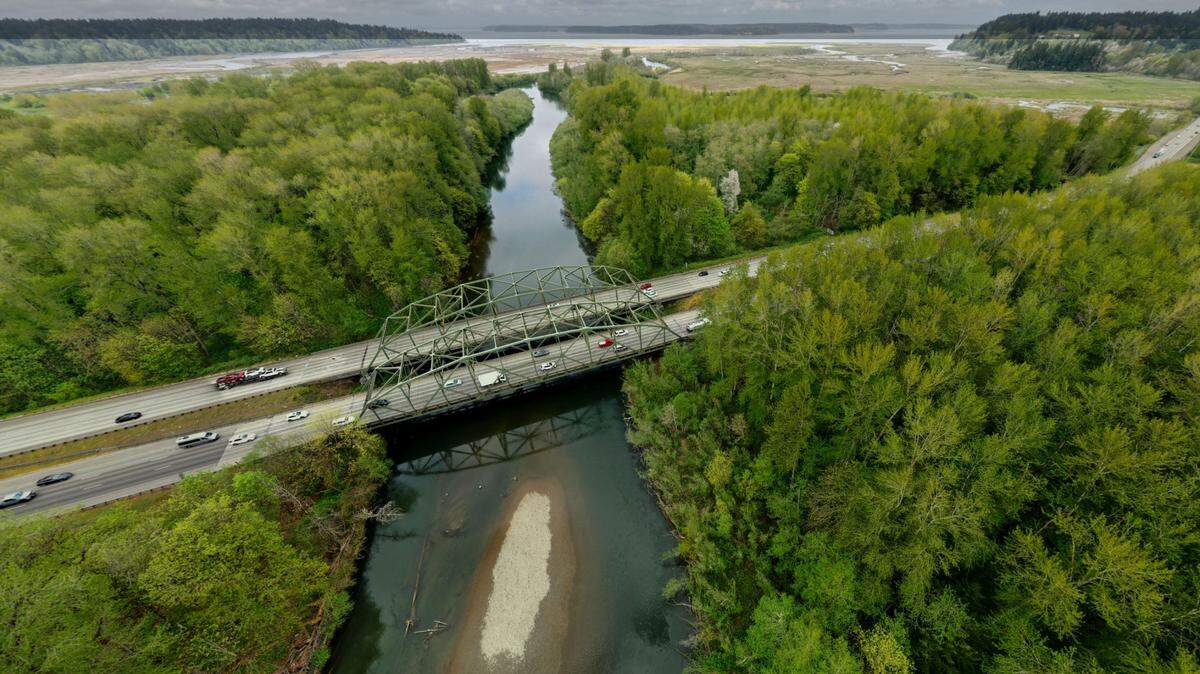
Plans to modify and replace Interstate 5 bridges over the Nisqually River from Marvin Road (Exit 111) to Mounts Road (Exit 116) are in the environmental review stage after much recent discussion about the risk of flooding, congestion and environmental issues that would remain in doing nothing.
A final federal planning and environmental-linkages study report was released in July, identifying needs and possible long-term solutions to address regional congestion and environmental concerns between Tumwater and Mounts Road. The study was conducted by the Washington State Department of Transportation in cooperation with the Federal Highway Administration.
In 2021, the state Legislature appropriated $5 million to conduct preliminary engineering to develop alternatives and complete a federal environmental review proposal of that I-5 section and to restore the Nisqually River Delta at the existing freeway crossing. The 2022 Move Ahead Washington funding package included $75 million for preliminary engineering related to the I-5 Nisqually Delta crossing.
Among the proposed changes are replacing and extending the I-5 bridges over the river, adding HOV lanes in both directions of travel and adding a pedestrian and bike path separated by a concrete barrier.
Officials also plan to clear a build up of silt, concrete and debris under the bridges that has affected the flow of water through the Nisqually River Delta and hurt migration patterns of salmon and other creatures, impacting protected tribal resources and hunting patterns as well.
As rising sea levels and flash floods increase water flow under the bridges, I-5 is at risk of flooding as soon as 2040, according to initial models by the U.S. Geological Survey. A highway shutdown could not only be a headache for drivers who take the West Coast’s main north-south highway but could result in a national security risk for neighboring Joint Base Lewis-McChord, as previously reported by The News Tribune.
Construction timelines and costs are still to be calculated, but the price is expected to be in the billions. It’s estimated to become one of the most expensive projects in Washington history.
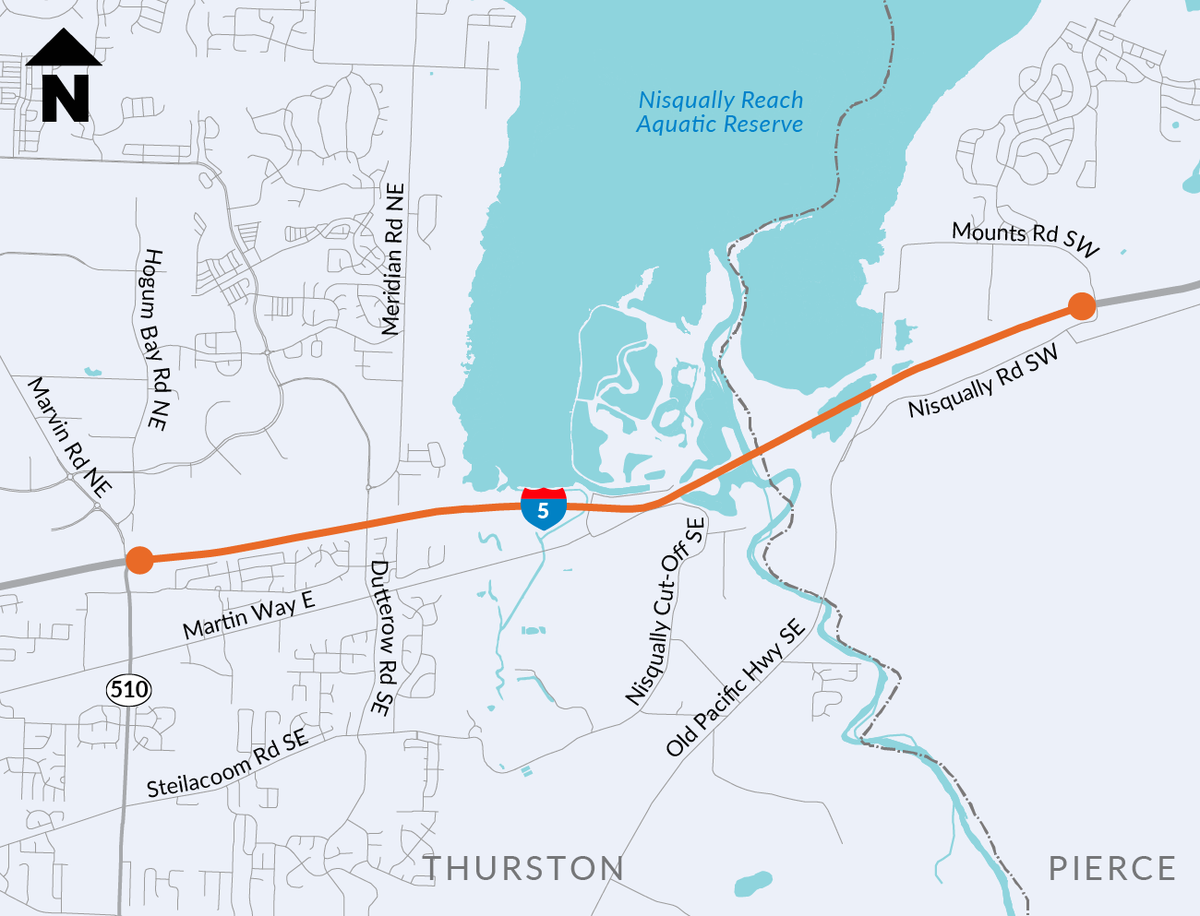
Daily traffic volumes that already “exceed highway design capacity during peak travel periods, including weekends” are expected to increase along this corridor as time goes on and Thurston and Pierce County see a boom in population growth, according to Washington State Department of Transportation estimates. By 2045, weekday traffic volumes are expected to be 20-30% higher than today, and the amount of freight moved by trucks is expected to increase 55% by 2050, according to WSDOT.
Now that the final study report is complete, Ashley Carle, a WSDOT multimodal development manager in the Olympic region and member of the study team, said they will start looking at potential environmental impacts of potential road work, as required under the National Environmental Policy Act.
“When we start NEPA, then we’ll start looking at the potential impacts. There will be short-term impacts due to construction, then long-term impacts from the results of the project,” she said. “We’re expecting that to take about a year to a year and a half to complete once we officially initiate it later this year.”
Carle said they are moving forward “with the idea that we will be able to keep all six lanes of I-5 operational during construction.”
Because construction funding hasn’t been secured, Carle said she couldn’t provide an estimate on when construction might begin.
The final study considered the “shortest possible construction timeline with two stages” which would result in shifting all I-5 traffic to either the southbound bridge or the northbound bridge with decreased lanes and shoulder widths while the other is being removed and replaced.
Other alternatives would take four stages, require at least 50% more time to complete and have higher costs due to inefficiency and extended overhead costs, according to the study.
The alternatives included steps to:
Construct a temporary northbound or southbound roadway in the existing median. Construct temporary roadway widening and bridges at the Nisqually River bridge and south overflow channel.
Shift the northbound or southbound roadway to the median with a reduction to three lanes and shoulder widths. Shift roadway to temporary structures and widening sections.
Construct a new southbound or northbound roadway and shared-use path structure with the existing right of way and roadway footprint.
Shift both the southbound and northbound I-5 roadways onto the bridge (3 lanes in each direction).
Construct new northbound or southbound structure within the footprint of the existing northbound roadway.
Additional HOV lane, pedestrian path considered
This massive construction project is still in a pre-construction study phase. According to a WSDOT planning and environmental linkage study published in July, several conceptual designs to the bridges are being considered by stakeholders, although they are waiting on environmental reviews.
The preferred design recommended in the final project study was to widen I-5 to add high occupancy vehicle lanes in both directions between Marvin Road and Mounts Road. Doing so would improve travel times and reduce traffic congestion, according to the study. There currently isn’t enough ridership potential to support services like light rail, and commuter rail would be cost prohibitive from a local funding perspective, the study said.
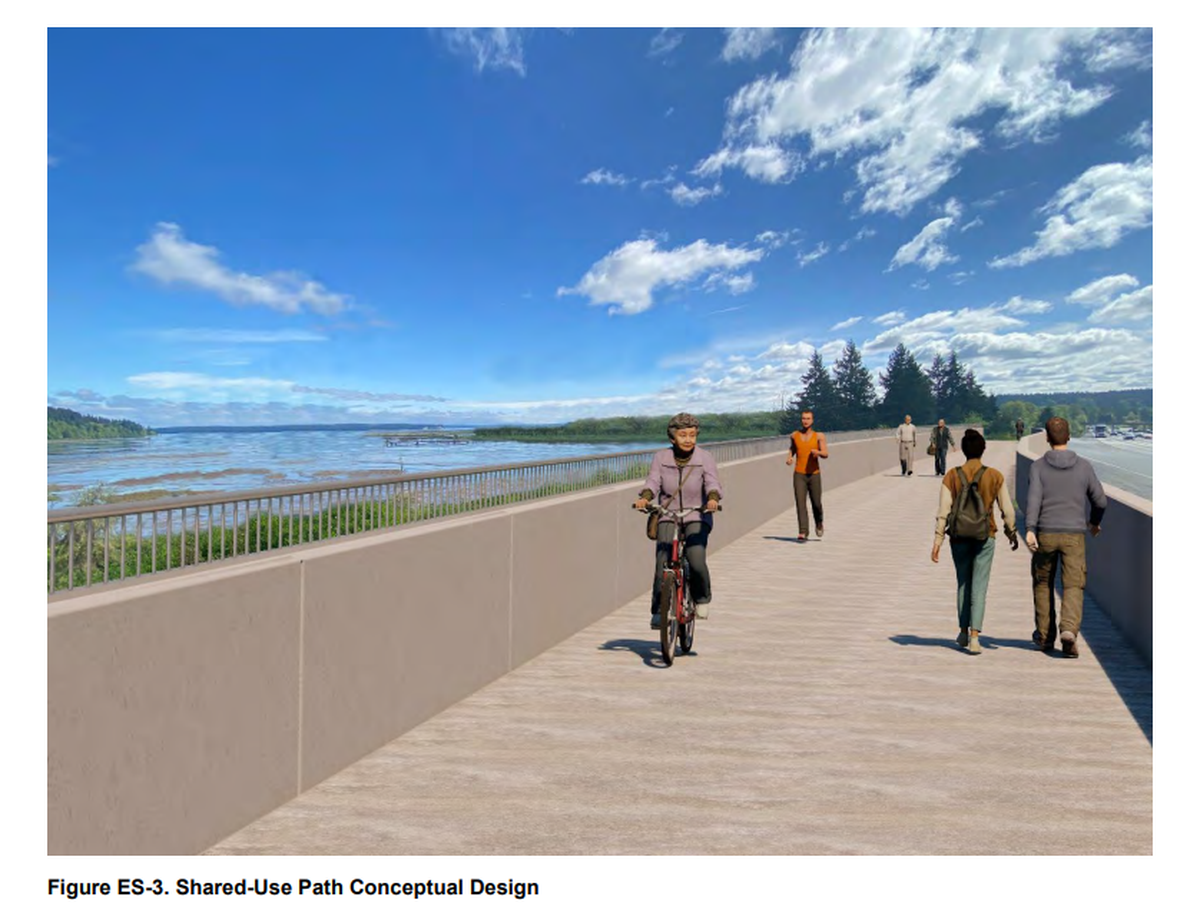
Also being considered is a shared-use path that would provide a 4.7-mile continuous facility for pedestrians, bicyclists and others from the Marvin Road interchange (near Exit 111) to the Mounts Road interchange (Exit 116). According to the final report, the path would be separated from traffic by a concrete barrier and would provide views of the Billy Frank Jr. Nisqually National Wildlife Refuge, the McAllister Creek and Nisqually River deltas, Puget Sound and the Olympic Mountains, with bump-out locations along the path to allow users to stop and admire the scenery.
People could access the path from local roads at or near the vicinity of the Marvin Road and Mounts Road interchanges, and path access would also be provided at the Nisqually Road interchange, a connection to the Billy Frank Jr. Nisqually National Wildlife Refuge as well, per the final report. Entry and exit points would be compliant with Americans with Disabilities Act requirements.
Options to replace, rebuild Nisqually River bridges
Widening and raising the bridges will require new structures. WSDOT and stakeholders are considering several bridge option designs, which will be evaluated further in the National Environmental Policy Act environmental process, according to the final report:
Option A: Replace the Nisqually River bridges, remove fill under the bridges and add an additional bridge structure approximately 3,000 feet in length. This bridge option would have the shortest elevated structure and the lowest cost compared to other options. The section would pass through an environmentally sensitive area of the Nisqually River valley and not remove fill or add bridge structures west of the Nisqually River.
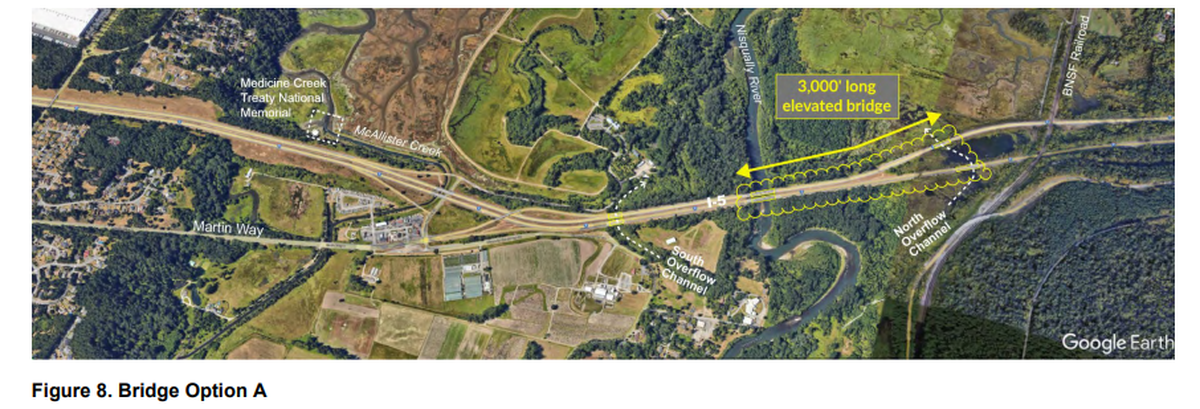
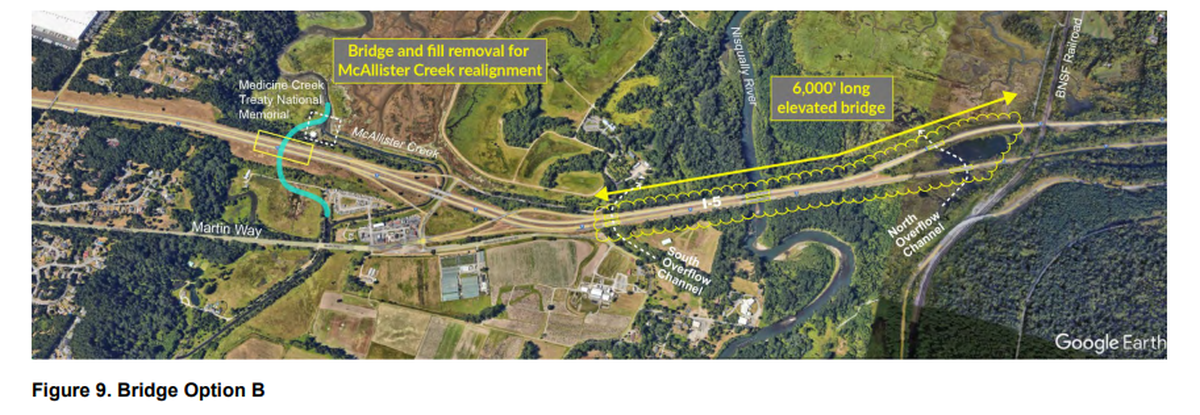
Option B: Replace the Nisqually River bridges, remove fill under the bridges and add an additional bridge structure about 6,000 feet in length. This bridge option would have a longer elevated structure compared to Option A and have a higher cost, but would provide additional environmental benefits. Option B removes fill and extends the bridge structure over the Nisqually River to the North and South Overflow Channels. It would not remove fill or add bridge structures west of the South Overflow Channel, except for a new bridge and fill removal for realigning McAllister Creek.
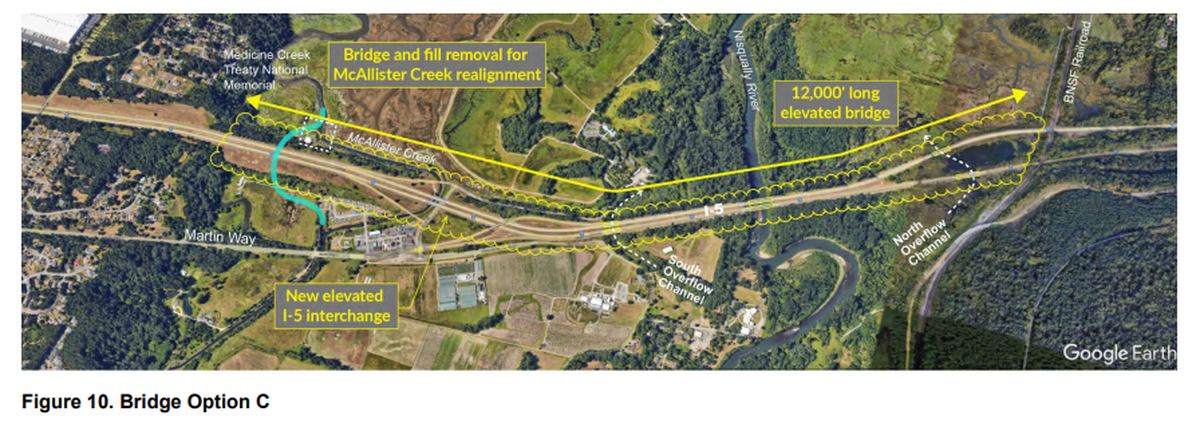
Option C: Replace the Nisqually River bridges, remove fill under the bridges and add an additional bridge structure about 12,000 feet in length. Option C includes a new elevated I-5 interchange at Exit 114. Option C would expand fill removal and add a bridge structure to encompass the lower elevation area from west of McAllister Creek to the BNSF rail line, including the North and South Overflow Channels, which would improve the resiliency of I-5 to withstand the continued movement of the Nisqually River and high water flow events. Bridge Option C also adds bridge structures from the South Overflow Channel to west of the realigned McAllister Creek. The existing Nisqually interchange would require reconstruction with Bridge Option C due to the new bridge height. I-5 freeway lanes would be modified to go over the Nisqually Cutoff Road, and ramps would need to be rebuilt to connect to the new elevated I-5 freeway lanes.
Another option proposed was a high-level, long-span bridge of 14,000 linear feet that would remove the existing I-5 interchange at Exit 114. It was deemed the longest, tallest and most expensive option, could not maintain three lanes in each direction and was described as “unreasonable and not recommended for advancement to the Detailed Evaluation,” according to the final report.
This story was originally published August 18, 2023 at 5:15 AM.