Here’s how Tacoma council voted on electric-fence expansion, a South End land designation

Two code proposals that in May received thumbs down from the Planning Commission have received approval from Tacoma City Council after changes.
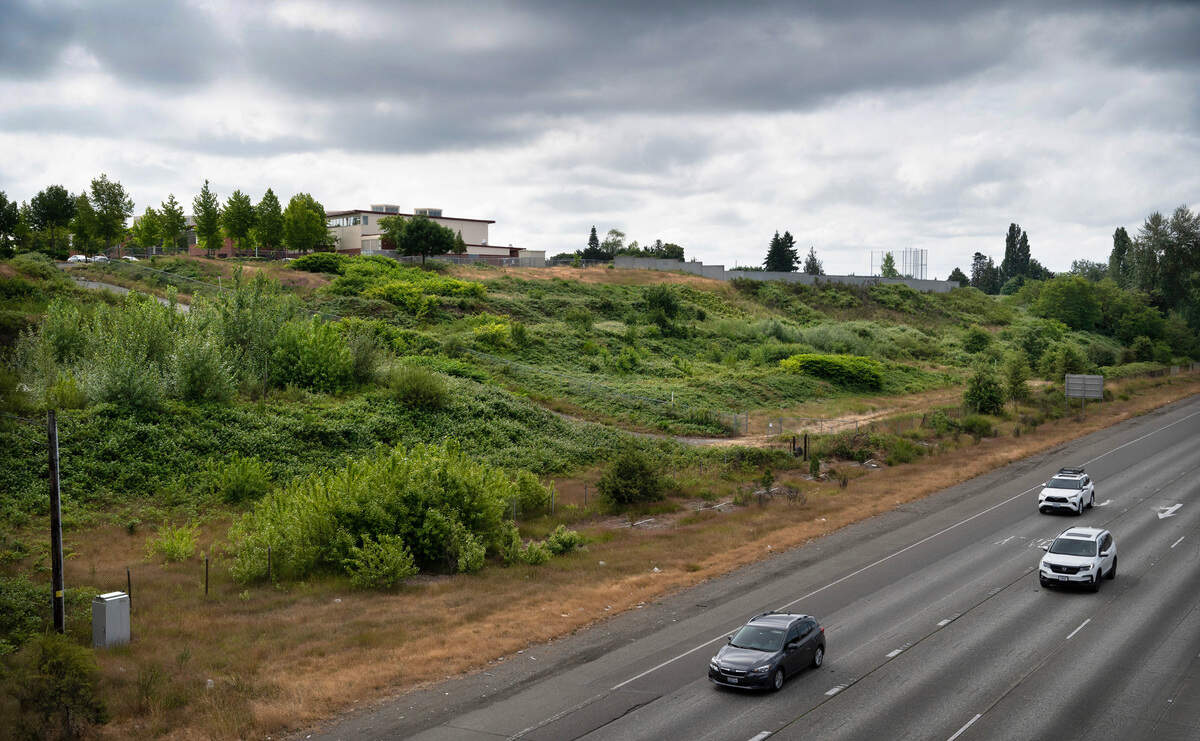
One measure grants a land-use designation change from low-scale residential to general commercial with some restrictions for a privately owned parcel between Interstate 5 and Giaudrone Middle School in Tacoma’s South End.
Another measure allows businesses to use electric fences to safeguard storage in more parts of the city.
The proposals were among several as part of the Annual Amendment to the One Tacoma Comprehensive Plan and Land Use Regulatory Code receiving a final reading Tuesday.
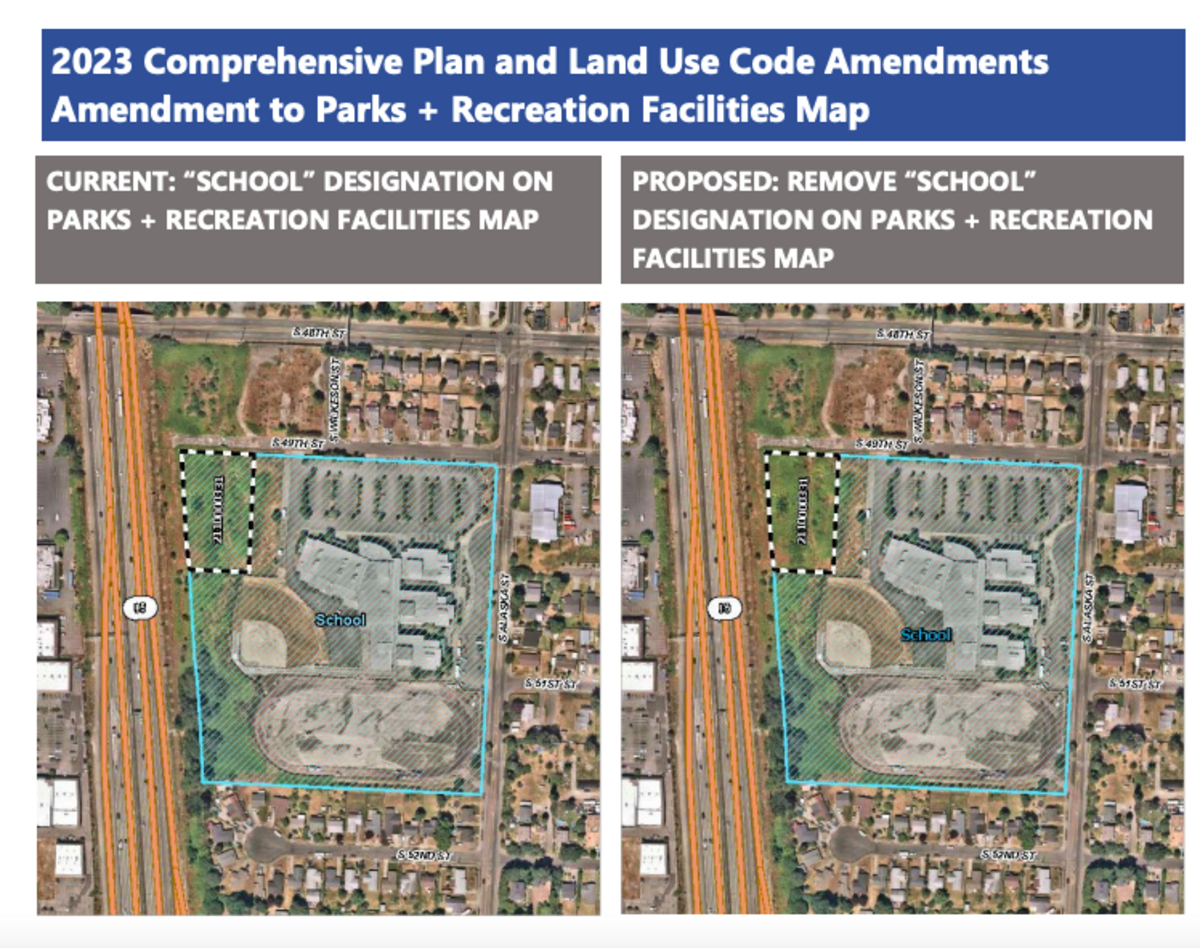
For the Mor Furniture land parcel, the Planning Commission rejected the initial proposal and sent an alternative recommendation to council: removing the “Schools” designation for the parcel on the Parks and Recreation Facilities Map.
The commission also recommended that the council reject the electric fence proposal. The commission cited safety concerns, among other issues.
In the end, the council passed reworked measures on both items at its regular Aug. 15 meeting.
Council member Catherine Ushka acknowledged the difference in the council’s decisions versus the Planning Commission’s recommendations.
“When we send anything to our boards and commissions, we’re looking for advice and recommendations. We’re not necessarily going to adopt all of it all the time,” she said at Tuesday’s meeting. “We certainly respect the work and do most of the time. But sometimes we’ve got a little bit more insight into what’s happening on the ground.”
Land use proposal for site near I-5
Council member Joe Bushnell, whose district includes parts of South Tacoma, the South End and East Tacoma, introduced the two revamped measures. The first one is referred to as “the Mor Furniture site” and would apply to property owned by the furniture retailer’s parent company, Wesco Management LLC.
The amendment would allow for a change in the land-use designation to general commercial but includes a restrictive covenant, Bushnell explained during the introduction of the measure during Tuesday’s council meeting.
“There was some concern because it could be rezoned to general commercial, that there are any number of uses that could fall within that including airports, fueling stations, golf courses, marijuana retailers, etc.,” he said. “Things that do technically fall under commercial zoning but wouldn’t necessarily be conducive to the neighborhood.
“So there’s a myriad of restrictive covenants that they’re willing to place on that property in the event that they decide to go forward with a project,” he said.
The amendment states, “The owner of the Mor Furniture site has offered to record a restrictive covenant on the property limiting the uses that may be developed on the site, which shall be a condition precedent to any future rezone of the Mor Furniture site.”
Further specific details on restrictions were not included in the council agenda items or amendment language posted online as of Wednesday.
The amendment also called for avoiding “new higher density resident development in proximity” to Interstate 5 and state Route 16 due to “the adverse air quality and noise impacts associated ... . Where such residential use is located in proximity to Interstate 5 and state Route 16, use building design and site design elements, such as setbacks and landscaped buffer areas, and other techniques, to mitigate the negative effects of air pollution and noise on residents.”
The amendment removes the parcel from the city’s Parks and Recreation Facilities Map. Wesco purchased the roughly 1.2-acre site from the Tacoma School District in February 2018 for $280,000, according to county records.
Bushnell said Tuesday, “The removal of the park designation is really important because it is not usable as a park because of the steep nature of the hillside there, but also ... it’s basically blackberry bushes. It’s a very challenging site.”
Resident Heidi Stephens was critical of the amended measure during Tuesday’s public comment.
“I was really proud of the Planning Commission’s recommendation to deny” the land use designation request, Stephens told the council. “And the restrictive covenant referred to has not been available to the public for review, to see what those restrictions are. But the amendment seems to be simply saying no housing can be built there, which no one had assumed would be, but will still allow for other commercial uses.”
She added, “That’s what we don’t want to see happen. That protective green buffer to noise, pollution, unsightliness and retaining urban wildlife habitat needs to be protected, but will still be destroyed for commercial development, so I don’t see how this is an improvement.”
Council member Ushka described working with Bushnell on the amendment and seeing for herself the site’s limitations.
“It’s not a place conducive to regular care,” Ushka said, “so finding a positive use for it, that’s hopefully not residential ... that keeps it clean and at least engaged makes more sense in a lot of ways, particularly since the lot just across the street from it (that) Mor Furniture already owns is commercial.”
She added that while she didn’t think the other Mor properties had any restrictive covenants, “it’s still intended for a low-density usage, in their opinion.”
The parcel is one of five owned by Wesco in that area. Wesco’s initial plan was for a new Mor Furniture retail site.
Those plans shifted to a new store site near the Tacoma Mall during the Planning Commission’s deliberations, with the applicant still seeking approval of its original application for the site near I-5.
Bushnell noted that the amendment was introduced to balance the owner’s right to develop a challenging location while also attempting to address concerns raised on potential effects on the neighboring school and residences.
The measure received unanimous council approval Tuesday among those present. Council member Keith Blocker was absent.
Electric fences
Tacoma businesses seeking an easier permit process to add electric fences in more areas gained it through a substitute proposal also approved by all attending council members Tuesday.
The debate over allowing electric fencing for more Tacoma businesses dates back more than a year after it was introduced for consideration by former council member Robert Thoms.
The measure expands areas where businesses could add electric fences without seeking a permit variance. Now, under design regulations they will be allowed in association with outdoor storage in C-1 and C-2 Commercial Districts; WR Warehouse Residential Districts; DMU Downtown Mixed-Use Districts; and CIX, CCX, and UCX Mixed-Use Commercial Districts, according to the substitute ordinance.
In its recommended rejection of a draft measure, the Planning Commission’s report stated, among other issues, that “local businesses who could testify as to the need and effectiveness of electric fences were noticeably absent.”
In introducing the substitute measure, Bushnell said, “Local businesses have shared repeatedly to all of us the hardships they face due to break-ins and theft and sometimes repeatedly causing thousands of dollars worth of damage.”
He noted that property damage could have compounding issues for businesses.
“That damage could potentially have folks lose their insurance and they’d be uninsurable due to the high costs of those damages,” he said.
According to Bushnell’s outline, the new ordinance includes:
▪ Lower the maximum height limits for electric fences: 8 feet instead of 10 feet.
▪ No chain link on perimeter fence.
▪ Lowering setback requirement from 5 feet to 1 foot when next to dwellings, playground/school or park/recreation open space or adjacent to a street right-away. This would allow businesses ““to fully utilize their space for storage,” Bushnell said.
▪ It further sets code for fence designs to help avoid incidental contact from passersby.
▪ Removes prohibition of electric fences adjacent to designated core pedestrian streets or designated pedestrian streets, such as South Tacoma Way, Lincoln District, “but it would designate that there’s a 5-foot landscaping setback,” Bushnell said. “And that could be shrubs, trees, any number of any number of landscaping components to soften that view next to core pedestrian streets specifically, again, (to make) sure our neighborhoods look nice.”
▪ It would only allow electric fencing between a building front and adjacent street “when there is outdoor storage located between the building and front property line ... in existence at the time of passing this ordinance,” he said.
“This means that future development wouldn’t be allowed for electric fences in front of their property,” he said, adding, “conceivably over time, these fences will phased out as new development comes in.”
Other measures in annual amendment
The rest of the measures approved Tuesday in the annual code amendment were in line with earlier commission recommendations, and described by the city as follows:
▪ Shipping containers: Expand allowances for accessory and temporary uses.
▪ Delivery-only retail businesses: Require in-person customer sales for retail uses on pedestrian streets and apply standards to commissary kitchens.
▪ Commercial zoning: Update design and development standards for Neighborhood Commercial Nodes and expand use of the 12- and 20-year Multifamily Tax Exemption, which require a percentage of rent-restricted units. This is tied to Tacoma’s MFTE revisions in 2021.
▪ Minor amendments: Correct minor errors, address inconsistencies, update information and clarify if needed. No substantive or policy-level changes.
More information on each measure is available online at the city’s 2023 Amendment page.